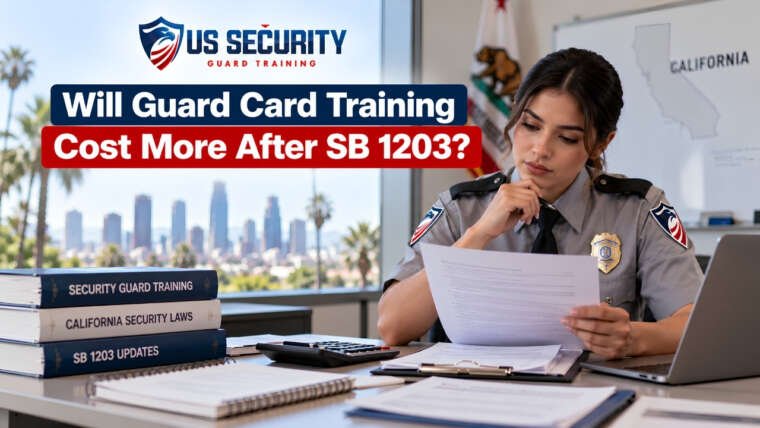
The question that almost all new students ask us is the price of a guard card. That question has become a lot more difficult to answer since the enactment of SB 1203. It is posted online that the cost of training would go up by thousands of dollars. But the entire scenario appears quite different when you read the law. Our US Training Guard team read the text and fees of the bill. This guide includes the amount security guard training applicants pay, both in California and in the future. You will get to know who pays, what is changed and how to save money at this moment.
The Short Answer
Yes, there will most definitely be an increase in the overall price of training each guard. However, the individual who makes the payment on that bill will be different in 2029 to most guards. SB 1203 places the burden of the necessary skills training on the employer who is hiring. They also have to pay guards to the amount of time they are in the classroom. The state fees and the eight-hour course in pre-registration will probably be your own cost. In the meantime, employers will encounter increased training expenses, wage bills and time management hassles.
What Guard Card Training Costs in California Right Now
The current cost of obtaining a guard card includes three expenses: training, fingerprints, and fees. BSIS has imposed a fee of 60 on the new guard card applications that will be received after October 1, 2025. That fee increased by an amount many older guides give, erroneously. Live Scan charges DOJ and FBI processing fees and a site rolling fee. By comparison, guard card renewal is $44 every two years with BSIS. Prices of training in schools, formats, and bundles of courses differ throughout the state. For example, some providers sell the full 40-hour path for about $200. There are complete online packages of the 32 after registration hours at a cost of less than 100 USD. However, the existing legislation does not tell who finances security guard training California needs. Most of the guards are forced to pay all the money themselves.
What SB 1203 Changes Starting January 1, 2029
SB 1203 does not change much about the eight-hour pre-registration course of applicants. But after registration skills training increases to 42 hours overall. The guards are required to complete 18 of those hours in 30 days following registration. Two of these initial hours touch on the right of workers with regards to the California labor law. Moreover, eight hours of in-person de-escalation with a live instructor. The 42 hours should all be carried out in conventional classroom training and not online modules. Annual refresher training also increases the number of training hours annually; the number of hours increases to twelve. At least 12 hours of those 12 hours should be in-person de-escalation role-play. Thus, in the first year, a new guard will record 50 training hours.
Who Pays for Training Under SB 1203?
This section of the law is the most important to your wallet and your budget. The price of the necessary post-registration security skills training should be met by employers. They will also have to pay wages during the class time when you are employed by them. Those are the applicants who have an outstanding job offer with the company. None of the training can take place during an on-duty guard. Any employer that the guard is working under has to pay annual refresher hours. The law, however, does not seem to put the burden of the eight-hour course on employers. All applicants will be required to meet that course and state fees independently. Concisely, security guard training California guards undergo once employed will be financed by employers.
Will Online Guard Card Training Disappear?
Not completely, since the eight-hour course is already a combination of online and classroom education. There is no need to change Power to Arrest to be online and Use of Force to be face to face. The 42 post-registration hours, in its turn, will have to be transferred to a real classroom. A large number of online-only schools can be closed or collaborate with local local-in-person classroom providers. Real-life classrooms and qualified teachers will also remain in good standing. That is why a well-established hybrid school is a safe haven today and insures you against disruption in the future.
Cost Estimates: What Each Side Says
The picture of the financial impact is very different among industry groups and supporters. The president of CALSAG, e.g., warned against new expenditures in excess of $2 billion. In the Assembly analysis, an industry estimated costs in the year to over $534 million annually. One of the online schools argued that the per-student fees would increase to up to $79 to more than 4,200. Remember these figures were the majority of those generated by groups that were against the bill. Proponents claim that professional guards eliminate accidents, litigation and expensive employee attrition. They further emphasis that working guards will cease to fund after registration training themselves. The actual expenses will be based on BSIS regulations, school rates, and employment decisions.
What SB 1203 Means for New Guards
In the case of new guards, the initial cost can even remain near the present rates. You will continue to pay for an eight hours course, Live Scan and BSIS. The 42-hour classroom course is paid by your employer and the time spent in the classroom is paid by him. On the negative side, employers might become more discriminating regarding the nature of applicants they choose. Other firms can be keen on recruiting individuals with a guard card and experience. It is a good and cost-effective decision to get your card prior to 2029. Now you can complete the security guard training California needs at a reduced cost. Another advantage of hybrid courses is that you can begin online and complete in-person within a short time.
What It Means for Current Guard Card Holders
The change will be experienced by the current guards by the longer annual refresher mostly. Those twelve hours and your time should be paid by your employer. In the case of renewals, the BSIS fee is currently at $44 after every two years. CALSAGA cautioned that renewal fees might increase to over $350 to finance new BSIS work. To date we have not observed any change in an BSIS fee associated with it. Always leave your guard card charged, and store evidence of all the courses you complete.
Other Costs Guards Often Forget
In addition to training and fees, new guards have some minor startup expenses. Lots of companies need black boots, dark trousers, and a good working flashlight. California law requires that, as a general rule, employers should provide themselves with the necessary work uniforms. Commuting to school and work places also accumulate during a number of weeks. Other additional permits, such as baton or firearm, are optional and must have their own courses and fees of BSIS. Such permits usually result in more well-paying positions, and thus, many guards find such permits valuable. Earmark these extras, and your initial paychecks will go a long way farther.
What It Means for Employers and Security Companies
By far the greatest new expenditures under SB 1203 are the expenses that employers face. To begin with, they have to cover course fees of 42 classroom hours per new guard. They will have to pay all the training hours, twelve hours of which are refresher hours annually. Classroom guards are not able to do posts, thus the managers have to plan additional shift coverage. The amount of fines for maximum citations increases to between $2,500 and 10,000 per individual violation. Intelligent employers will already plan to incur these costs of security guard training in California. A significant number will also transfer some of the expenditures to the clients in the form of increased hourly rates.
Why Train With US Training Guard
The US Training Guard assists the Californians in getting their guard cards within a short time and at a low cost. With our hybrid model, you can take Power to Arrest online within three hours. Then you come through the five-hour Use of Force session with us. The remaining post-registration training that BSIS needs is included in our 32-hour course bundle. And, you will be able to take Live Scan fingerprints at our Chatsworth location. Our instructor in lead has more than 12 years of practical experience in the security business. He is a criminal justice degree holder, PPO license holder, and baton instructor. This is why our school has a 4.9 rating out of more than 1,500 reviews. Our courses will be revised to the new 2029 classroom standards. We also follow all the new updates of BSIS and disseminate it among students.
FAQs
What is the current price of a guard card in California?
BSIS application fee is 60 USD and Live Scan fees are additional. Prices of training, however, vary depending on the school and the course format you want to do. Phone us to find out our prices on the eight-hour and 32-hour courses.
Will my guard card training be funded by employers after 2029?
When hired, employers are required to pay the 42 hours skills course. They also have to cover your classroom hours and yearly renewal hours. The eight-hour pre-registration course will probably be considered your personal expense.
Can I still take guard card training online?
At the moment you are able to take some of your training online. Beginning in 2029 though, the 42 skills hours will have to occur in a classroom. The de-escalation sessions will require the presence of a live instructor in the room throughout the entire session.
Will there be an increase in guard card renewal fees?
The cost of a guard card renewal at the moment at BSIS is 44. There are some groups in the industry that forecast an increase in fees, but we have not actually noticed any official increase. See the official BSIS fee page to get the current price of renewal.
Will SB 1203 make security guard jobs harder to get?
The industry associations caution that increased costs may decrease the number of guards in California. Proponents, conversely, believe that with improved training, pay and retention will improve. An early earned guard card provides you with a definite advantage in employment.
Should I purchase my guard card now or until 2029?
It will probably cost you less to get your card now and get you working much faster. It is possible that you will be able to complete your hours of skills within the new, more accommodating schedule. You also gain experience that will make you more appealing to prospective employers.
Final Thoughts
SB 1203 will increase the overall price of California training security workforce. But to most guards employers will now bear much of that new responsibility. The best thing you can do is to get the security guard training California needs as soon as possible. In that manner, you pin down the reduced costs, and begin to receive a paycheck at an earlier stage.
Register In US Training Guard.
Ready to start your guard card training with a trusted California school? We are located in Chatsworth, CA, 21032 Devonshire St, Suite 207. You can also enroll online and start your Power to Arrest course tonight. Let’s get you trained, licensed, and ready to start your security career.