

For businesses that depend on purified drinking water every day, installing a commercial RO system is only the first step. Keeping the system in good working condition is equally important.
Whether the system is being used in a factory, hotel, restaurant, office, school, hospital, warehouse, or another commercial facility, continuous usage puts different components under regular operating pressure.
Filters collect impurities, membranes work continuously, pumps operate repeatedly, and cooling components are expected to provide chilled water whenever users need it.
Without proper maintenance, even a well-designed system can gradually lose efficiency.
The good news is that commercial RO maintenance can be managed effectively with a planned approach. Regular inspections, timely replacement of consumable components, proper cleaning, and professional servicing can make the system easier to operate over the long term.
Why Maintenance Should Be a Priority
Many businesses think about maintenance only after a problem occurs.
A filter gets blocked, water flow decreases, chilled water is not cooling properly, or the system suddenly stops working.
At that point, emergency servicing becomes necessary.
For a commercial facility, this can be inconvenient.
Imagine a factory with hundreds of employees or a hotel with a large number of guests. A temporary water-system problem can affect daily operations.
Regular maintenance provides a more proactive approach.
It allows businesses to monitor the condition of important components and address potential issues before they become major disruptions.
Understand the Main Components
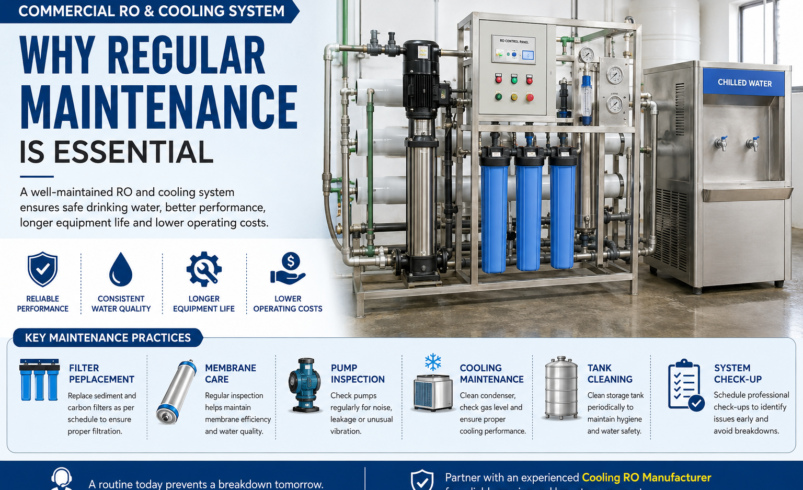
A commercial RO and cooling system can include several different components.
Depending on the system design, these may include:
- Sediment filters
- Carbon filters
- RO membranes
- Pumps
- Valves
- Storage tanks
- Pipes and connections
- Cooling components
- Electrical controls
- Dispensing points
Each component has a different purpose and maintenance requirement.
This is why maintenance should cover the entire system rather than focusing only on the RO membrane.
Filter Replacement Matters
Filters are among the components that require regular attention.
Their job is to help reduce certain impurities before water reaches subsequent treatment stages.
As water continues to pass through them, filters gradually accumulate retained material.
Eventually, their performance may decline.
Delaying replacement for too long can affect the overall treatment process and may place additional stress on downstream components.
Businesses should therefore follow the replacement schedule recommended by their Cooling RO Manufacturer, while also considering actual water quality and usage.
Taking Care of the RO Membrane
The RO membrane is one of the most important parts of the purification process.
It works under pressure to separate water from many dissolved substances.
However, membrane performance can change over time.
Several factors can influence its condition, including:
- Source-water quality
- Pretreatment
- Operating pressure
- Water temperature
- Usage
- Maintenance practices
If output or system performance changes noticeably, the equipment should be inspected.
Regular monitoring can help identify whether the membrane or another part of the treatment system needs attention.
Don’t Forget Pretreatment
Pretreatment plays an important role in many commercial RO systems.
Depending on the source water, pretreatment may be used to reduce suspended particles or address other conditions before water reaches the RO membrane.
If pretreatment components are not maintained correctly, the membrane may face additional stress.
This is why businesses should maintain filters and other pretreatment stages according to the recommended schedule.
A healthy treatment process depends on all stages working together.
Cooling Maintenance Is Equally Important
For systems that provide chilled drinking water, the cooling section deserves the same attention as the purification section.
Businesses often focus heavily on water treatment and forget about cooling until users notice that the water is not as cold as expected.
Cooling performance can be affected by equipment condition, ambient temperature, usage patterns, and other operating factors.
Regular inspection can help ensure that the cooling section continues to perform as intended.
Technical maintenance should be carried out according to the equipment manufacturer’s instructions.
Keep an Eye on Pumps
Pumps are essential to the movement and operation of water within many commercial systems.
Because pumps may operate frequently, unusual changes should not be ignored.
Facility staff can watch for:
- Unusual sounds
- Excessive vibration
- Leakage
- Reduced water flow
- Irregular operation
If something appears unusual, qualified technicians should inspect the system.
Early attention can help prevent a small mechanical issue from becoming a larger problem.
Check Pipes, Valves and Connections
Water systems contain numerous pipes, valves, connectors, and joints.
These components may seem minor compared with the RO membrane, but they are essential for proper operation.
Regular inspection can help identify:
- Leakage
- Loose connections
- Damaged components
- Pressure-related problems
- Signs of wear
A small leak should not be ignored simply because the system continues to operate.
Storage Tank Maintenance
Many commercial water systems use treated-water storage.
If storage is part of the setup, the tank should be included in the maintenance plan.
The tank should be inspected and cleaned according to the recommended procedure for the equipment.
Proper maintenance helps keep the water-storage section in suitable condition and supports overall system hygiene.
Dispensing Points Need Attention Too
The point where users collect drinking water is just as important as the main treatment system.
Taps, nozzles, dispensing surfaces, and surrounding areas should be kept clean.
In offices, factories, restaurants, and other high-traffic locations, dispensing points may be used hundreds of times each day.
Regular cleaning and inspection can help maintain a better user environment.
Keep the Installation Area Clean
The equipment area should also be part of routine housekeeping.
Dust, clutter, standing water, and poor ventilation can make maintenance more difficult.
A clean installation area makes it easier for facility staff and technicians to inspect equipment.
It also makes it easier to notice leaks or other visible problems.
Create a Maintenance Calendar
A simple maintenance calendar can make a big difference.
Instead of relying on memory, businesses can schedule specific checks.
For example:
Routine Checks
- Inspect for visible leaks
- Observe water flow
- Check unusual sounds
- Keep the area clean
- Check dispensing points
Periodic Checks
- Inspect filters
- Review membrane performance
- Check pumps
- Inspect valves
- Review cooling performance
- Check storage tanks
Scheduled Technical Service
- Detailed system inspection
- Electrical checks
- Cooling-system service
- Component replacement
- Technical troubleshooting
The actual frequency should be based on the system design and manufacturer’s recommendations.
Why Maintenance Records Are Useful
A maintenance record does not need to be complicated.
It can simply include:
Date: When was maintenance completed?
Component: What was inspected?
Action: Was anything cleaned, repaired, or replaced?
Observation: Was any issue found?
Next service: When should it be checked again?
Over time, this information creates a useful history of the equipment.
It can also help facility managers identify components that require frequent attention.
Preventive Maintenance Helps Avoid Surprises
No equipment can be guaranteed to operate without any problems forever.
However, businesses can take steps to reduce avoidable interruptions.
Preventive maintenance provides an opportunity to identify problems before they become serious.
For example, a technician may notice a worn component during a routine inspection.
Replacing that component during scheduled maintenance may be much easier than waiting for it to fail during peak operating hours.
Maintenance Depends on Water Quality
Not every RO system operates under the same conditions.
Source-water quality can have a major effect on maintenance requirements.
Water with higher levels of certain impurities may place greater demands on pretreatment and purification components.
This means two businesses with identical systems may still have different maintenance schedules.
The system should therefore be maintained according to its actual operating conditions.
Usage Also Matters
A commercial RO system used by 20 people will generally experience different operating conditions from one serving 500 people.
High usage means more water passes through filters and membranes.
Cooling equipment may also operate more frequently.
This is why businesses should consider usage when planning maintenance.
A system’s maintenance schedule should reflect real-world operation rather than relying only on a generic calendar.
Why Professional Technical Support Matters
Some routine tasks can be handled by trained facility staff.
However, technical servicing should generally be performed by qualified personnel.
Professional technicians can inspect components and identify the actual cause of a problem rather than simply treating its symptoms.
Technical support can be particularly important for:
- RO membrane-related issues
- Pump problems
- Electrical components
- Cooling equipment
- Pressure issues
- System performance problems
A dependable manufacturer or service team can therefore be an important part of the overall purchasing decision.
Spare Parts Should Be Considered
Before purchasing a commercial system, businesses should understand which components are likely to require replacement.
They can ask the manufacturer about:
- Filter availability
- Membrane availability
- Pump components
- Cooling-system parts
- Electrical components
- Other commonly replaced items
Easy access to replacement parts can make future servicing more convenient.
Maintenance and Operating Costs
Maintenance is part of the total cost of owning commercial water equipment.
Businesses should consider:
- Replacement filters
- Membranes
- Electricity
- Cleaning
- Technical service
- Cooling maintenance
- Spare parts
A system with a slightly higher initial price may sometimes offer better long-term value if it is easier to maintain and operate.
This is why purchasing decisions should consider the complete ownership cost rather than only the initial price.
Common Maintenance Mistakes
1. Waiting for a Breakdown
Waiting until the system stops working can lead to unnecessary downtime.
2. Ignoring Filter Replacement
Filters should be changed according to appropriate recommendations.
3. Forgetting Cooling Components
Chilled-water equipment needs maintenance too.
4. Ignoring Small Leaks
Minor leaks can become larger problems if left unattended.
5. No Maintenance Records
Without records, it can be difficult to track service history.
6. Using Incorrect Parts
Replacement components should be suitable for the specific system.
7. Attempting Complex Repairs Without Expertise
Technical work should be handled by qualified personnel.
How Businesses Can Build a Better Maintenance Routine
A practical maintenance approach can be divided into three stages.
Stage 1: Daily Observation
Facility staff can look for obvious changes such as leaks, unusual sounds, reduced flow, or cooling issues.
Stage 2: Scheduled Inspection
Filters, pumps, membranes, valves, tanks, and other components can be inspected periodically.
Stage 3: Professional Servicing
Technical components can be serviced by qualified technicians according to the manufacturer’s recommended schedule.
This combination creates a more organized maintenance process.
Choosing a Manufacturer With Strong Support
A commercial RO system should be considered a long-term investment.
The relationship with the manufacturer should not end after installation.
Before purchasing, businesses should ask about:
- Installation support
- Warranty
- Service coverage
- Spare parts
- Maintenance schedules
- Technical assistance
- Troubleshooting support
An experienced Cooling RO Manufacturer can help businesses understand the equipment’s maintenance requirements from the beginning.
Conclusion
A commercial RO and cooling system works hard every day to provide purified and chilled drinking water.
Regular maintenance helps businesses protect that investment and keep the equipment operating smoothly.
Filter replacement, membrane monitoring, pump inspection, cooling maintenance, storage-tank cleaning, dispensing-point hygiene, and preventive servicing should all be part of a complete maintenance plan.
The exact maintenance schedule will depend on water quality, usage, system design, operating hours, and manufacturer recommendations.
For businesses such as factories, hotels, restaurants, offices, schools, and institutions, a proactive approach can make water-system management much easier.
Instead of waiting for a breakdown, businesses can monitor performance, maintain proper records, schedule servicing, and work with qualified technical professionals when required.
In the long run, good maintenance is not simply about fixing equipment. It is about creating a more reliable, predictable, and convenient drinking-water solution for the people who depend on it every day.
Frequently Asked Questions
1. Why is commercial RO maintenance important?
Regular maintenance helps monitor system performance, replace worn components, maintain hygiene, and reduce the chances of unexpected operational problems.
2. How often should filters be replaced?
The replacement frequency depends on source-water quality, usage, system design, and the manufacturer’s recommendations.
3. Does an RO membrane require regular inspection?
Yes. Monitoring membrane performance can help identify changes in output or treatment performance.
4. Does the cooling section need maintenance?
Yes. Cooling components should be inspected and maintained according to the equipment’s recommended service procedure.
5. What signs may indicate a system needs inspection?
Reduced water flow, unusual sounds, leaks, changes in output, or reduced cooling performance can indicate that inspection may be required.
6. Should storage tanks be cleaned?
Yes. Storage tanks should be inspected and cleaned according to the appropriate maintenance and hygiene procedures.
7. Can facility staff perform maintenance?
Staff can handle suitable routine observations and housekeeping, while technical servicing should generally be performed by qualified personnel.
8. Does source-water quality affect maintenance?
Yes. Different water conditions can place different demands on filters, pretreatment components, and membranes.
9. Why should businesses maintain service records?
Records help track component replacement, repairs, inspections, and upcoming maintenance requirements.
10. What is preventive maintenance?
Preventive maintenance involves inspecting and servicing equipment at planned intervals instead of waiting for a breakdown.
11. Why are spare parts important?
Having access to suitable replacement parts can make repairs and scheduled maintenance easier.
12. Does high usage increase maintenance requirements?
It can. Systems serving large numbers of users may require more frequent attention because components experience greater usage.
13. Should cooling performance be monitored?
Yes. Businesses that depend on chilled drinking water should monitor cooling performance as part of routine equipment management.
14. How can a manufacturer help with maintenance?
A manufacturer can provide maintenance recommendations, technical support, replacement components, and service assistance depending on the arrangement.
15. What is the best way to maintain a commercial RO system?
Follow the equipment-specific maintenance schedule, monitor system performance, replace components when required, keep the installation hygienic, maintain service records, and use qualified technicians for technical work.