

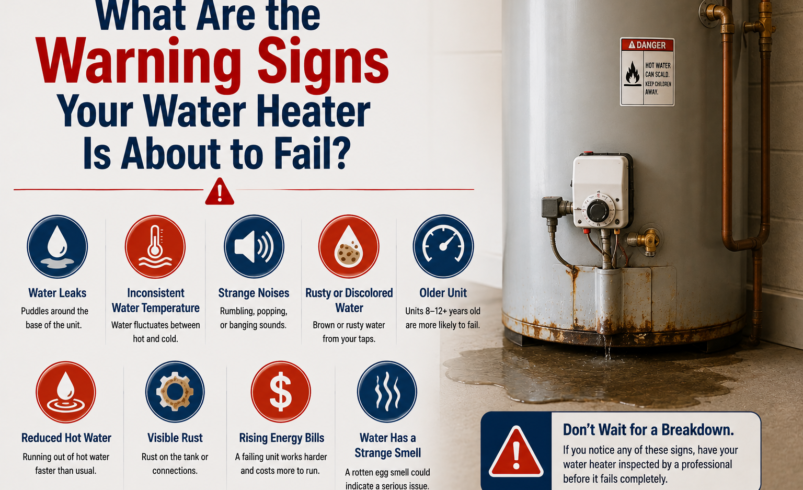

If you’re asking “what are the warning signs your water heater is about to fail?”, there are several symptoms that can give you advance notice before a complete breakdown. Inconsistent hot water, unusual noises, rusty water, leaks, and rising energy bills can all indicate that your system needs attention. AAA AUGER’s water heater services include repair, replacement, installation, flushing, and descaling for traditional and tankless water heaters.
A water heater rarely fails without showing any warning. Recognizing these signs early can give you time to repair the problem or plan for replacement instead of suddenly losing hot water when you need it most.
1. Your Hot Water Is Inconsistent
One of the most noticeable signs of a water heater problem is inconsistent water temperature.
Your shower may start with hot water but gradually become lukewarm or cold. You may also notice that the water temperature changes unexpectedly while you’re using a faucet or shower.
Several problems can cause this, including a failing thermostat, damaged heating element, sediment buildup, or another water heater component that is no longer working correctly. AAA AUGER identifies inconsistent or fluctuating hot water as a common warning sign that a water heater may need repair.
If the problem keeps occurring, don’t assume it is simply a temporary shortage of hot water.
2. You Are Suddenly Getting Little or No Hot Water
A complete lack of hot water is an obvious warning sign, but it can sometimes develop gradually.
You may notice that:
- Hot water takes longer to arrive
- Showers become shorter because hot water runs out
- Several fixtures cannot provide hot water at once
- The water never reaches its normal temperature
- Your water heater stops producing hot water altogether
For electric water heaters, a faulty heating element or thermostat can be responsible. Gas water heaters may have problems involving the burner, pilot system, gas supply, or other components.
AAA AUGER states that a lack of hot water can indicate problems such as a faulty thermostat or broken heating element.
3. Your Water Heater Makes Popping, Banging, or Rumbling Sounds
Unusual noises are another warning sign, especially with traditional tank water heaters.
A popping, banging, or rumbling sound can occur when sediment settles at the bottom of the tank. As the water heats, bubbles can become trapped beneath the sediment and create popping or rumbling noises.
Over time, heavy sediment buildup can reduce efficiency and place additional stress on the tank.
AAA AUGER explains that sediment buildup can cause unusual noises and reduce water heater efficiency. Flushing can help remove accumulated sediment in appropriate situations.
If the tank has been neglected for years, however, maintenance may not be enough if significant corrosion or internal damage has already developed.
4. Water Is Leaking Around the Unit
Water around your water heater should never be ignored.
A leak may come from a valve, connection, fitting, pressure-related component, or the tank itself.
A small leak does not necessarily mean you need a new water heater. Some components can be repaired or replaced. However, if the storage tank has developed a structural leak because of corrosion, replacement is generally necessary.
AAA AUGER identifies leaks around the unit as an important warning sign and notes that they can result from valve problems, tank corrosion, or pressure issues.
Because a tank can hold a large amount of water, even a small leak can eventually cause significant property damage.
5. The Hot Water Looks Rusty or Discolored
If hot water comes out brown, orange, or rusty, it may indicate corrosion.
For traditional tank water heaters, deterioration of the anode rod can allow corrosion to develop inside the tank. Eventually, corrosion can weaken the tank and contribute to leaks.
Rust-colored water can sometimes originate from plumbing pipes rather than the water heater, so the source should be determined before assuming the heater is failing.
AAA AUGER identifies rusty or discolored water as a potential indication of corrosion and recommends professional attention when this occurs.
6. Your Energy Bills Are Increasing
A sudden increase in your energy bill can have many causes, but an aging or inefficient water heater may be one of them.
As sediment accumulates or components wear out, a water heater may need to work harder to provide the same amount of hot water.
You might notice that your utility costs are increasing even though your household’s water usage has not changed significantly.
An inspection can help determine whether the water heater is operating efficiently or whether another issue is responsible.
7. Your Water Heater Is Getting Older
Age is another important factor when deciding whether a water heater may be approaching failure.
AAA AUGER’s water heater FAQ identifies an older unit, particularly one over 10–12 years old, as a reason to consider whether repair or replacement makes more sense.
Age alone does not guarantee that a water heater will fail immediately. A properly maintained system may continue operating, while a poorly maintained unit may develop problems earlier.
However, if an older water heater is also leaking, making unusual noises, or producing inconsistent hot water, replacement planning becomes more important.
8. You Are Constantly Repairing the Same Water Heater
Frequent repairs can be another indication that your water heater is reaching the end of its useful service life.
A single failed thermostat or heating element may be a relatively straightforward repair. But if you are repeatedly replacing components, paying for service calls, or dealing with recurring hot-water problems, continuing to repair the system may not be the most cost-effective option.
AAA AUGER notes that minor issues such as thermostat problems or sediment buildup may be repairable, while outdated systems or expensive repairs may make replacement more practical.
9. Your Tankless Water Heater Has Reduced Performance
Warning signs are not limited to traditional storage-tank systems.
Tankless water heaters can also experience problems involving mineral buildup, reduced water flow, inconsistent temperature, clogged filters, or component issues.
AAA AUGER’s tankless maintenance information highlights descaling, component inspection, filter cleaning, and performance testing as important maintenance steps.
If your tankless system is not delivering hot water as consistently as it once did, professional maintenance may restore performance without requiring immediate replacement.
Can Water Heater Maintenance Prevent Failure?
Regular maintenance can help identify problems before they become major failures.
For traditional tank water heaters, maintenance may include flushing the tank, checking components, inspecting for corrosion, and evaluating valves and connections.
Tankless systems may require periodic flushing and descaling to reduce mineral buildup.
AAA AUGER offers flushing and descaling services for water heaters and recommends appropriate maintenance based on the system and its condition.
Maintenance cannot prevent every failure, particularly when a tank has reached the end of its service life, but it can help identify developing problems earlier.
When Should You Repair or Replace Your Water Heater?
The right choice depends on the age, condition, type, and problem affecting your system.
Repair may make sense when:
- A thermostat has failed
- A heating element needs replacement
- A valve or fitting is leaking
- Sediment needs to be removed
- A serviceable component has failed
Replacement may make more sense when:
- The tank itself is leaking
- The unit is significantly corroded
- The water heater is older
- Repairs are becoming frequent
- Hot-water performance continues to decline
- Repair costs are becoming excessive
AAA AUGER installs and repairs traditional, tankless, and hybrid water heaters and can evaluate the system before recommending repair or replacement.
Don’t Wait for a Complete Water Heater Failure
So, what are the warning signs your water heater is about to fail? Look for inconsistent hot water, unusual tank noises, leaks, rusty water, rising energy costs, reduced performance, and frequent repairs. An older unit with several of these symptoms deserves particular attention.
Getting the system inspected while it is still operating can give you more options. You may be able to repair a failing component, perform needed maintenance, or plan a replacement before the old unit stops working completely.
AAA AUGER provides water heater repair, replacement, installation, flushing, and descaling services and states that its technicians are available 24/7.
FAQs
1. How do I know if my water heater is about to fail?
Common warning signs include inconsistent hot water, unusual popping or rumbling noises, leaks, rusty water, rising energy bills, frequent repairs, and an aging unit.
2. How long does a water heater usually last?
Lifespan varies by water heater type, installation, water quality, usage, and maintenance. AAA AUGER recommends considering replacement when a traditional unit is more than approximately 10–12 years old, particularly when other problems are developing.
3. Is a noisy water heater a sign that it is failing?
It can be. Popping, banging, or rumbling sounds may indicate sediment buildup inside a tank. Heavy buildup can reduce efficiency and place additional stress on the system.
4. Can a leaking water heater be repaired?
Sometimes. A leaking valve, fitting, or connection may be repairable. If the storage tank itself has developed a structural leak because of corrosion, replacement is generally the more appropriate solution.
5. Should I repair or replace my old water heater?
It depends on the unit’s age, condition, repair history, and the source of the problem. If an older system requires frequent repairs or has a leaking tank, replacement may be more practical than continued repairs.