


An RO system can be working exactly as designed and still show performance changes when the water entering it changes. The equipment may look identical from one month to the next, but the water conditions can tell a completely different story.
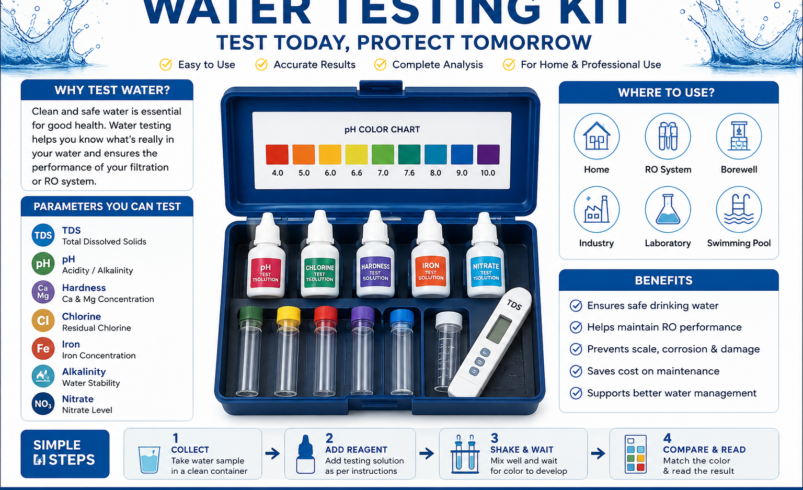
This is why a Water Testing Kit can be useful beyond basic water checking. It can help create a clearer picture of the conditions under which an RO system operates and provide useful information before a technician decides to replace filters, inspect the membrane, or modify treatment.
For homeowners, RO dealers, service professionals, commercial facilities, and water-treatment businesses, the smartest approach is not to test everything blindly. It is to test the parameters that can answer the specific question being investigated.
Featured Snippet: How Does a Water Testing Kit Help With RO Systems?
A Water Testing Kit can help monitor selected characteristics of feed and treated water, allowing users to compare readings, identify changes, and support RO troubleshooting. Depending on the kit, measurements may include TDS, pH, hardness, chlorine, iron, alkalinity, or other parameters. Testing should be interpreted alongside system operating conditions and should not be treated as a complete water-quality analysis unless the kit is specifically designed for that purpose.
1. The RO System May Not Be the Real Problem
When an RO purifier starts behaving differently, the first suspicion often falls on the machine.
The membrane may be old.
The filters may be clogged.
The pump may not be operating correctly.
The technician may recommend replacing a component.
But there is another variable that deserves attention:
Feed water.
An RO system processes whatever water enters it. If the characteristics of that water change, the treatment process may experience different conditions.
This is particularly relevant when water comes from sources that can vary over time.
Instead of immediately asking:
“Which RO part has failed?”
a better starting point can be:
“Has anything changed in the water entering the system?”
A suitable Water Testing Kit can help investigate that question.
2. Water Has a Fingerprint
Every water source has a set of characteristics that can be thought of as its own fingerprint.
That fingerprint can include selected measurable properties such as:
- TDS
- pH
- Hardness
- Chlorine
- Iron
- Alkalinity
- Other application-specific parameters
The exact combination depends on the source.
Municipal water may have different characteristics from groundwater.
Borewell water can differ from surface-derived supplies.
Treated water can differ from source water.
Even the same source can change over time.
This is why water testing is more useful when it is viewed as a way of understanding the water’s characteristics rather than simply producing a pass-or-fail result.
3. A Water Testing Kit Can Create a Baseline
One of the smartest uses of a testing kit is establishing a baseline.
Suppose an RO technician installs or services a system and records selected readings.
Those readings become a reference point.
If the system is checked again several months later, the technician can compare current results with the baseline.
For example:
| Parameter | Initial Reading | Later Reading | Purpose |
|---|---|---|---|
| TDS | Recorded | Recorded | Compare change |
| pH | Recorded | Recorded | Monitor variation |
| Hardness | Recorded | Recorded | Review scaling conditions |
| Chlorine | Recorded | Recorded | Review relevant treatment conditions |
The actual parameters should be chosen according to the application.
The important concept is baseline versus current condition.
Without a baseline, a new reading has less context.
4. Why “Normal” Water Can Still Change
People often assume that if water has always been used successfully, it must remain the same.
That assumption can be risky.
Water sources can experience changes because of:
- Seasonal conditions
- Rainfall
- Groundwater movement
- Changes in supply
- Storage conditions
- Local environmental factors
- Treatment-process changes
Not every change will be visible.
That is why a water test can reveal something that a visual inspection cannot.
The water may look exactly the same while its measurable characteristics have changed.
5. The Borewell Factor
Borewell water is a particularly good example of why periodic monitoring can be useful.
Groundwater interacts with the surrounding geological environment.
As a result, dissolved mineral characteristics can vary according to location and conditions.
For an RO system using borewell water, the water entering the system can therefore be an important part of the maintenance picture.
A technician may notice increased scaling, changing output, or different filter performance.
Instead of assuming the equipment alone is responsible, the technician can compare current water-quality readings with previous measurements.
This does not automatically identify the cause.
But it creates another evidence point for the investigation.
6. Why TDS Is Useful but Not the Whole Story
TDS is probably one of the first parameters associated with RO water testing.
A TDS meter is convenient and fast.
It can be useful for routine monitoring and comparison.
However, TDS does not identify every individual dissolved substance in water.
For example, two water sources may have similar TDS values while having different compositions.
This means TDS can answer one question:
“What is the approximate dissolved-solids level according to this measurement method?”
But it may not answer:
“Which substances are present?”
or
“What is causing this specific treatment problem?”
Additional testing may therefore be appropriate depending on the situation.
7. When Hardness Becomes an Important Clue
Hardness can be an important consideration when scaling is suspected.
Calcium and magnesium are major contributors to water hardness.
If a treatment system experiences scale-related issues, a suitable hardness test can provide useful information about the source-water condition.
This is where a Water Quality Testing Kit can be particularly useful.
The goal is not to assume that hardness causes every RO problem.
Instead, it is to identify whether hardness is a relevant variable worth investigating.
This distinction is important because professional troubleshooting should be based on evidence rather than a single predetermined explanation.
8. Chlorine Testing Can Answer a Different Question
Chlorine represents another type of water-quality measurement.
In appropriate RO applications, chlorine-related conditions may be relevant to membrane protection and pre-treatment.
If a technician is investigating a membrane-related issue, checking relevant feed-water conditions may help provide additional context.
However, the test should be selected according to the membrane type, treatment design, and application.
This is another example of why there is no single universal water test.
Different problems require different information.
9. What Happens If You Test Only the Final Water?
Testing only the final output can provide useful information, but it may not tell you where a problem originated.
Consider a system with four important points:
Source → Pre-Treatment → RO → Storage
If the final water is different from expected, there are several possible places to investigate.
Testing multiple relevant points can help narrow down where the change occurs.
For example:
- If source water has changed, investigate the supply.
- If source water is stable but pre-treated water differs, inspect pre-treatment.
- If feed conditions are stable but RO output changes, investigate RO performance.
- If treated water is satisfactory but stored water differs, inspect the storage stage.
The correct sampling strategy depends on the system.
But the principle is universal:
Where you test can be as important as what you test.
10. The Difference Between a Test and a Diagnosis
A water test produces information.
It does not automatically produce a diagnosis.
This is an important distinction.
Suppose a technician obtains a higher reading than expected.
That result should lead to further evaluation.
Questions may include:
- Is the test method correct?
- Was the sample collected correctly?
- Is the instrument calibrated?
- Is the result consistent with previous measurements?
- Has the source water changed?
- Are system operating conditions normal?
- Is another parameter relevant?
A good testing process therefore looks like:
Measurement → Verification → Comparison → Interpretation → Action
That is much stronger than:
Measurement → Immediate replacement
11. Why Water Testing Can Reduce Guesswork
RO maintenance can become expensive when decisions are made entirely from assumptions.
Replacing components without identifying the likely cause can lead to repeated service visits.
Testing does not eliminate uncertainty, but it can reduce it.
For example, if a customer’s water characteristics have changed significantly, that information becomes part of the troubleshooting process.
If water characteristics remain stable, attention can move toward equipment and operating conditions.
This makes the investigation more focused.
For professional service businesses, that can improve efficiency.
For customers, it can make technical recommendations easier to understand.
12. Water Testing Before Installing Treatment Equipment
Testing should not begin only after something goes wrong.
It can also be useful before installing treatment equipment.
An RO dealer can use selected water-quality information to understand the starting conditions.
This may help when considering:
- Treatment requirements
- Pre-treatment
- System configuration
- Maintenance expectations
- Component selection
- Service planning
The objective is not to let one test result determine everything.
Water testing should be combined with other information such as water demand, pressure, source, installation environment, and system requirements.
But it provides an important starting point.
13. What Makes a Good Water Quality Testing Kit?
There is no single “best” kit for every user.
The right choice depends on the application.
When evaluating a Water Quality Testing Kit, consider:
Relevant Parameters
Does it test what you actually need?
Measurement Range
Can it handle the expected water conditions?
Testing Method
Is it based on strips, reagents, digital measurement, or another method?
Accuracy
Is its performance appropriate for the intended use?
Ease of Use
Can technicians or users perform the test consistently?
Consumables
Are replacement strips or reagents available?
Documentation
Can results be recorded and compared easily?
A kit with fewer but highly relevant tests may be more useful than a larger kit containing parameters that are rarely needed.
14. Water Testing Kit Price Should Be Viewed Long-Term
A buyer searching for Water Testing Kit Price may naturally compare the lowest available cost.
But purchase price is only one part of the equation.
Consider a professional user who tests water regularly.
The actual cost can also involve:
- Replacement reagents
- Test strips
- Calibration
- Maintenance
- Accessories
- Replacement parts
- Number of tests supported
A slightly more expensive kit may offer better long-term value if it is easier to maintain and matches the required application.
Likewise, an expensive professional kit may be unnecessary for someone who needs only basic household screening.
The right purchase is the one that fits the testing requirement.
15. Why a Drinking Water Testing Kit Needs Clear Expectations
A Drinking Water Testing Kit can provide useful information, but users should understand what the kit can actually measure.
Basic kits are often intended for selected screening parameters.
They should not automatically be interpreted as a complete assessment of drinking-water safety.
If the concern involves a specific contaminant, suspected contamination, or a formal regulatory requirement, appropriate laboratory testing may be necessary.
This distinction prevents a common misunderstanding:
A test result is only meaningful within the scope of the test performed.
16. The Sample Can Change the Result
The testing process begins with sample collection.
If the sample is collected incorrectly, even good testing equipment may produce an unhelpful result.
Depending on the test, users may need to pay attention to:
- Clean sample containers
- Correct sampling location
- Sample quantity
- Testing time
- Reagent condition
- Instrument calibration
- Manufacturer instructions
For professional applications, standardizing the sample-collection process can make results more consistent.
A good testing system therefore includes both equipment and procedure.
17. One Reading Should Not Always Trigger a Major Decision
Imagine a technician records an unexpected reading.
The temptation may be to immediately recommend equipment replacement.
A better approach can be to verify the result first.
Repeat the test where appropriate.
Check the equipment.
Review the sample.
Compare with historical readings.
Look at other relevant parameters.
Then evaluate the result alongside the RO system’s operating condition.
This process can help separate a genuine change from a testing error or temporary variation.
18. How Testing Can Become a Preventive-Maintenance Tool
Most people think of preventive maintenance as scheduled filter replacement.
Water testing can add another layer.
Suppose a business regularly monitors selected source-water parameters.
A gradual change may become visible before the system experiences a major operational problem.
That information can support earlier investigation.
It does not mean every small variation requires immediate action.
Instead, testing creates awareness.
This is especially useful where water conditions are known to vary.
19. Testing Can Also Improve Service Documentation
A professional RO service company can use testing records as part of its service documentation.
A report might include:
Water Source: Borewell
Sample Point: RO Feed
Selected Parameters: Recorded
Previous Reading: Available
Current Reading: Available
Observation: Variation identified
Action: Further system inspection
This type of documentation can make service decisions more transparent.
It can also help the same technician—or another technician—understand what happened during previous visits.
20. The Real Value Is in Connecting Water Data to Action
Water testing should never become a numbers game.
The purpose is not to collect a long list of readings and then ignore them.
The purpose is to connect information with decisions.
For example:
Change detected → Investigate source
Scaling concern → Review relevant hardness conditions
Membrane protection concern → Review relevant feed-water conditions
Unexpected reading → Verify and compare
Stable source water + changed output → Investigate system conditions
This makes testing practical.
Frequently Asked Questions
What is a Water Testing Kit mainly used for?
It is used to measure selected water-quality parameters. Depending on the kit, these may include TDS, pH, hardness, chlorine, iron, alkalinity, or other indicators.
Can a Water Testing Kit diagnose an RO membrane problem?
Not by itself. It can provide useful water-quality information that supports troubleshooting, but membrane performance also depends on system operating conditions and other factors.
Why should borewell water be tested?
Borewell water can have variable characteristics influenced by geological and environmental conditions. Periodic testing can help users identify changes over time.
Is a Water Quality Testing Kit useful before RO installation?
Yes, when the kit measures relevant parameters. Testing can provide useful source-water information for treatment planning, although equipment selection should consider other system factors as well.
Does a higher Water Testing Kit Price always mean better performance?
No. Price can reflect features, testing range, number of parameters, accessories, and intended application. The kit should be evaluated according to the user’s actual requirements.
Can a Drinking Water Testing Kit replace laboratory testing?
Generally, basic kits are intended for selected screening rather than complete analysis. Laboratory testing may be appropriate for comprehensive assessment or specific contamination concerns.
Conclusion
An RO system does not operate independently of its water source.
When water conditions change, treatment performance and maintenance requirements can change as well.
That is why a Water Testing Kit can be a valuable part of a modern water-treatment workflow.
It can establish a baseline, reveal changes, support troubleshooting, improve service documentation, and provide information before major treatment decisions are made.
For RO professionals, the most useful testing strategy is not necessarily the one with the largest number of parameters. It is the one that answers the right technical questions.
For homeowners, a suitable Drinking Water Testing Kit can provide basic screening information, while more comprehensive concerns may require laboratory testing.
For businesses comparing Water Testing Kit Price, the focus should remain on long-term usefulness, relevant parameters, testing capability, consumables, and application requirements.
The smartest approach to water treatment is simple:
Do not replace first and investigate later. Understand the water, evaluate the system, and then decide.