

Water purification is not simply about making water look clean. Many contaminants are invisible, and microorganisms can remain present even when water appears clear and fresh. This is why choosing the right purification technology requires an understanding of the actual quality of the source water.
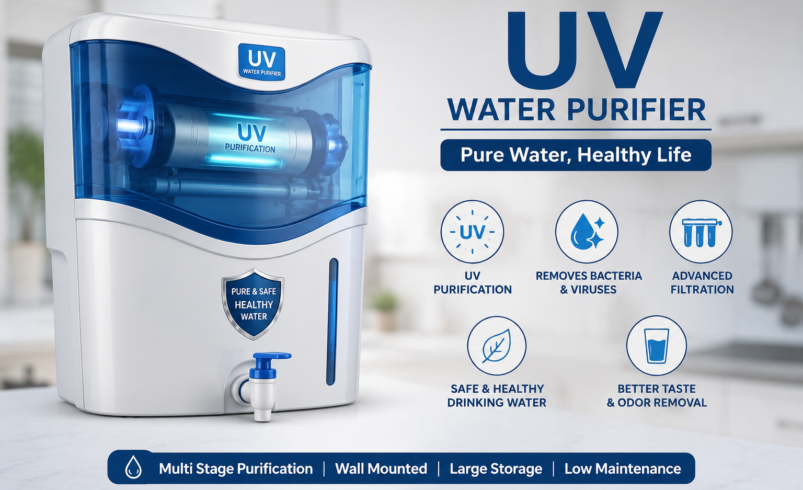
A UV Water Purifier is designed mainly for microbial disinfection. It uses ultraviolet radiation to inactivate susceptible microorganisms as water passes through a specially designed chamber. Because the process does not require adding a disinfectant chemical to the water, UV technology is widely considered for residential, commercial, and industrial water-treatment applications.
However, good results depend on more than installing a UV lamp. Water quality, filtration, flow rate, UV dose, maintenance, and system design all have a role.
Featured Snippet: How Does a UV Water Purifier Work?
A UV Water Purifier disinfects water by exposing it to ultraviolet radiation. The UV energy damages the genetic material of susceptible microorganisms, preventing them from effectively reproducing. UV purification is mainly used for microbial control and does not normally remove TDS, hardness, dissolved salts, or suspended particles.
Why UV Purification Is Different From Conventional Filtration
Traditional filters primarily work by physically separating particles from water.
A sediment filter, for example, can capture suspended particles of suitable size. Activated carbon can help reduce certain organic compounds, chlorine, taste, and odor.
UV technology works differently.
Instead of physically trapping microorganisms, ultraviolet radiation interacts with them as they pass through the treatment chamber.
This makes UV particularly useful as a disinfection stage.
A well-designed treatment system may therefore combine several technologies rather than relying on one process for every water-quality issue.
For example:
Sediment Filtration → Carbon Filtration → RO → UV → Final Water
The exact configuration depends on the water source and treatment objective.
Understanding the Main Purpose of a UV Water Purifier
The primary purpose of a UV Water Purifier is microbial inactivation.
Depending on the system design and delivered UV dose, UV treatment can be used against susceptible microorganisms such as:
- Bacteria
- Viruses
- Certain protozoa
- Other microorganisms
The effectiveness of treatment depends on several conditions.
A properly designed UV system needs to deliver an appropriate dose while the water is within the required quality range.
This is why UV performance should never be judged simply by asking whether the lamp is switched on.
The more important question is whether the water is receiving the required treatment conditions.
Why Water Quality Should Be Tested Before Installation
A common mistake is purchasing a UV purifier without first understanding the source water.
Water quality can vary considerably between sources.
Groundwater may contain high hardness, iron, manganese, TDS, and dissolved minerals. Surface water can have higher turbidity and suspended material. Municipal water may have already undergone several treatment stages but can still require additional treatment depending on the application.
If the main problem is microbial contamination and the water is already reasonably clear, UV may be an appropriate technology.
But if the water also has high TDS, hardness, or turbidity, UV alone will not address those problems.
A basic water analysis can help determine what treatment stages are actually needed.
Why Pre-Filtration Is Important for UV Systems
Water clarity can strongly influence UV treatment.
UV radiation needs to travel through the water to reach microorganisms.
If the water contains excessive suspended particles or turbidity, these materials can interfere with UV transmission. In some cases, microorganisms may also be shielded by particles.
This is why many UV systems are installed after filtration.
A suitable pre-filtration system can help create clearer water before it enters the UV chamber.
The exact filtration level depends on the source-water quality and the UV system’s specifications.
This simple step can make the overall treatment process more reliable.
UV Dose Matters More Than Just Lamp Power
When comparing UV systems, many buyers look at lamp wattage.
However, wattage alone does not tell the complete story.
The actual treatment depends on the UV dose delivered to the water.
UV dose is influenced by:
- UV intensity
- Flow rate
- Exposure time
- Water clarity
- Lamp condition
- Quartz sleeve condition
- Chamber design
A powerful lamp does not automatically mean better treatment if the system is incorrectly sized or operated above its intended flow rate.
This is why buyers should consider the manufacturer’s rated capacity and UV-dose information instead of comparing only lamp wattage.
How Flow Rate Affects UV Performance
Flow rate is particularly important when selecting a UV system.
Every UV chamber has an intended operating range.
If water moves through the chamber too quickly, exposure conditions can change. The water has less time under the UV field, potentially reducing the delivered dose.
This becomes particularly important in commercial and industrial installations.
A home may require a relatively low flow rate, while a hotel, restaurant, hospital, school, or manufacturing facility may require substantially higher flow.
For larger systems, peak flow should be considered rather than looking only at average consumption.
A correctly sized UV system is better positioned to provide consistent treatment under expected operating conditions.
UV Water Purifier vs RO System
UV and RO are often compared as though one must replace the other.
In reality, they perform different functions.
UV Water Purifier
Primarily provides microbial disinfection.
RO System
Reduces many dissolved substances, including dissolved salts and TDS.
Combined Treatment
In situations where both microbial and dissolved-contaminant concerns exist, RO and UV can be used as complementary stages.
For example, an RO system may reduce dissolved contaminants, while UV provides a final microbial-disinfection stage.
The appropriate sequence depends on the complete system design and water-quality requirements.
What UV Does Not Remove
Understanding limitations helps prevent unrealistic expectations.
A UV Water Purifier does not normally remove:
- TDS
- Hardness
- Dissolved salts
- Sediment
- Most dissolved metals
- Many chemical contaminants
- Physical particles
If these contaminants are present, another treatment method may be required.
For example, sediment can be addressed through filtration, hardness through an appropriate softening process, and high TDS through technologies such as RO when suitable.
This is why water treatment is usually most effective when each stage has a clearly defined purpose.
The Role of UV in a Multi-Stage Water Treatment System
UV does not have to operate alone.
In many systems, it serves as one stage within a larger treatment process.
A possible arrangement could be:
Raw Water → Sediment Filter → Carbon Filter → RO → UV → Storage or Point of Use
Another system may require only:
Filtered Water → UV → Distribution
The correct arrangement depends on the source water.
The key principle is simple:
Use each treatment technology for the problem it is designed to address.
Why UV Lamps Need Regular Replacement
A UV lamp can continue to operate while its performance changes over time.
This means that visual confirmation that the lamp is glowing is not enough to prove that the system is delivering the intended UV treatment.
Lamp replacement should follow the manufacturer’s recommended service interval.
Some systems also provide lamp-failure alarms or UV-intensity monitoring.
These features can be particularly useful in commercial or industrial applications where continuous treatment performance is important.
Ignoring the lamp’s service life can undermine the purpose of the entire UV system.
Do Not Ignore the Quartz Sleeve
The quartz sleeve is one of the most important components surrounding the UV lamp.
It protects the lamp while allowing ultraviolet radiation to pass into the water.
Mineral deposits can gradually accumulate on the sleeve, especially when the source water has higher mineral content.
These deposits can reduce UV transmission.
As a result, even a properly functioning lamp may not deliver the expected amount of UV energy into the water.
Regular inspection and cleaning of the quartz sleeve should therefore be included in the maintenance routine.
Why UV Treatment Does Not Leave a Residual
One advantage of UV treatment is that it can provide disinfection without adding a chemical disinfectant during the UV process.
However, UV does not normally leave a disinfectant residual in treated water.
This is important when water needs to travel through long distribution networks or remain in storage.
Once water leaves the UV chamber, it can potentially become contaminated again through contact with an unclean tank, pipe, tap, or other surface.
Therefore, post-treatment hygiene is an important part of the overall system.
Storage Tank Hygiene and UV Water Treatment
A UV system can treat water effectively at the point where it is installed, but the storage environment also matters.
Suppose treated water enters a storage tank that has accumulated dirt or microbial growth.
The water can potentially become contaminated again.
This is why storage tanks should be cleaned and maintained appropriately.
Pipes, fittings, taps, and other downstream components should also be kept hygienic.
Water treatment should therefore be viewed as a complete journey from the source to the final point of consumption.
UV Water Purifier for Residential Applications
A residential UV system can be useful when the source water requires microbial disinfection and is suitable for UV treatment.
Before installation, homeowners should consider:
- Water source
- Water clarity
- TDS
- Hardness
- Flow requirement
- Microbiological quality
- Existing filtration
- Storage arrangements
For example, groundwater with high TDS may require RO in addition to UV.
On the other hand, water with acceptable dissolved-solids levels but a microbial concern may require a simpler treatment configuration.
The right system depends on actual water characteristics.
UV Water Purifier for Commercial Applications
Commercial facilities often have higher and more variable water demand.
Restaurants, hotels, offices, schools, and other institutions may need UV systems capable of treating substantially larger flows than residential equipment.
In these applications, system sizing should account for peak demand.
Maintenance planning also becomes more important.
Operators should have a clear schedule for:
- Lamp replacement
- Quartz-sleeve cleaning
- Pre-filter replacement
- UV monitoring
- Leak inspection
- System sanitation
For critical applications, additional monitoring may also be appropriate.
UV in Industrial Water Treatment
Industrial UV systems can be integrated into larger water-treatment processes.
They may be used for process water, treated water, wastewater applications, or as part of multi-stage purification systems.
Industrial installations can involve much higher flow rates and more demanding operating conditions.
Engineers may need to evaluate:
- UV transmittance
- Required UV dose
- Peak flow
- Lamp configuration
- Hydraulic design
- Monitoring
- Maintenance access
- System redundancy
The larger and more critical the application, the more important detailed system design becomes.
Common Mistakes When Using UV Water Purifiers
Installing UV Without Checking Water Quality
UV may not address the main issue if the water contains high turbidity, TDS, hardness, or chemical contamination.
Choosing Only by Wattage
Lamp wattage alone does not determine the delivered UV dose.
Operating Above the Rated Flow
Excessive flow can change exposure conditions.
Ignoring Pre-Filtration
Turbidity and suspended particles can interfere with UV transmission.
Delaying Lamp Replacement
A lamp can continue to operate even when its treatment performance has declined.
Forgetting Quartz-Sleeve Cleaning
Deposits can reduce UV transmission.
Ignoring Downstream Contamination
Storage tanks and plumbing can introduce contamination after treatment.
How to Maintain a UV Water Purifier
A simple maintenance routine can significantly improve system reliability.
Check the Lamp
Follow the manufacturer’s recommended replacement schedule.
Clean the Quartz Sleeve
Inspect for mineral deposits and clean according to the recommended procedure.
Replace Pre-Filters
A blocked or exhausted pre-filter can affect water quality and system performance.
Check Flow
Make sure actual water flow remains within the UV system’s design range.
Inspect Connections
Look for leakage, damaged seals, or other mechanical problems.
Check Monitoring Devices
If the system includes UV-intensity sensors or alarms, respond to warnings promptly.
Maintain Storage Tanks
Keep tanks and downstream plumbing appropriately maintained.
How to Decide If You Need UV, RO, or Both
The answer starts with water analysis.
If microorganisms are the primary concern and the water is suitable for UV treatment, a UV system may be appropriate.
If dissolved salts and high TDS are the main concern, RO may be more suitable.
If both types of concerns exist, combining technologies may provide a more complete treatment solution.
A simple decision framework is:
Microbial concern → Consider UV
High TDS or dissolved salts → Consider RO
Turbidity → Consider filtration
Hardness → Consider suitable softening or treatment
Multiple concerns → Consider a multi-stage system
This approach avoids choosing technology based solely on marketing claims.
Frequently Asked Questions
Is a UV Water Purifier safe for drinking water?
UV technology is widely used for water disinfection when the system is properly designed, operated, and maintained. The suitability of the complete treatment system depends on the source-water quality and application.
Does UV remove TDS?
No. UV is primarily a microbial-disinfection technology and does not normally reduce TDS.
Does UV remove hardness?
No. UV does not soften water or remove dissolved hardness minerals.
Can UV kill bacteria?
UV systems are designed to inactivate susceptible microorganisms, including many bacteria, when the appropriate UV dose is delivered.
Does UV remove viruses?
UV can inactivate susceptible viruses under suitable treatment conditions. Performance depends on the organism, UV dose, water quality, and system design.
How often should the UV lamp be replaced?
The replacement interval varies by system and manufacturer. Users should follow the specified service schedule.
Does UV need a sediment filter?
In many applications, pre-filtration is recommended because turbidity and suspended particles can interfere with UV transmission.
Can UV and RO work together?
Yes. RO and UV address different water-treatment requirements and can be combined in a multi-stage purification system.
Conclusion
A UV Water Purifier can be an effective and practical part of a water-treatment system when microbial disinfection is required.
Its biggest advantage is its focused approach to microorganisms. Instead of relying on chemical disinfectants during the treatment stage, UV radiation is used to inactivate susceptible microorganisms as water passes through the chamber.
But reliable UV purification depends on the complete system.
The water should be suitable for UV treatment. Pre-filtration may be necessary to improve clarity. The UV unit must be correctly sized for the required flow. Lamp performance and quartz-sleeve cleanliness need to be maintained. Storage tanks and downstream plumbing should also be kept hygienic.
Most importantly, UV should not be expected to solve every water-quality problem.
It does not normally reduce TDS, hardness, dissolved salts, or most chemical contaminants. When these issues are present, filtration, activated carbon, RO, softening, or other appropriate treatment technologies may need to be included.
The best approach is therefore simple: test the water, identify the actual problem, and select the treatment technology around that requirement.
When properly designed and maintained, UV technology can become a valuable component of residential, commercial, and industrial water-treatment systems.