
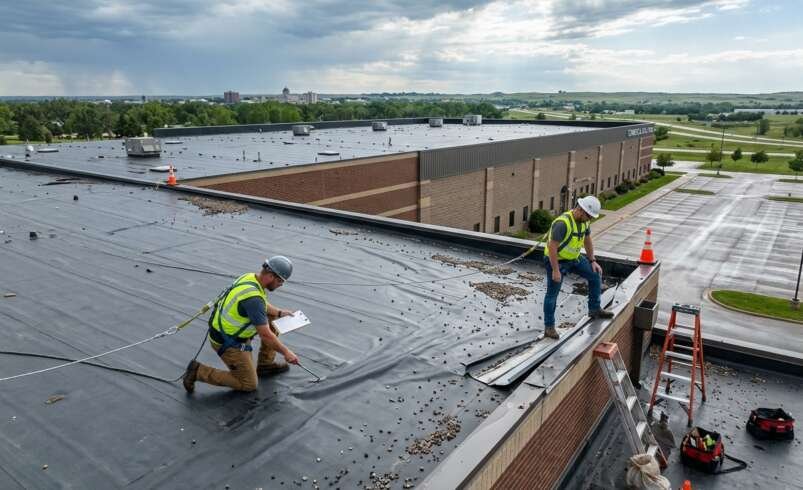

In high-volume distribution hubs and fulfillment centers across central South Dakota, seamless inventory movement is everything. However, while logistics managers focus on dock operations, supply chain metrics, and inventory turnover, the largest single vulnerability often sits directly overhead: the flat commercial roof.
For high-square-footage facilities, ineffective runoff management is the primary cause of sudden interior water intrusion. Implementing structured drainage audits and proactive warehouse roof leak prevention Pierre SD protocols is essential to protect valuable stored goods, preserve floor safety, and avoid costly supply chain disruptions.
Why Flat Roof Drainage Fails in Large Warehouse Facilities
Industrial warehouse roofs cover expansive square footage with minimal slope. Because gravity alone is insufficient to shed heavy precipitation quickly, these structures rely heavily on engineered drainage systems. In central South Dakota, extreme seasonal shifts—from heavy prairie snowstorms to torrential summer rain—place massive stress on these systems.
Common structural breakdown factors include:
-
Sustained Water Ponding: Water remaining on a flat deck for more than 48 hours breaks down membrane seams and accelerates adhesive deterioration.
-
Structural Deck Deflection: Heavy standing water adds thousands of pounds of dead weight, causing structural steel joists to sag and creating permanent low spots where water pools.
-
Debris & Wind Scour Clogs: Prairie winds carry dirt, gravel, and blown debris that gather around drain strainers, choking off primary runoff paths.
-
Thermal Expansion Stress: Rapid temperature fluctuations cause large metal decks to expand and contract, pulling flashing away from perimeter scuppers.
Addressing these structural factors through systematic warehouse roof leak prevention Pierre SD ensures water flows off the deck before hydrostatic pressure causes active leaks over storage bays.
Phase 1: Primary Drainage Outlet Clearance
-
Internal Drain Strainers: Verify that dome strainers are securely attached, unbroken, and completely free of leaves, mud, or wind-blown debris.
-
Perimeter Wall Scuppers: Ensure secondary overflow scuppers sit unobstructed so excess water can escape if primary drains fail.
-
Downspout Conductors: Check downspout discharge zones at ground level to ensure water moves rapidly away from the facility foundation.
Phase 2: Deck Slope & Low-Spot Mapping
-
Identify Standing Water Zones: Map low areas where standing water lingers 48 hours post-storm.
-
Inspect Saddle Tapers: Evaluate tapered insulation saddles designed to direct water between primary drains to ensure they have not compressed over time.
Phase 3: Flashing & Penetration Seal Verification
-
Expansion Joint Inspection: Examine expansion joints spanning wide warehouse decks for tears caused by thermal movement.
-
Parapet & Wall Terminations: Probe termination bars along perimeter walls to confirm water cannot migrate behind base flashings during high water events.
Regular execution of these three audit phases forms the backbone of reliable warehouse roof leak prevention Pierre SD.
Partner with Central South Dakota’s Industrial Roofing Experts
Do not let hidden flat roof drainage blockages put your distribution hub, stored inventory, or warehouse staff at risk. For professional thermal moisture audits, drain maintenance, and complete warehouse roof leak prevention Pierre SD, connect with the region’s trusted commercial roofing specialists:
-
Business Name: Weather All Roofing, Inc.
-
Address: 20492 Homestead Pl, Pierre, SD 57501, United States
-
Phone: +1 605-224-7982
Frequently Asked Questions (FAQs)
Q1: How does proper drainage audit execution contribute to warehouse roof leak prevention Pierre SD?
Drainage audits identify blocked drains, sagging deck sections, and compromised flashing seals before water builds up on the roof deck. By ensuring meltwater and rain clear quickly, you eliminate the standing water pressure that causes roof leaks over warehouse inventory.
Q2: What is the rule of thumb for acceptable water ponding on a flat warehouse roof?
Standing water that evaporates within 48 hours under normal weather conditions is generally acceptable. However, water remaining after 48 hours indicates structural ponding, which requires corrective warehouse roof leak prevention Pierre SD measures such as adding tapered insulation saddles.
Q3: How often should high-square-footage warehouse roofs undergo drainage audits in Pierre, SD?
Warehouse facilities should undergo full drainage audits at least twice a year—ideally in early spring (to clear winter debris and ice damage) and late autumn (to prepare for winter snowfall). Additional checks should be conducted after major windstorms or heavy rain.
Q4: Can poor roof drainage damage the building’s structural steel or concrete foundation?
Yes. Clogged roof drains force heavy water to pool along perimeter parapets or cascade down exterior walls. Over time, this uncontrolled runoff can erode ground-level soil around concrete footings and cause rust damage to internal steel roof decking.