

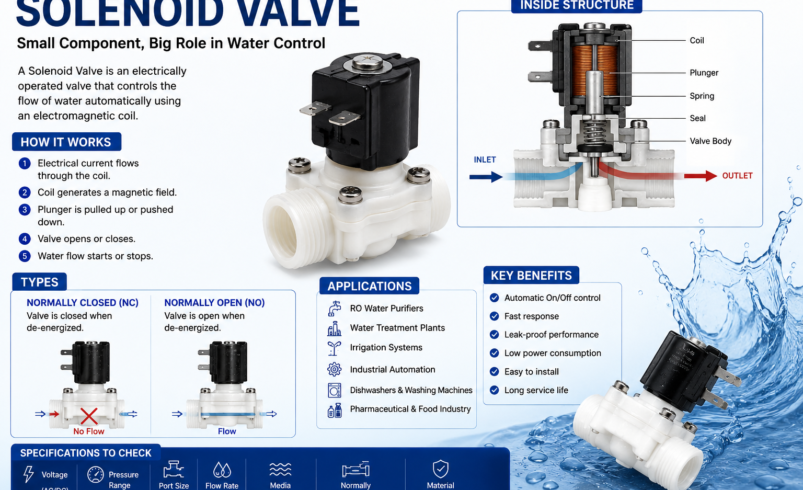

A solenoid valve can control the movement of water without anyone touching the pipeline, making it one of the simplest ways to add automatic flow control to an RO or water-treatment system.
In a water purification system, not every important component is designed to remove impurities. Some components are responsible for making sure the purification process happens at the right time and in the right sequence. The Solenoid Valve belongs to this category.
It works quietly in the background, responding to an electrical command and changing the condition of a water line. When the system needs water, the valve can allow flow. When the control system requires the flow to stop, the valve can close, depending on its configuration.
This simple action becomes extremely useful in RO purifiers, commercial water-treatment plants, automatic filtration equipment, and industrial fluid-control systems.
For an RO business, the solenoid valve is also more than just a component. It is a practical spare part that connects installation, servicing, manufacturing, and distribution.
A Water Line That Can Listen to an Electrical Signal
A normal manual valve needs a person.
A solenoid valve needs a signal.
That difference changes the entire way a water system can operate.
Imagine an RO purifier where water needs to enter only during a particular stage. Instead of manually opening the inlet, the control circuit can activate the solenoid valve.
The coil receives power.
The electromagnetic field is created.
The internal mechanism moves.
The water passage changes.
When the electrical command is removed, the valve returns to its designed state.
This process happens quickly and repeatedly in automated systems.
The valve therefore acts almost like a switch for water flow, except the switching action is performed mechanically inside a fluid line.
Why This Small Component Becomes Important in RO
The purification process depends on water moving through the correct stages.
Water may need to travel through pre-filtration, reach the pump, pass through the RO membrane, and eventually reach the storage or delivery section.
If water flow is not controlled properly, the rest of the system cannot operate according to its intended sequence.
A RO Solenoid Valve can be used as part of this flow-control arrangement.
Its exact location and function depend on the purifier’s design, but common purposes can include:
- Controlling inlet water
- Supporting automatic shut-off
- Managing specific water-flow paths
- Participating in flushing sequences
- Coordinating with electrical controls
The valve does not replace the membrane or pump. It helps those components operate within the required system sequence.
The Difference Between “Flow” and “Purification”
This distinction is useful when explaining an RO system to customers.
A filter removes or retains certain contaminants.
A membrane separates water based on the RO process.
A pump provides pressure.
A solenoid valve controls flow.
Each component contributes differently.
When a purifier has a water-flow problem, replacing the membrane won’t necessarily solve it. Similarly, replacing a solenoid valve won’t improve the water’s filtration quality.
Knowing what each component actually does makes diagnosis and product selection more accurate.
What Happens When the Power Goes Off?
This is where valve configuration becomes particularly important.
A Normally Closed Solenoid Valve is closed when it isn’t energized. It opens after receiving the required electrical signal.
A Normally Open Solenoid Valve behaves in the opposite way. It remains open without power and closes when energized.
The choice depends on how the system is designed to behave.
For an automatic RO system, the default state should be considered carefully because it determines what happens when the control signal disappears.
This is not merely a product specification. It is part of the system’s operating logic.
The Coil Is Small, But Its Specification Is Critical
The electromagnetic coil is responsible for creating the force that operates the valve.
That makes its electrical specification extremely important.
A solenoid valve may be designed for a specific AC or DC voltage. The control circuit needs to provide the appropriate electrical supply.
If a technician installs a valve with an incompatible coil, several problems can occur:
- Valve may not activate
- Coil may overheat
- Valve may operate incorrectly
- Electrical components may be affected
- The expected automatic sequence may fail
This is why replacing a valve based only on physical appearance is risky.
The electrical rating should always be checked.
When a Valve Fits the Pipe but Still Doesn’t Fit the System
This is one of the most common mistakes in component selection.
Suppose the old valve and replacement valve have the same connection size.
That doesn’t necessarily make them interchangeable.
The replacement may have:
- Different voltage
- Different pressure rating
- Different flow capacity
- Different valve configuration
- Different sealing material
- Different temperature limits
The outside dimensions may look similar while the internal specifications are completely different.
For RO dealers and technicians, checking the complete specification can prevent unnecessary installation failures.
Pressure Is Part of the Valve’s Environment
Water pressure is constantly acting on the valve.
The valve must therefore be suitable for the pressure conditions of the system.
Domestic RO equipment and industrial water-treatment plants can have very different pressure requirements.
A valve intended for one operating range should not automatically be transferred to another application.
Pressure compatibility can influence whether the valve opens correctly, closes reliably, and maintains proper sealing.
For commercial systems, this becomes even more important because flow rates and operating pressures can be substantially higher.
The Role of Flow Capacity
Every valve has an internal flow passage.
The size and design of this passage influence how fluid moves through the component.
If the required flow is greater than the valve can comfortably handle, the system may experience unnecessary restriction.
If the valve is oversized, it may not provide any meaningful advantage either.
Therefore, the right Water Solenoid Valve should be matched with the actual flow requirements of the application.
This is especially important for larger water-treatment installations.
Material Is More Than an Appearance Choice
Solenoid valves can be manufactured using different body and internal materials.
Depending on the application, options can include plastics, brass, stainless steel, and other materials.
The correct choice depends on the fluid and operating environment.
For ordinary water applications, one material may be perfectly suitable.
For corrosive chemicals, high temperatures, or demanding industrial processes, another material may be required.
The seals also matter.
A chemically compatible body with an unsuitable seal can still create a reliability problem.
Why RO Service Professionals Need to Understand the Whole System
When an RO purifier doesn’t behave correctly, it is easy to replace the most obvious component.
But good troubleshooting asks a different question:
Where exactly is the process stopping?
If water isn’t entering the system, check the inlet path.
If the valve isn’t opening, check its electrical signal.
If it opens but water doesn’t move, check pressure and possible obstruction.
If water doesn’t stop, check both the valve and the control signal.
This system-level approach can prevent unnecessary replacement of functional components.
The Valve Can Fail in More Than One Way
A solenoid valve doesn’t have only one possible failure mode.
It May Stay Closed
The system expects water, but the valve doesn’t open.
It May Stay Open
The system expects the water flow to stop, but the valve remains open.
It May Operate Intermittently
Sometimes it responds correctly and sometimes it doesn’t.
It May Leak
Water can escape externally or pass internally when the valve should be closed.
The Coil May Overheat
Electrical mismatch or unsuitable operating conditions can contribute to excessive coil temperature.
Each symptom requires a slightly different diagnostic approach.
When You Hear a Click, Don’t Assume Everything Is Fine
A clicking sound is often interpreted as proof that the valve is working.
But the sound may only indicate that the electromagnetic mechanism is responding.
The valve could still have:
- Internal debris
- Mechanical obstruction
- Damaged sealing surfaces
- Incorrect pressure conditions
- Internal wear
The real test is whether the water-flow behavior matches the system’s requirement.
This is a useful distinction for technicians troubleshooting automatic RO systems.
Why Clean Installation Matters
Small internal passages can be affected by contamination.
During installation or replacement, debris from the pipeline can enter the valve.
Particles may interfere with the internal mechanism or sealing surfaces.
Suitable filtration upstream can also help reduce the amount of particulate material reaching the valve during normal operation.
This is one reason the solenoid valve should be viewed as part of the complete hydraulic system rather than as an isolated spare part.
Solenoid Valve in Commercial Water Treatment
In commercial water treatment, automatic flow control becomes increasingly important.
A larger system may contain several treatment stages and pipelines.
The control system may need to coordinate:
- Pumps
- Filters
- Membranes
- Storage tanks
- Sensors
- Valves
A solenoid valve can become one of the components executing these commands.
For example, an automated sequence may require one water path to open while another remains closed.
The control system sends the appropriate signal, and the valve changes its position.
The actual arrangement varies according to the plant design.
Industrial Use Requires More Than Basic Compatibility
Industrial applications can involve demanding conditions.
The fluid may be chemically aggressive.
The pressure may be high.
The temperature may be elevated.
The operating cycle may be frequent.
Under these conditions, selecting a generic valve without checking specifications can create problems.
An industrial solenoid valve may require carefully selected:
- Body material
- Seal material
- Pressure rating
- Temperature rating
- Coil configuration
- Flow capacity
- Connection type
The more demanding the process, the more important detailed specification becomes.
Why Solenoid Valves Make Sense for Automation
One major reason for using solenoid valves is their compatibility with electrical control systems.
They can work alongside:
- Sensors
- Timers
- Controllers
- Switches
- Control boards
- Automation systems
This makes them useful where repetitive manual valve operation would be inconvenient.
An operator doesn’t need to physically turn the valve every time.
The system can make the decision and the solenoid valve can execute it.
The Business Side: Why Dealers Should Not Ignore This Product
For RO dealers, a solenoid valve can be a useful addition to a spare-parts range.
Customers who purchase RO systems may eventually require replacement components.
Filters may be replaced frequently.
Membranes may require periodic replacement.
Pumps may eventually need servicing.
Solenoid valves can also become replacement items when the flow-control mechanism develops a problem.
A dealer who already supplies RO components can therefore naturally add solenoid valves to the product portfolio.
One Product Can Serve Multiple Customer Types
A solenoid valve can have demand from several types of customers.
RO Manufacturers
For new purifier assembly.
RO Dealers
For installation and replacement.
Service Technicians
For repair work.
Water Treatment Companies
For automated water-control applications.
Distributors
For supplying components to multiple businesses.
This makes the product relevant across different levels of the water-treatment supply chain.
What Makes a Good Solenoid Valve for Business Stock?
For inventory purposes, the important thing is not simply quantity.
The right specifications matter more.
A business can organize its stock according to:
- Voltage
- Port size
- Normally open/closed configuration
- Pressure range
- Application
- Body material
This makes it easier to identify the correct replacement when a customer has a specific requirement.
Keeping product specifications organized can reduce confusion and improve order accuracy.
Don’t Judge Quality Only by Price
A solenoid valve is relatively small, which can make price comparisons tempting.
But the cheapest product is not automatically the most economical choice.
A valve that fails prematurely can create:
- Repeat service calls
- Installation delays
- Customer dissatisfaction
- Replacement costs
- Additional labor
A suitable valve with dependable specifications can provide better overall value.
For businesses, cost of ownership can be more meaningful than purchase price alone.
How the Valve Supports Better System Automation
Automation is ultimately about consistency.
The system should respond to the same condition in the same way.
When the controller sends a signal, the valve should respond as expected.
When the signal stops, it should return to its designed state.
When these components work together correctly, the RO system can operate with less manual intervention.
That is the real value of the solenoid valve.
It turns an electrical instruction into predictable fluid movement.
A Practical Selection Thought
Instead of asking:
“Which solenoid valve is best?”
a better question is:
“Which solenoid valve is correct for this system?”
That change in thinking can improve product selection.
A valve may be excellent in one application and completely unsuitable in another.
The correct product depends on the actual requirements.
Frequently Asked Questions
What is a Solenoid Valve used for in water treatment?
It is used to automatically control water flow according to an electrical signal from the system’s control mechanism.
Does an RO Solenoid Valve improve water quality?
No. It controls water movement. Water quality is determined by the treatment components and overall system design.
What causes a solenoid valve to remain open?
Possible causes include mechanical obstruction, internal damage, sealing problems, or a control circuit that continues sending the activation signal.
What causes a solenoid valve to remain closed?
Possible causes include lack of electrical power, coil failure, wiring problems, mechanical obstruction, or unsuitable pressure conditions.
Is a solenoid valve suitable for industrial water treatment?
Yes, provided the valve is specifically selected for the required pressure, flow, temperature, fluid, materials, and electrical conditions.
How can RO dealers choose the right valve?
They should compare the required voltage, connection, pressure, flow, configuration, material compatibility, and application rather than relying only on size or appearance.
Conclusion
The Solenoid Valve is a small component with a surprisingly important responsibility: controlling the movement of water according to an electrical instruction.
In RO systems, it can support inlet control, automatic shut-off, flushing, and other flow-management functions. In larger water-treatment plants, it can become part of an automated network connecting controllers, sensors, pumps, tanks, and treatment equipment.
For technicians, understanding its electrical and hydraulic sides can make troubleshooting more accurate. For dealers and distributors, its role in both new installations and replacement requirements makes it a valuable RO product category.
The real strength of a solenoid valve is not its size or appearance. It is the simplicity of its function: an electrical command can become a physical change in water flow within seconds.
That small connection between automation and fluid control is what keeps the RO Solenoid Valve relevant across modern water purification and treatment applications.