
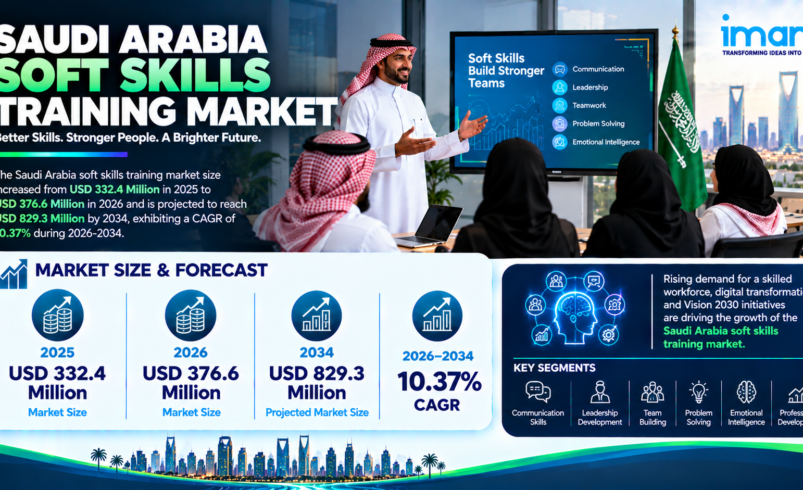

IMARC Group, a leading global market research and management consulting firm, has published its latest market intelligence report on the Saudi Arabia soft skills training market. The Saudi Arabia soft skills training market size increased from USD 332.4 Million in 2025 to USD 376.6 Million in 2026 and is projected to reach USD 829.3 Million by 2034, exhibiting a CAGR of 10.37% during 2026-2034, driven by Vision 2030 workforce development mandates, rising corporate HR training budgets, and growing adoption of digital learning platforms across Saudi Arabia’s evolving workforce.
The market is riding sustained structural momentum as the Kingdom embeds soft skills development into its national human capital strategy. Corporate HR investment, HRDF-backed reskilling programs, and digital learning platform adoption are widening the addressable market across leadership, communication, and teamwork competencies spanning corporate, academic, and government channels. Corporate/enterprise clients keep in-house delivery the dominant sourcing model, while Riyadh’s concentration of corporate headquarters, government ministries, and accredited training centers anchors the Northern and Central Region as the Kingdom’s largest training hub, together creating a market built on sustained institutional demand rather than a single training cycle.
Saudi Arabia Soft Skills Training Market at a Glance:
- Market Size (2025): USD 332.4 Million
- Market Size (2026): USD 376.6 Million
- Forecast Market Size (2034): USD 829.3 Million
- CAGR (2026-2034): 10.37%
- Leading Channel Provider (2025): Corporate/Enterprise, 56.7% share
- Leading Sourcing (2025): In-house, 61.4% share
- Dominant Region (2025): Northern and Central Region, 36.9% share
How AI is Reshaping the Future of the Saudi Arabia Soft Skills Training Market
- AI-Driven Personalized Learning Pathways: Training providers are embedding AI and machine learning tools within learning management systems to generate adaptive learning paths based on individual competency assessments, prior training history, and role-specific development goals, improving both efficiency and behavioral change outcomes for corporate and government learners.
- Gamification and Immersive Learning Simulations: Points, leaderboards, and scenario-based simulations are being embedded into leadership and communication programs to increase engagement, while virtual reality is being piloted for high-stakes negotiation and interpersonal skills practice in controlled environments across the Kingdom.
- Mobile Microlearning and Automated Competency Tracking: Mobile-optimized platforms delivering three-to-ten-minute modules are enabling employers to embed continuous soft skills development into daily workflows, while AI-powered competency-gap analysis and real-time performance feedback are making training outcomes measurable across distributed workforces.
Grab a sample PDF of this report: https://www.imarcgroup.com/saudi-arabia-soft-skills-training-market/requestsample
Saudi Arabia Soft Skills Training Market Trends and Drivers:
Enterprise HR investment is the single biggest structural shift in the market, with corporate/enterprise commanding 56.7% of the channel provider mix in 2025 as organizations fund leadership development, communication, and customer service programs to support workforce transformation. The Human Resources Development Fund aided 143,000 Saudi individuals in securing private-sector jobs during the first quarter of 2025 alone, allocating SAR 1.83 Billion toward training, empowerment, and support programs, while academic/education accounts for a further 27.8% share as universities and vocational institutes integrate soft skills certification into graduate curricula.
In-house delivery, at 61.4% of the sourcing mix, reflects large enterprises’ and government institutions’ preference for customized, culturally adapted content delivered by internal or captive trainers rather than external providers, with outsourced delivery at 38.6% gaining traction among mid-sized enterprises seeking specialized expertise and certified instructors without building internal training infrastructure. Rising EdTech adoption and expanding bilingual Arabic-English content are compounding this shift, lowering delivery costs and extending program reach into smaller cities and non-metro corporate sites nationwide.
Government-backed capital is the accelerant behind both trends. Vision 2030’s workforce capability agenda and Saudization targets are pushing organizations and educational institutions to strengthen leadership, communication, and collaboration skills, while the National Human Capital Strategy and ongoing HRDF accreditation requirements are steering enterprise training budgets toward registered, certified providers. Layered on top, large-scale infrastructure, tourism, and new economic city projects under Vision 2030 are generating fresh talent-development needs across hospitality, retail, and project management sectors, pulling new demand pools into the formal training market.
Government Schemes and Vision 2030 Initiatives Driving Demand:
- Vision 2030 Workforce Development Mandate: Vision 2030 emphasizes workforce capability development and employability, encouraging organizations and educational institutions to strengthen leadership, communication, collaboration, and other interpersonal skills across the public and private sectors.
- Human Resources Development Fund (HRDF) Training Support: HRDF aided 143,000 Saudi individuals in securing private-sector jobs during the first quarter of 2025, allocating SAR 1.83 Billion toward training, empowerment, and support programs, directly subsidizing enterprise soft skills training uptake.
- National Human Capital Strategy: The national strategy is embedding soft skills training as a structural investment priority across government, enterprise, and academic sectors, tying funding and program design to measurable productivity and leadership outcomes.
- HRDF Accreditation and Compliance Requirements: Growing enterprise reliance on HRDF-registered, certified training providers is steering procurement toward accredited program portfolios, favoring established regional and international training firms with proven localization capabilities.
- EdTech and Digital Learning Investment Programs: Government-aligned investment in EdTech platforms, AI-powered competency assessment tools, and mobile-first microlearning systems is expanding bilingual Arabic-English training delivery to learners in smaller cities and remote corporate sites nationwide.
Saudi Arabia Soft Skills Training Industry Segmentation:
The report has segmented the market into the following categories:
Breakup By Soft Skill Type:
- Management and Leadership
- Administration and Secretarial
- Communication and Productivity
- Personal Development
- Teamwork
- Others
Management and Leadership programs anchor demand across the soft skill type segment, supported by enterprise leadership pipelines and managerial effectiveness mandates, while Communication and Productivity and Personal Development competencies are gaining traction as organizations broaden training scope beyond management tiers to customer-facing and early-career staff.
Breakup By Channel Provider:
- Corporate/Enterprise
- Academic/Education
- Government
Corporate/enterprise commands the largest channel provider share at 56.7% in 2025, driven by rising HR investment in leadership development, communication, and customer service programs, and remains the primary growth engine for the market as organizations undergo workforce transformation. Academic/education follows at 27.8%, reflecting growing university and vocational institute partnerships that integrate soft skills certification into graduate and continuing education programs.
Breakup By Sourcing:
- In-house
- Outsourced
In-house delivery leads the sourcing segment at 61.4% share in 2025, reflecting large corporates’ and government institutions’ preference for customized, brand-aligned programs delivered through internal training functions or dedicated corporate academies. Outsourced delivery, at 38.6% share, is the fastest-expanding sourcing category, driven by rising SME demand for affordable, HRDF-registered programs that avoid the overhead of building internal training infrastructure.
Breakup By Delivery Mode:
- Online
- Offline
Delivery mode is shifting toward a blended model as training providers integrate in-person workshops with virtual instructor-led sessions and self-paced digital modules, improving completion rates and enabling flexible deployment across multi-site corporate clients, while offline instruction remains central to high-stakes leadership and negotiation training requiring in-person facilitation.
Breakup By End Use Industry:
- BFSI
- Hospitality
- Healthcare
- Retail
- Media and Entertainment
- Others
BFSI and Hospitality represent core end-use demand pools, with banks and financial institutions funding customer service and compliance-linked communication programs, while hospitality and tourism operators expand soft skills investment to support Vision 2030-driven tourism infrastructure and service-quality mandates across the Kingdom’s growing visitor economy.
Breakup By Region:
- Northern and Central Region
- Western Region
- Eastern Region
- Southern Region
The Northern and Central Region dominates the Saudi Arabia soft skills training market with a 36.9% share in 2025, anchored by Riyadh’s concentration of corporate headquarters, government ministries, and HRDF-registered training centers. The Western Region follows at 30.5%, leveraging Jeddah’s active commercial environment, growing academic partnerships, and expanding hospitality-sector training needs, while the Eastern Region’s 21.2% share reflects energy-sector workforce development and rising multinational presence around Dhahran and Dammam, and the Southern Region’s 11.4% share is supported by emerging special economic zones and government-sponsored training initiatives. The Eastern Region is expanding at an above-average rate as energy companies, petrochemical firms, and infrastructure contractors invest in structured interpersonal and leadership training for their Saudi national workforces.
Competitive Landscape:
The report provides a comprehensive analysis of the competitive landscape in the Saudi Arabia soft skills training market with detailed profiles of all major companies, including:
- Meirc Training & Consulting
- Franklin Covey Co.
- Dale Carnegie & Associates Global, Inc.
- Korn Ferry
Market Concentration Analysis:
- Fragmentation: The market is moderately fragmented, with established international training firms, regional specialists, and government-affiliated academies competing across corporate, academic, and public sector channels, and no single provider holding a dominant share of total market revenue
- Consolidation Trend: Larger training organizations are gradually acquiring niche content specialists and regional providers to broaden program portfolios and geographic reach, with strategic partnerships between global training brands and local Saudi partners reshaping competitive positioning
- Capital Inflows: Investment activity is concentrated in EdTech platforms offering Arabic-language soft skills content, AI-powered competency assessment tools, and HRDF-accredited training businesses capable of scaling bilingual program delivery across the Kingdom
What Does The Full Report Cover?
If you are tracking the Saudi Arabia soft skills training market for investment decisions, market entry planning, competitive benchmarking, or strategic advisory, IMARC Group’s report gives you everything in one place:
- Complete market sizing in value terms with forecasts covering the full 2026-2034 projection period
- Quantified growth driver analysis with impact scoring across soft skill type, channel provider, sourcing, delivery mode, end use industry, and regional markets
- Sub-segment breakdowns for six soft skill types, three channel providers, two sourcing models, two delivery modes, six end-use industries, and all four regions of the Kingdom, each with individual share data
- Regional data across the Northern and Central, Western, Eastern, and Southern regions of Saudi Arabia
- Competitive profiles of leading global and regional training providers with strategic landscape assessment
- Value chain analysis, market concentration assessment, and investment and growth opportunity mapping
- Latest technology trends covering AI-driven personalized learning, gamification and immersive simulations, mobile microlearning, and Vision 2030-driven workforce development opportunities shaping market competition across the Kingdom
Recent Developments at Key Companies in the Saudi Arabia Soft Skills Training Market
- Meirc Training & Consulting: The firm has continued to broaden its training portfolio and strengthen its regional presence, supporting corporate and government clients across the Kingdom with expanded leadership, communication, and professional development program offerings.
- Franklin Covey Co.: The company has continued to advance its digital and in-person program offerings, supporting enterprise clients across Saudi Arabia with enhanced training solutions, expanded delivery formats, and growing digital subscription adoption through its licensee network.
- Dale Carnegie & Associates Global, Inc.: The organization has continued to strengthen its authorized franchise network and expand program delivery across the Kingdom, supporting corporate clients with structured soft skills and leadership development solutions.
Note: If you require specific details, data, or insights that are not currently included in the scope of this report, we are happy to accommodate your request. As part of our customization service, we will gather and provide the additional information you need, tailored to your specific requirements. Please let us know your exact needs, and we will ensure the report is updated accordingly to meet your expectations.
Key Questions This Report Answers
- What is the current Saudi Arabia soft skills training market size and what is its projected value?
- Which channel provider holds the largest share in the Saudi Arabia soft skills training market?
- What are the key drivers of Saudi Arabia soft skills training market growth?
- Which region dominates the Saudi Arabia soft skills training market and why?
- How is Vision 2030, HRDF funding, and digital learning adoption reshaping training delivery and competitive strategy in the Saudi Arabia soft skills training industry?
- Who are the top companies in the Saudi Arabia soft skills training market and what are their competitive strategies?
- What are the investment and market entry opportunities across outsourced delivery, EdTech platforms, and bilingual content localization in Saudi Arabia?
About Us
IMARC Group is a global management consulting firm that helps the world’s most ambitious changemakers to create a lasting impact. The company provides a comprehensive suite of market entry and expansion services. IMARC offerings include thorough market assessment, feasibility studies, company incorporation assistance, factory setup support, regulatory approvals and licensing navigation, branding, marketing and sales strategies, competitive landscape and benchmarking analyses, pricing and cost research, and procurement research.
Media and Sales Contact
IMARC Group
Email: sales@imarcgroup.com
United States: +1-201-971-6302
India: +91-120-433-0800
United Kingdom: +44-753-714-6104