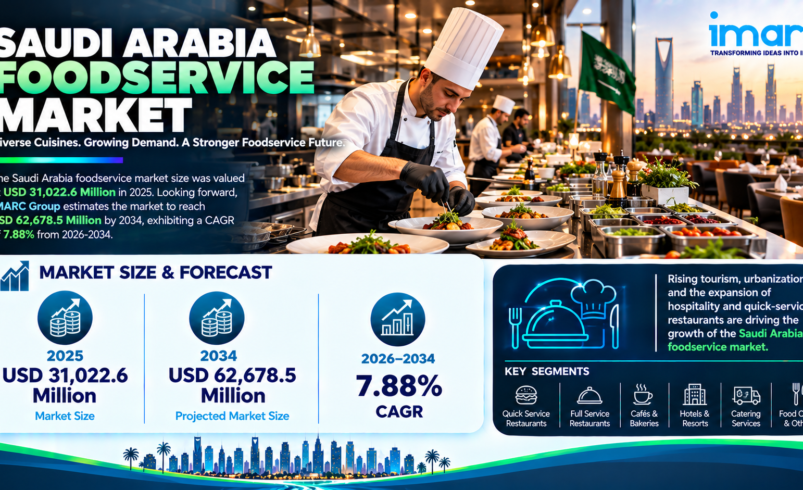

IMARC Group, a leading global market research and management consulting firm, has published its latest market intelligence report on the Saudi Arabia foodservice market. The Saudi Arabia foodservice market size was valued at USD 31,022.6 Million in 2025. Looking forward, IMARC Group estimates the market to reach USD 62,678.5 Million by 2034, exhibiting a CAGR of 7.88% from 2026-2034, driven by a rising wave of new restaurant openings, rapid urbanization, and the deepening integration of digital ordering and delivery technology across the Kingdom.
Foodservice benefits from the everyday nature of dining demand in Saudi Arabia, with a growing urban population translating directly into more frequent visits to cafes, quick service counters, and full service restaurants. The market is forecast to add roughly USD 29.21 Billion in incremental value between 2026 and 2034, with three structural forces shaping this trajectory: a decisive consumer shift toward convenience-led dining, a government-backed push to multiply the number of organized cafes per capita, and a tourism boom that is pulling global culinary concepts into the Kingdom.
Saudi Arabia Foodservice Market at a Glance:
- Market Size (2025): USD 31,022.6 Million
- Forecast Market Size (2034): USD 62,678.5 Million
- CAGR (2026-2034): 7.88%
- Base Year: 2025
- Forecast Period: 2026-2034
Grab a sample PDF of this report: https://www.imarcgroup.com/saudi-arabia-foodservice-market/requestsample
How AI is Reshaping the Future of the Saudi Arabia Foodservice Market
- AI-Powered Ordering and Loyalty Systems: Operators across Saudi Arabia are deploying AI-driven ordering platforms and mobile apps to speed up service, personalize menu recommendations, and strengthen customer loyalty as the sector digitizes rapidly on the back of rising smartphone penetration.
- Delivery-Optimized Cloud Kitchens: Cloud kitchen operators are using digital platforms and delivery-app integrations to run multiple virtual restaurant brands from a single facility, cutting overhead costs while meeting the Kingdom’s surging appetite for online food ordering.
- Contactless and App-Based Dining: Seamless ordering and payment technology is reshaping dining behavior, with restaurants enhancing their digital presence and delivery partnerships to serve an increasingly convenience-driven, tech-savvy consumer base.
Saudi Arabia Foodservice Market Trends and Drivers:
Urbanization is the foundational force behind rising demand in the foodservice market in Saudi Arabia, with most of the population expected to live in cities, bringing modern lifestyles, dual-income households, and hectic schedules that favor quick-service and takeaway options over home cooking. Expanding economic activity in urban centers is also fueling appetite for a wider range of culinary experiences, from casual dining to premium international cuisine, particularly among younger consumers.
Online food delivery has become deeply embedded in the dining experience, with established platforms making ordering convenient and widespread. Restaurants are strengthening their digital presence and delivery partnerships, while cloud kitchens are gaining ground by offering delivery-only formats that reduce overhead. Health-conscious dining is advancing in parallel, with restaurants expanding gluten-free, vegan, and keto-friendly menus alongside juice bars and salad-focused concepts to meet shifting consumer preferences, creating new growth opportunities across the foodservice market in Saudi Arabia.
Tourism is reshaping the foodservice landscape as Vision 2030’s cultural and entertainment initiatives draw growing numbers of international visitors to Riyadh, Jeddah, and other hotspots. Seasonal festivals and heritage-inspired dining experiences are attracting food enthusiasts, while high-end restaurants and food festivals cater to global palates, creating fresh opportunities across both premium and experiential dining formats.
Government Schemes and Vision 2030 Initiatives Driving Demand:
- Cafe Density Expansion Target: A Vision 2030 goal to raise the number of cafes per million people from roughly 258 today toward 1,000, encouraging rapid growth in organized cafe and specialty beverage formats nationwide.
- Tourism and Cultural Investment: Vision 2030’s focus on tourism, entertainment, and cultural development is driving a wave of new restaurant openings catering to both international visitors and a fast-growing domestic audience.
- Healthy Eating Initiatives: Government-backed health and wellness programs are encouraging restaurants to adopt nutritious, low-calorie, and balanced menu options in line with national public health objectives.
- Urbanization-Linked Infrastructure: Continued investment in urban infrastructure is supporting the expansion of shopping malls, entertainment centers, and transit hubs, each creating new footfall-driven foodservice opportunities.
Saudi Arabia Foodservice Industry Segmentation:
The report has segmented the market into the following categories:
Breakup By Foodservice Type:
- Cafes and Bars
- Cloud Kitchen
- Full Service Restaurants
- Quick Service Restaurants
Cafes and bars remain central to the Kingdom’s social and leisure culture, spanning cozy neighborhood cafes, juice and dessert bars, and upscale specialty coffee and tea houses. Cloud kitchens are expanding fast as a delivery-only model that lets operators run extensive menus without the cost of dine-in space. Full service restaurants span Asian, European, Latin American, Middle Eastern, and North American cuisines, while quick service restaurants, covering bakeries, burger outlets, ice cream parlors, meat-based concepts, and pizza chains, continue to draw young, urban consumers seeking fast, customizable meals.
Breakup By Outlet:
- Chained Outlets
- Independent Outlets
Chained outlets, including international franchises and regional brands, dominate malls, entertainment centers, and travel hubs on the strength of consistent quality and brand recognition. Independent outlets, often family-owned, preserve the Kingdom’s culinary heritage through authentic recipes and personalized service, carving out a loyal following in smaller towns and among consumers seeking cultural authenticity.
Breakup By Location:
- Leisure
- Lodging
- Retail
- Standalone
- Travel
Leisure destinations such as amusement centers and cultural festivals draw diverse foodservice demand from families and tourists alike, while lodging locations centre on upscale dining for business travelers and visitors. Retail hubs in malls combine quick-service and full-service formats for shoppers, standalone outlets in high-traffic or scenic spots build distinctive dining identities, and travel locations such as airports and highway stops serve commuters with fast, recognizable options.
Breakup By Region:
- Northern and Central Region
- Western Region
- Eastern Region
- Southern Region
The Northern and Central Region, anchored by Riyadh, leads on the back of high disposable incomes and a thriving business and tourism scene that favors cafes, full-service restaurants, and cloud kitchens. The Western Region, home to Jeddah and Makkah, benefits from religious tourism and a steady flow of pilgrims supporting traditional eateries and quick-service formats. The Eastern Region’s industrial and expatriate population base is driving demand for global cuisines and casual dining, while the Southern Region reflects a mix of traditional and modern dining trends as its urban centers expand.
Competitive Landscape:
The Saudi Arabia foodservice market remains highly fragmented, with international chains, regional franchise groups, and independent operators competing for a fast-growing consumer base. Players are investing in AI-powered ordering systems and mobile apps to enhance convenience and loyalty, while cloud kitchen formats are being deployed to meet booming delivery demand efficiently. Sustainability is gaining traction as well, with operators adopting eco-friendly packaging, reducing food waste, and expanding organic and plant-based menu offerings in step with shifting consumer preferences.
What Does The Full Report Cover?
If you are tracking the Saudi Arabia foodservice market for investment decisions, market entry planning, competitive benchmarking, or strategic advisory, IMARC Group’s report gives you everything in one place:
- Complete market sizing in value terms with forecasts covering the full projection period through 2034
- Quantified growth driver analysis across foodservice type, outlet, location, and regional markets
- Sub-segment breakdowns spanning four foodservice types, two outlet formats, five location categories, and four regions, each with individual trend analysis
- Competitive landscape assessment covering key operators, strategic positioning, and Porter’s Five Forces analysis
- Latest trends covering online food delivery platforms, health-conscious dining, and tourism-driven food experiences shaping competition across the Kingdom
Recent News and Developments in Saudi Arabia Foodservice Market
- December 2024: Zuma Riyadh, the renowned Japanese izakaya concept, opened within the King Abdullah Financial District in partnership with MJS Holding, featuring interactive sushi and robata counters alongside private dining spaces.
- July 2024: Epik Foods opened its first physical restaurant, Healthy & Co, in Riyadh’s Al Sahafah district after running a network of delivery-only kitchens, with expansion to Jeddah and Khobar planned through a partnership with GymNation.
- August 2024: SUSHISAMBA announced its entry into the Kingdom with a Riyadh location at KAFD, bringing its Japanese, Peruvian, and Brazilian fusion concept and signature interior design to the market.
- September 2024: Pizza Hut, in partnership with Americana Restaurants, launched the Opportunity4All program in Riyadh, opening the country’s first restaurant staffed by people with special needs in alignment with Vision 2030’s inclusion goals.
Note: If you require specific details, data, or insights that are not currently included in the scope of this report, we are happy to accommodate your request. As part of our customization service, we will gather and provide the additional information you need, tailored to your specific requirements. Please let us know your exact needs, and we will ensure the report is updated accordingly to meet your expectations.
Key Questions This Report Answers
- What is the current Saudi Arabia foodservice market size and what is its projected value?
- Which foodservice type and outlet format hold the largest share in the Saudi Arabia foodservice market?
- What are the key drivers of Saudi Arabia foodservice market growth?
- Which region dominates the Saudi Arabia foodservice market?
- How is Vision 2030’s tourism and cultural investment pipeline reshaping the Saudi Arabia foodservice industry?
- What role is technology, such as AI-powered ordering and delivery platforms, playing in the market’s evolution?
- What are the investment and market entry opportunities across cloud kitchens, health-conscious dining, and tourism-driven foodservice in Saudi Arabia?
About Us
IMARC Group is a global management consulting firm that helps the world’s most ambitious changemakers to create a lasting impact. The company provides a comprehensive suite of market entry and expansion services. IMARC offerings include thorough market assessment, feasibility studies, company incorporation assistance, factory setup support, regulatory approvals and licensing navigation, branding, marketing and sales strategies, competitive landscape and benchmarking analyses, pricing and cost research, and procurement research.
Media and Sales Contact
IMARC Group
Email: sales@imarcgroup.com
United States: +1-201-971-6302
India: +91-120-433-0800
United Kingdom: +44-753-714-6104