
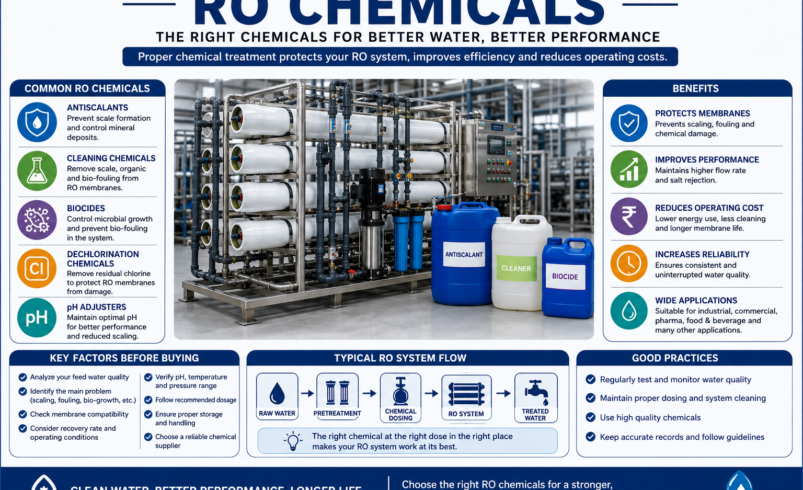

The effectiveness of an RO Chemical depends less on the product name and more on whether its formulation, dosage and application match the actual water chemistry and operating conditions of the RO plant.
Reverse osmosis systems are widely used for producing purified water in industries such as pharmaceuticals, food processing, beverages, textiles, chemicals, hospitals and manufacturing. While the RO membrane performs the main separation process, its performance can be significantly affected by the quality of the feed water.
Hardness, silica, dissolved minerals, organic matter, microorganisms and chlorine can create different challenges for an RO system. If these issues are not managed properly, membrane performance can decline, cleaning frequency can increase and operating costs can rise.
This is why RO Chemicals are commonly incorporated into water treatment programs.
However, choosing an RO chemical should not be based only on price or a supplier’s general recommendation. The product needs to be suitable for the water source, membrane type and operating conditions.
This guide explains eight important factors to consider before purchasing RO Chemicals for a commercial or industrial RO plant.
Featured Snippet: What Should You Check Before Buying RO Chemicals?
Before buying RO Chemicals, check the feed-water chemistry, RO membrane compatibility, recovery rate, pH, temperature, operating pressure, chemical dosage and existing pretreatment system. Select a chemical according to the specific scaling, fouling, biological or chemical-control problem rather than choosing solely on price.
1. Start With Feed-Water Analysis
The first and most important factor is water quality.
Every RO plant receives water with a different chemical composition. Even two plants using water from the same general source can have different treatment requirements.
A feed-water analysis can provide information about:
- TDS
- pH
- Total hardness
- Calcium
- Magnesium
- Alkalinity
- Chloride
- Sulfate
- Silica
- Iron
- Manganese
- Organic matter
- Other relevant contaminants
This information helps determine the potential risks to the membrane.
For example, water with high calcium and alkalinity may have a higher risk of carbonate scaling, while elevated sulfate concentrations can create different scaling concerns.
Without water analysis, chemical selection becomes largely guesswork.
Why Water Analysis Matters
An RO chemical designed for one water chemistry may not provide the same performance under another set of conditions.
This is especially important for antiscalants.
The chemical should be selected based on the specific minerals present, their concentration and the operating recovery of the RO plant.
A laboratory water report therefore provides an important starting point for chemical selection.
2. Identify the Actual RO Problem
Before buying a chemical, determine what problem needs to be controlled.
Different RO Chemicals serve different purposes.
Scaling
Mineral deposits form on the membrane surface.
Possible solutions may include an appropriate antiscalant and, when required, membrane cleaning.
Organic Fouling
Organic material accumulates on the membrane.
An appropriate cleaning program may be required, along with better pretreatment.
Biological Fouling
Microorganisms grow on or around the membrane system.
The treatment strategy may include suitable biological control and improved system hygiene.
Chlorine Exposure
Certain membrane materials are sensitive to free chlorine.
Dechlorination may therefore be required before the membrane.
pH Problems
Acid or alkaline chemicals may be used when process pH adjustment is necessary.
The important point is that one chemical does not solve every RO problem.
A supplier should understand the problem before recommending a product.
3. Check RO Membrane Compatibility
Membrane compatibility is a critical consideration.
Different RO membranes have specific chemical tolerance limits.
A chemical may be effective against a particular contaminant but unsuitable for the membrane if used incorrectly.
This is particularly important during membrane cleaning.
Cleaning chemicals should be selected according to:
- Membrane material
- Recommended pH range
- Maximum cleaning temperature
- Chemical concentration
- Cleaning duration
- Manufacturer instructions
Certain oxidizing chemicals can damage chlorine-sensitive membrane materials.
Therefore, always verify chemical compatibility before introducing a new product into the RO system.
4. Consider the RO Plant Recovery Rate
Recovery rate refers to the percentage of feed water converted into permeate.
For example, if a system processes 100 units of feed water and produces 75 units of permeate, its recovery is 75%.
The remaining water contains a higher concentration of dissolved substances.
As recovery increases, the concentration of minerals in the concentrate stream also increases.
This can influence scaling potential.
Therefore, recovery is an important parameter when selecting an RO Antiscalant.
A chemical program suitable for a lower-recovery system may need to be reassessed if the plant is modified to operate at significantly higher recovery.
Why This Matters for Antiscalant Selection
An antiscalant should be evaluated according to the concentration of scale-forming substances at the membrane concentrate.
This is more meaningful than choosing a product based solely on its general description.
5. Check Chemical Dosage Requirements
Dosage is another important purchasing factor.
Two products may have different prices per kilogram but completely different recommended dosage rates.
Therefore, comparing only the price of the chemical container can give a misleading impression.
A better comparison is:
Chemical cost per unit of treated water.
For example, consider:
- Product price
- Recommended dosage
- RO feed flow
- Daily operating hours
- Expected treatment performance
This provides a more realistic picture of operating cost.
Avoid Excessive Dosing
More chemical does not automatically mean better treatment.
Overdosing can:
- Increase chemical consumption
- Increase operating costs
- Create additional water-quality concerns
- Make troubleshooting more difficult
The objective should be accurate dosing based on the application.
6. Evaluate the Existing Pretreatment System
RO Chemicals should not be considered a substitute for proper pretreatment.
The pretreatment system may include:
- Multimedia filtration
- Cartridge filtration
- Activated carbon
- Water softening
- Ultrafiltration
- Coagulation
- Other treatment stages
The exact arrangement depends on feed-water quality.
If pretreatment is inadequate, the RO membrane may receive excessive suspended solids, organic matter or other contaminants.
In such a situation, simply increasing chemical dosage may not solve the underlying problem.
Example
Suppose an RO plant is experiencing rapid membrane fouling because excessive suspended solids are entering the system.
Increasing antiscalant dosage would not necessarily address that problem.
The pretreatment stage would need to be investigated first.
This is why chemical treatment should be part of an integrated water-treatment strategy.
7. Consider pH and Temperature
pH and temperature can both affect RO performance and chemical behavior.
pH
pH influences the solubility and precipitation behavior of several minerals.
It can also affect membrane rejection and chemical performance.
Temperature
Temperature affects water viscosity and membrane productivity.
It can also influence mineral precipitation and chemical reactions.
Therefore, the chemical supplier should know the actual operating temperature and pH of the RO system.
A product should be evaluated under the conditions in which it will actually be used.
8. Choose a Reliable RO Chemicals Supplier
The supplier can be just as important as the chemical itself.
A reliable RO Chemicals Supplier should be able to provide technical assistance rather than simply selling a standard product.
Before selecting a supplier, consider:
- Technical experience
- Product documentation
- Application knowledge
- Chemical compatibility information
- Dosage guidance
- Troubleshooting support
- Product consistency
- Storage recommendations
A supplier that understands RO systems can help identify whether the problem is actually chemical-related.
This can prevent unnecessary chemical consumption.
Main Types of RO Chemicals
Understanding the different categories can also make product selection easier.
RO Antiscalants
Antiscalants are used to help control certain mineral scaling conditions.
They are commonly used in RO plants where dissolved minerals may precipitate as water becomes concentrated.
The correct product depends on feed-water chemistry and system conditions.
Membrane Cleaning Chemicals
These are used to remove deposits that have already accumulated on membranes.
Different cleaners are formulated for different types of deposits.
Acidic cleaning formulations may be appropriate for certain mineral scales, while alkaline formulations may be used for certain organic or biological deposits.
The correct procedure depends on membrane manufacturer recommendations.
Biocides
Biocides may be used in suitable treatment programs to control biological growth.
Their use requires careful consideration of membrane compatibility and system design.
Dechlorination Chemicals
Where chlorine-sensitive membranes are used, dechlorination may be required.
Chemical reducing agents can be used in suitable systems, while other plants may rely on activated carbon or another pretreatment method.
pH Adjustment Chemicals
Acidic or alkaline chemicals may be used to bring process water into a required pH range.
The appropriate product and dosage depend on the water chemistry and treatment objective.
RO Chemicals and Membrane Performance
Membrane performance is generally monitored using several parameters.
Important indicators include:
- Permeate flow
- Feed pressure
- Differential pressure
- Salt rejection
- Permeate conductivity
- Recovery
A change in these parameters can provide clues about developing problems.
For example, a gradual reduction in normalized permeate flow may indicate fouling or scaling.
An increase in pressure drop may indicate deposits or flow restrictions.
A decline in salt rejection may indicate membrane damage, aging or other operating issues.
Chemical treatment should therefore be combined with regular performance monitoring.
When Should RO Membranes Be Cleaned?
Membrane cleaning should generally be based on performance rather than an arbitrary schedule.
Operators may consider cleaning when there is a sustained change from the plant’s normal baseline.
Possible indicators include:
- Reduced normalized permeate flow
- Increased differential pressure
- Increased feed pressure
- Reduced salt rejection
The exact cleaning trigger should follow the membrane manufacturer’s guidance and the operating history of the system.
Why Delayed Cleaning Can Be a Problem
If scaling or fouling becomes severe, removing the deposits may become more difficult.
This can potentially increase cleaning time and chemical consumption.
Timely maintenance can therefore be beneficial.
How RO Chemicals Can Reduce Operating Costs
The cost of an RO chemical should be evaluated in relation to the overall plant.
A properly designed chemical program may help reduce:
- Unnecessary membrane cleaning
- Premature membrane replacement
- Excessive downtime
- Energy consumption associated with fouled membranes
- Chemical wastage from incorrect dosing
However, these benefits depend on correct application.
A poorly selected chemical can increase operating expenses rather than reduce them.
RO Chemicals for Different Applications
Commercial RO Plants
Commercial systems may supply purified water for offices, hotels, restaurants, institutions and other facilities.
The chemical program depends on feed-water quality and plant configuration.
Industrial RO Plants
Industrial systems often operate at higher flow rates and may process more challenging water sources.
Chemical optimization can therefore have a significant impact on operating costs.
Pharmaceutical Water Treatment
Pharmaceutical applications can have strict requirements for water quality and equipment hygiene.
Chemical compatibility, documentation and process control can become particularly important.
Food and Beverage
Food and beverage facilities often require reliable water quality and effective equipment cleaning.
The treatment program should consider both feed-water quality and the final water-use requirements.
Boiler Feed Water
RO systems are commonly used as part of water treatment for boiler applications.
The treated water quality requirements can be stringent because dissolved minerals may contribute to scaling and other boiler problems.
How to Store RO Chemicals
Correct storage can help maintain product quality and improve workplace safety.
Storage requirements vary by product, so always follow the manufacturer’s instructions.
General considerations include:
- Keep containers properly labeled
- Protect products from unsuitable temperatures
- Keep containers closed when not in use
- Provide appropriate ventilation where required
- Keep incompatible chemicals separated
- Follow the recommended shelf life
- Maintain access to Safety Data Sheets
Chemical storage areas should also have appropriate spill-management procedures.
Safety During RO Chemical Handling
Operators should be trained before handling treatment chemicals.
Depending on the chemical, appropriate protective equipment may include:
- Gloves
- Eye protection
- Protective clothing
- Suitable footwear
The exact requirements depend on the chemical’s hazard classification.
Operators should follow the manufacturer’s safety instructions and site procedures.
Chemicals should never be mixed unless their compatibility has been specifically confirmed.
Common Mistakes When Buying RO Chemicals
Choosing Only Based on Price
The cheapest chemical may not have the lowest operating cost.
Ignoring Water Analysis
Without feed-water data, product selection may be inaccurate.
Using Another Plant’s Chemical
A chemical that works elsewhere may not suit your water chemistry.
Increasing Dosage Without Diagnosis
Higher dosage is not always the solution.
Ignoring Membrane Compatibility
An unsuitable chemical can cause membrane damage.
Neglecting Pretreatment
Chemical treatment cannot compensate for poor filtration or unsuitable pretreatment.
Not Tracking Performance
Without system data, it is difficult to determine whether the chemical is actually working.
A Simple RO Chemical Selection Checklist
Before placing an order, confirm the following:
| Parameter | What to Check |
|---|---|
| Feed Water | Latest laboratory analysis |
| RO Capacity | Feed flow and permeate flow |
| Recovery | Current operating recovery |
| Membrane | Type and model |
| pH | Operating range |
| Temperature | Normal and maximum |
| Scaling Risk | Major scale-forming minerals |
| Fouling Risk | Organic, colloidal or biological |
| Dosage | Recommended dosing range |
| Compatibility | Membrane and system compatibility |
| Documentation | Technical and safety information |
| Supplier Support | Technical assistance |
This checklist can make the purchasing process more systematic.
Benefits of Choosing the Right RO Chemicals
A suitable chemical program can offer several potential benefits.
Better Scaling Control
Appropriate antiscalants can help control specific mineral scaling risks.
Better Fouling Management
Proper chemical treatment combined with pretreatment can reduce contaminant accumulation.
Improved Membrane Protection
Correct treatment can help minimize certain damaging conditions.
More Stable RO Operation
Better control of water chemistry can support consistent plant performance.
Reduced Cleaning Requirements
Effective treatment may reduce unnecessary membrane cleaning.
Better Long-Term Value
Controlling avoidable problems can potentially reduce maintenance and replacement costs.
Frequently Asked Questions
What are RO Chemicals?
RO Chemicals are treatment products used in reverse osmosis systems to control problems such as scaling, fouling, biological growth, chlorine exposure and pH imbalance.
Which RO Chemical is best for scaling?
An appropriate RO antiscalant can help control certain types of mineral scaling, but the product should be selected according to feed-water chemistry and operating conditions.
Can I use the same RO Chemical for every plant?
No. Chemical requirements vary depending on water quality, membrane type, recovery, temperature, pH and other operating conditions.
How do I calculate RO chemical dosage?
Dosage depends on the specific product, feed flow, water chemistry and treatment objective. Follow the supplier’s technical recommendation and use a properly calibrated dosing system.
Can RO Chemicals increase membrane life?
A properly selected chemical program can help control scaling and fouling, which may support longer membrane service life.
What information should I give an RO Chemicals Supplier?
Provide your water analysis, RO capacity, recovery, membrane details, operating conditions, pretreatment configuration and current performance issues.
Are RO Chemicals safe?
Safety depends on the specific chemical. Always follow the product’s Safety Data Sheet, handling instructions and applicable workplace safety procedures.
Conclusion
Selecting RO Chemicals should be treated as a technical decision rather than a simple purchasing exercise.
The right chemical depends on the actual water chemistry, membrane type, recovery rate, pH, temperature, pretreatment and specific problem affecting the RO plant.
Before buying, businesses should analyze their feed water, identify the treatment challenge and verify membrane compatibility. They should also compare products based on dosage and total operating cost rather than purchase price alone.
An experienced RO Chemicals Supplier can provide valuable support by reviewing water analysis, recommending appropriate products and helping establish suitable dosing practices.
Most importantly, chemical treatment should work together with proper pretreatment and regular RO performance monitoring.
When these elements are managed correctly, businesses can improve scaling and fouling control, protect their membranes and maintain more consistent RO plant performance.
The best RO chemical is not simply the cheapest product—it is the product that matches your water chemistry, membrane and operating conditions while delivering reliable treatment at the right dosage.