

Honey is a natural food enjoyed in many Australian households, but different types of honey can have very different characteristics. Manuka honey vs regular honey is a common comparison, particularly for consumers interested in flavour, origin, MGO ratings and product quality.
Both are produced by bees from flower nectar, but Manuka honey has a more specific botanical source and is commonly identified using measurable chemical markers such as methylglyoxal (MGO).
Understanding these differences can help you choose a honey that suits your preferences and intended use.
What Is Regular Honey?
Regular honey is made by honey bees from the nectar of flowering plants. The floral sources can include eucalyptus, clover, citrus, wildflowers and many others.
Because different plants produce different nectar, regular honey can vary considerably in:
- Colour
- Aroma
- Texture
- Sweetness
- Flavour
Most everyday honey is purchased primarily as a natural sweetener for foods and drinks. It can be used in tea, toast, baking, porridge, sauces and desserts.
There is no single “regular honey” composition because its characteristics depend on the floral sources used to produce it.
What Is Manuka Honey?
Australian Manuka honey is produced from nectar collected from plants in the Leptospermum genus. Australia has more than 80 native Leptospermum species, creating a diverse botanical source for Australian Manuka honey.
Manuka honey may be monofloral or multifloral, depending on the floral sources visited by bees. The Australian Manuka Honey Association (AMHA) has established scientific criteria to help identify authentic Australian Manuka honey.
This specific floral origin is one of the biggest differences between Manuka honey and many conventional honeys.
What Is MGO?
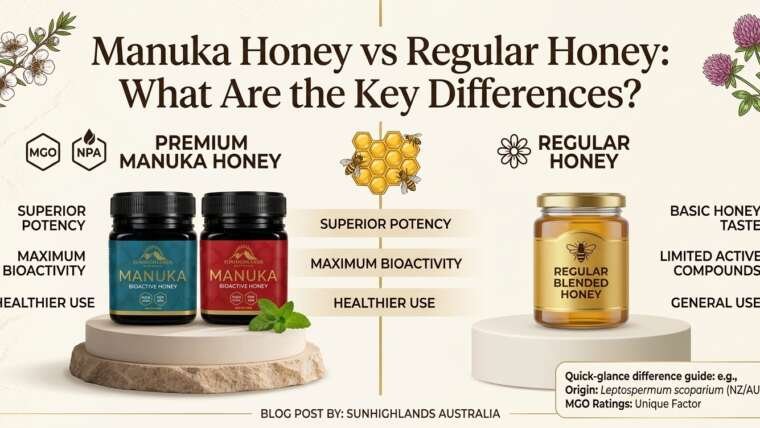
One of the most important differences when considering Manuka honey vs regular honey is the use of an MGO rating.
MGO stands for methylglyoxal, a naturally occurring compound associated with the characteristic activity of Manuka honey. MGO develops from dihydroxyacetone (DHA), which occurs naturally in the nectar of some Leptospermum plants. As the honey matures, DHA can convert into MGO.
MGO can be directly measured through laboratory testing, allowing Manuka honey products to be labelled with numerical ratings such as MGO 100+, MGO 550+ or MGO 850+.
Regular honey is generally not marketed around an MGO grading system in the same way.
Manuka Honey vs Regular Honey: Key Differences
| Feature | Manuka Honey | Regular Honey |
|---|---|---|
| Main floral source | Leptospermum plants | Many different flowering plants |
| MGO rating | Commonly measured and displayed | Usually not a defining label |
| Flavour | Often rich and distinctive | Varies by floral source |
| Origin | Can be Australian or New Zealand depending on product | Produced in many regions |
| Authenticity testing | Specific Manuka criteria are available | Depends on product and supplier |
| Market position | Often sold as a specialty honey | Commonly used as an everyday food |
The differences do not mean that one type is suitable for everyone. They simply reflect different types of honey and different ways of identifying their characteristics.
Why Is MGO Important?
MGO provides a measurable characteristic that helps distinguish Manuka honey from many conventional honeys.
The AMHA uses MGO as a key component of its Australian Manuka honey quality framework. Its authenticity criteria also consider DHA and the Leptospermum source.
For consumers, this means an MGO rating can provide more specific information than broad terms such as “premium” or “active.”
It is important, however, to understand that MGO is a concentration measurement, not a medical dosage.
Does Manuka Honey Taste Different?
Taste is another noticeable difference.
Regular honey can range from delicate and floral to strong and caramel-like, depending on the nectar source. Manuka honey is often recognised for its richer and more distinctive flavour.
Australian Manuka honey can naturally vary in flavour, colour and texture because different Leptospermum species, locations and seasons influence the honey.
This makes Manuka honey appealing to consumers who enjoy specialty foods and want a more distinctive honey experience.
What About Colour and Texture?
Neither colour nor texture can reliably tell you whether honey is genuine Manuka or determine its MGO rating.
Natural honey can vary from pale gold to darker amber. It may also be smooth and fluid or become thicker and crystallised over time.
Crystallisation is a natural process and does not necessarily mean the honey has spoiled.
When comparing Manuka products, laboratory testing and transparent product information are more useful indicators than appearance alone.
Does Manuka Honey Have More MGO Than Regular Honey?
Manuka honey can contain significantly higher levels of MGO than many conventional honeys because its floral source can provide naturally occurring DHA, which can convert to MGO as the honey matures.
However, MGO levels vary naturally, and not every Manuka honey has the same concentration.
This is why products are available at different MGO levels, including MGO 100+, MGO 550+, MGO 850+ and higher.
Why Does Australian Origin Matter?
For Australian consumers, origin can be an important part of choosing Manuka honey.
The AMHA has established criteria specifically for authentic Australian Manuka honey, with qualifying products required to meet defined requirements and undergo independent testing.
The association’s framework is designed to help consumers distinguish genuine Australian Manuka honey from other honey products and reduce the risk of misleading claims.
If Australian origin is important to you, check the country-of-origin information rather than relying only on the word “Manuka” on the front of the jar.
How Is Manuka Honey Tested?
Testing is particularly relevant when buying high-MGO Manuka honey.
MGO can be measured through laboratory analysis, and the AMHA’s quality framework incorporates independent testing and traceability.
When comparing products, look for clear information about:
MGO concentration: What MGO rating is stated?
Testing: Has the MGO level been independently verified?
Origin: Is the honey clearly identified as Australian?
Authenticity: Is there recognised certification or supporting documentation?
These checks can provide a better understanding of the product than price or packaging alone.
How Can You Use Manuka and Regular Honey?
Both types can be used in everyday foods and drinks.
You can add either honey to:
- Toast
- Porridge
- Greek yoghurt
- Fresh fruit
- Smoothies
- Warm drinks
- Homemade recipes
Manuka honey’s distinctive flavour may make it particularly enjoyable when used directly or in simple foods where its taste can stand out.
Regular honey may be a practical everyday choice for cooking and baking, especially when a particular floral character is not important.
Is Manuka Honey Better Than Regular Honey?
There is no universal answer.
Manuka honey has a specialised floral source and can carry a measurable MGO rating, making it different from many conventional honeys. Regular honey, meanwhile, offers a broad range of flavours and floral varieties and can be an excellent everyday sweetener.
The better question is which honey suits your needs?
Consider your preferred flavour, intended use, budget, desired MGO rating and whether Australian origin is important to you.
A Note About Health Claims
Manuka honey is widely discussed because of MGO and its naturally occurring bioactive compounds. However, consumers should distinguish between documented properties and broad marketing claims.
An MGO rating does not mean that honey is a medicine or that a higher number guarantees a specific health effect.
Manuka honey should be considered a food unless a specially manufactured and approved medical honey product is being used for a clinical purpose.
As with all honey, it also contains naturally occurring sugars and should be enjoyed appropriately as part of a balanced diet.
Final Thoughts
Understanding Manuka honey vs regular honey comes down to their floral source, chemical characteristics and how they are identified and tested.
Regular honey can come from many different flowers, while Australian Manuka honey is associated with Leptospermum plants. Manuka honey can also be labelled with an MGO rating, which provides a measurable indication of methylglyoxal concentration.
Neither type needs to be viewed simply as “better.” They are different products suited to different preferences.
For Australian consumers choosing Manuka honey, look beyond the label and consider MGO rating, Australian origin, independent testing, authenticity, flavour and intended use.
Once you understand these differences, comparing Manuka honey with regular honey becomes much easier—and you can select the product that best fits your pantry, preferences and budget.