Industrial Adhesive in India
Industrial manufacturing depends on reliable bonding to produce strong, durable, and high-quality products. Whether the application involves woodworking, furniture, packaging, paper products, footwear, mattresses, or general manufacturing, choosing the right industrial adhesive can significantly affect production efficiency and final product performance.
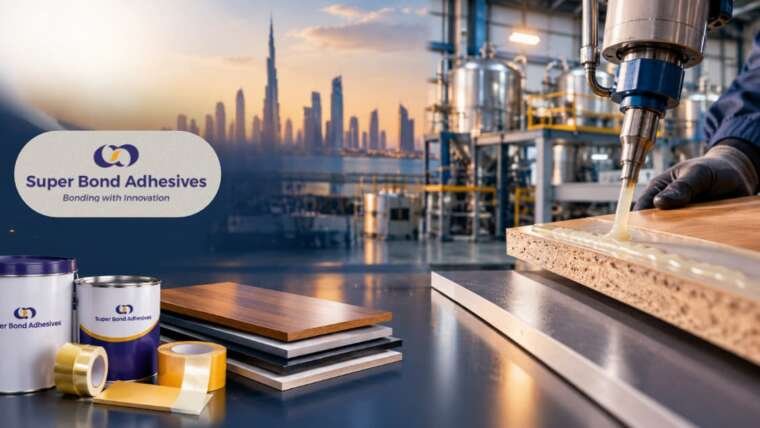
Superbond has been serving the adhesive industry since 1974, providing adhesive solutions for different industrial requirements. With experience across hot melt, water-based, rubber-based, and other adhesive technologies, Superbond focuses on helping manufacturers select appropriate bonding solutions for their applications.
What Is an Industrial Adhesive?
An industrial adhesive is a bonding material specifically designed for manufacturing and commercial applications. Unlike ordinary household glue, industrial adhesives are formulated to meet specific production requirements, such as bonding strength, application speed, setting time, temperature resistance, flexibility, and compatibility with different materials.
Depending on the formulation, industrial adhesives can be used with materials such as:
- Wood and engineered wood
- Paper and cardboard
- Laminates
- Fabrics and textiles
- Leather
- Foam
- Plastics
- Packaging materials
- Other industrial substrates
Because every manufacturing process is different, selecting an industrial adhesive should be based on the materials, production equipment, environmental conditions, and expected performance of the finished product.
Why Is Industrial Adhesive Important?
Adhesives are an important part of modern manufacturing because they allow different materials to be joined efficiently.
A suitable industrial adhesive can provide strong and consistent bonding while supporting efficient production. In certain applications, adhesives can also reduce or complement the need for mechanical joining methods such as screws, staples, or other fasteners.
The benefits depend heavily on selecting the correct adhesive technology. Factors such as bond strength, open time, setting speed, application temperature, viscosity, and substrate compatibility should be evaluated before choosing a product.
Different Types of Industrial Adhesive
There is no universal adhesive suitable for every industrial application. Manufacturers use different adhesive technologies depending on their production requirements.
Hot Melt Adhesive
Hot melt adhesive is widely used in industrial manufacturing. It is typically supplied as a solid material and heated during application. After being applied to the substrate, it develops its bond as it cools.
Hot melt adhesives are particularly useful in applications requiring fast processing. Depending on the specific formulation, they can be used in packaging, woodworking, furniture, bookbinding, mattresses, hygiene products, product assembly, and other manufacturing processes.
The relatively quick setting characteristics of hot melt systems can make them suitable for automated and high-speed production environments.
Water-Based Industrial Adhesive
Water-based adhesives use water as a carrier for the adhesive components. They are widely used for many porous substrates and can be formulated for different industrial requirements.
A water-based industrial adhesive may be suitable for applications involving paper, cardboard, wood, furniture components, packaging, and laminating.
Manufacturers should consider drying conditions, production speed, substrate absorbency, and final bond requirements when selecting a water-based adhesive.
Rubber-Based Adhesive
Rubber-based adhesives are another category used across various industries. Depending on their formulation, these products can provide useful initial tack and bonding characteristics.
They may be suitable for applications involving foam, furniture, mattresses, footwear, leather, laminates, and other materials.
As with any industrial adhesive glue, the exact product should be tested against the intended substrates and production conditions before full-scale use.
Pressure-Sensitive Adhesive
Pressure-sensitive adhesives create adhesion when pressure is applied between the adhesive and substrate.
They are commonly associated with products such as labels, tapes, stickers, protective materials, and self-adhesive products.
Important properties for pressure-sensitive adhesive applications can include initial tack, peel strength, holding power, surface compatibility, and performance under expected environmental conditions.
Industrial Adhesive for Woodworking and Furniture
Woodworking and furniture manufacturing involve many different bonding operations.
An industrial adhesive can be used in applications involving furniture components, laminates, edge-related operations, wood-based panels, and other assembly processes.
Choosing the best solution depends on the type of wood or board, surface condition, production speed, application equipment, required open time, and expected durability.
Superbond provides adhesive solutions across hot melt, water-based, and rubber-based technologies for various woodworking and furniture requirements.
Industrial Adhesive Glue for Packaging
Packaging manufacturers often operate at high production speeds, making reliable adhesive performance particularly important.
Industrial adhesive glue can be used for applications such as carton closing, case sealing, paper bags, boxes, labels, and other packaging products.
Hot melt adhesives are frequently considered for fast-moving packaging lines because suitable formulations can set quickly after application.
However, manufacturers should evaluate the packaging substrate, application temperature, equipment, production speed, and storage conditions before selecting an adhesive.
How to Choose the Right Industrial Adhesive
Selecting an adhesive based only on maximum bond strength can result in an unsuitable choice. The adhesive needs to match the complete manufacturing process.
Important considerations include:
1. Materials being bonded: Determine whether the substrates are wood, paper, plastic, foam, fabric, leather, laminate, or another material.
2. Application method: Consider whether the adhesive will be applied manually or through automated machinery.
3. Open and setting time: Production speed needs to match the working and setting characteristics of the adhesive.
4. Temperature conditions: Consider both manufacturing temperatures and the temperatures the finished product may experience.
5. Environmental exposure: Moisture, humidity, chemicals, and other environmental factors may influence adhesive performance.
6. Final application: The adhesive should meet the strength, flexibility, appearance, and durability requirements of the finished product.
Production trials are recommended because real-world conditions can differ from laboratory or technical specifications.
Choosing an Adhesive Manufacturer in India
When evaluating an adhesive manufacturer in India, businesses should consider more than the number of products offered.
Technical knowledge, product consistency, application understanding, manufacturing experience, and the ability to recommend adhesives for specific requirements can all be important.
Manufacturers working across multiple industries may also require different technologies instead of relying on one type of adhesive for every process.
Superbond: Industrial Adhesive Solutions in India
Superbond has been associated with adhesive manufacturing since 1974. Over the decades, the company has developed adhesive solutions for different industrial applications.
Its adhesive portfolio includes technologies such as hot melt adhesives, water-based adhesives, rubber-based adhesives, and pressure-sensitive solutions for different bonding requirements.
For businesses comparing glue companies in India, the appropriate supplier should ultimately be selected according to the application’s technical and production requirements.
Superbond focuses on understanding these requirements and providing adhesive solutions suited to specific materials and manufacturing processes.
The Future of Industrial Adhesive Technology
Manufacturing is continually evolving toward faster production, automation, new material combinations, and greater efficiency. Adhesive technology must evolve alongside these changes.
Modern industrial adhesive development therefore focuses not only on bond strength but also on processing efficiency, application consistency, compatibility with production equipment, and performance throughout a product’s intended life.
Choosing the correct adhesive technology can help manufacturers achieve reliable bonding while maintaining efficient production.
Conclusion
An industrial adhesive is much more than a simple bonding material. It can be an important component of the manufacturing process, influencing product strength, production speed, appearance, and overall quality.
From hot melt adhesive and water-based systems to rubber-based and pressure-sensitive technologies, different applications require different bonding solutions.
For manufacturers searching for reliable industrial adhesive solutions in India, Superbond brings decades of experience to a wide range of bonding applications. Understanding the substrates, production process, environmental conditions, and end-use requirements is the key to selecting the right adhesive and achieving consistent results.