
Ask any architecture graduate about their final-year project and you’ll get twenty minutes of pure enthusiasm. Ask them to squeeze it into three lines on a CV and the words disappear.
That gap is where good applications quietly die. The drawings are strong. The thinking is sound. But whoever is working through forty applications on a Tuesday afternoon never sees any of it, unless the CV explains it.
Ten years in UK practice taught me shortlists are rarely lost on talent. They’re lost on vagueness.
This guide is for students, recent graduates and early-career assistants going for UK roles, from Part 1 placements to Part 2 positions. Let’s fix the vagueness.
1. Your CV Gets Skimmed Before It Gets Read
In most studios, the first look takes seconds. The reader checks three things: your stage (Part 1 or Part 2), your software, and whether your portfolio opens without a fight.
So the top third of page one does the heavy lifting. Put your degree, qualification stage, graduation date and portfolio link where the eye lands. A link buried in the footer gets missed.
Keep the profile to three lines. “Part 1 graduate drawn to housing, confident producing Revit drawing sets and physical models” tells a reader far more than “passionate and hardworking designer”.
Try the six-second test. Print your CV, hold it at arm’s length and look at it for six seconds. Whatever you can still read is what a busy reader will take in. If it isn’t your name, stage and portfolio link, rework the top.
2. Describe Decisions, Not Just Projects
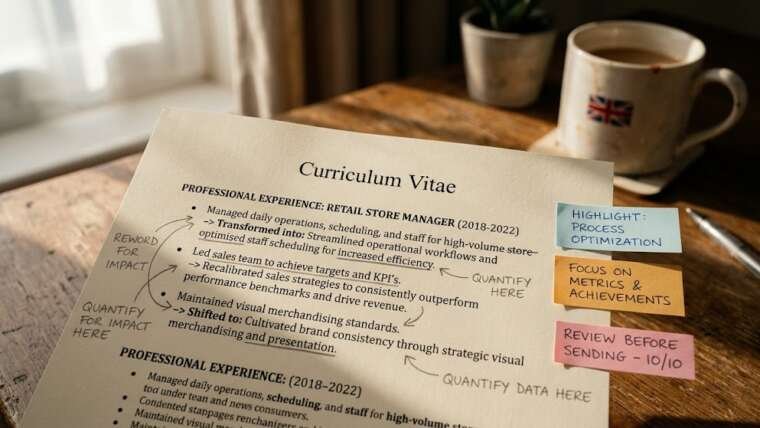
Plenty of people type UK Best Architecture CV Writing Services into Google hoping someone else will solve this. A good editor can tighten your sentences, but only you know why you moved that wall. That reasoning is the thing worth writing down.
A project title tells the reader what you drew. A decision tells them how you think, and that is what a practice is really hiring.
Use one pattern for every entry: problem, decision, evidence. What was the issue, what did you choose, and what did you produce to prove it?
A weak entry looks like this:
“Final-year housing project on a brownfield site.”
The same project, written properly:
“Designed 24 low-rise homes on a sloping brownfield site. Arranged the layout around a shared courtyard after daylight studies showed overshadowing, then produced plans, sections and a Revit model.”
Same project, same grade. The second version shows research, judgement and output in two sentences.
Numbers help too: unit counts, site areas, team sizes. They make work feel built rather than merely described.
Name the RIBA Plan of Work stage. This is the UK detail most CVs miss. Say your scheme reached Stage 2 (concept design) or Stage 3 (spatial coordination). It costs a few words and tells a practice you already speak their language.
Heading for Part 2? Tie one decision to planning policy, structure or materials. Practices want proof you understand how buildings actually get built.
3. Software: Show What You Can Produce
Software causes more second-guessing than anything else. Some students list every programme they’ve ever opened. Others apologise for what they lack.
Both miss the point. A line reading “AutoCAD, Revit, Rhino, SketchUp, Photoshop” doesn’t say how you use any of them.
Group your tools by what they produced:
- Drawing: AutoCAD for plans, sections and construction details
- Modelling: Revit for a coordinated model of your final scheme, Rhino for form studies
- Presentation: Photoshop and InDesign for boards and portfolio layout
Then add an honest level beside each: confident, working knowledge or still learning.
Revit is where precision pays. Call yourself advanced and you invite questions about sheet setup, view organisation and model management. Plenty of candidates with lovely portfolios go quiet at exactly that point.
If your experience is still growing, say so. A clear account of what you can produce beats a label you can’t support. Add hand sketching and model-making too, because many studios still value them.
4. Make Your Portfolio Back Up Your CV
Add a portfolio page reference to every project entry. Something like “See portfolio, pp. 6–11” takes seconds and sends the reader to the work instead of through a thirty-page PDF.
The pages you point to must support your claims. If the CV mentions environmental analysis, show a sun-path study. If it mentions technical drawing, show plans, sections or details.
Don’t lean only on polished renders. They show how the building looks. Sketches, alternative layouts and site analysis show how you got there, and that is what practices want to see.
Group projects need care. State which parts you researched, developed or drew, so nobody assumes everything was yours.
Finally, keep titles and dates identical in both documents. Name the file properly, such as Firstname-Surname-CV.pdf, keep it under about 5MB, and test the link on a phone and a laptop.
5. Work Experience When You Have Little
No placement yet? That’s completely normal, and it is not a dead end.
Look at what you’ve actually done. Group studio work meant deadlines, disagreements and critique, which is closer to office life than most people realise. Weekend retail or hospitality shifts show you stay calm with the public.
Add anything that took you out of the studio: volunteering, a measured survey, a competition entry. One honest line is enough.
Accuracy matters most. “Led the site research and produced the layout drawings” beats “worked on a team project”, because it tells the reader what you can be trusted with.
6. Mistakes That Quietly Cost Interviews
Sending one CV to every practice. A housing-led studio and a technical office want different emphasis. Move the most relevant project to the top, and borrow the language from their own website.
Claiming group work as solo work. Expect follow-up questions and be ready to explain exactly what you contributed.
Dressing coursework up as a commission. University projects are valuable as they are. Nobody expects you to have built a hospital.
Over-designing the layout. Tiny text and heavy graphics hide the information. Two clean pages is a sensible target.
Skipping the proofread. Typos stand out in a profession built on careful drawings. Read it aloud, then ask a friend to read it too.
7. Bringing It Together
A strong architecture CV explains the thinking between the brief and the final drawing. It chooses projects that show different strengths, describes software by what you produced and points to a portfolio that backs up every claim.
You don’t need to look like a finished architect. You need to look like someone worth investing in.
So give yourself one evening. Rewrite your three main projects using problem, decision, evidence. Add the page numbers. Check the top third. It’s a small job, and it can change how your whole application gets read.
A good CV doesn’t prove you’re finished. It proves you’ll learn fast and contribute early.