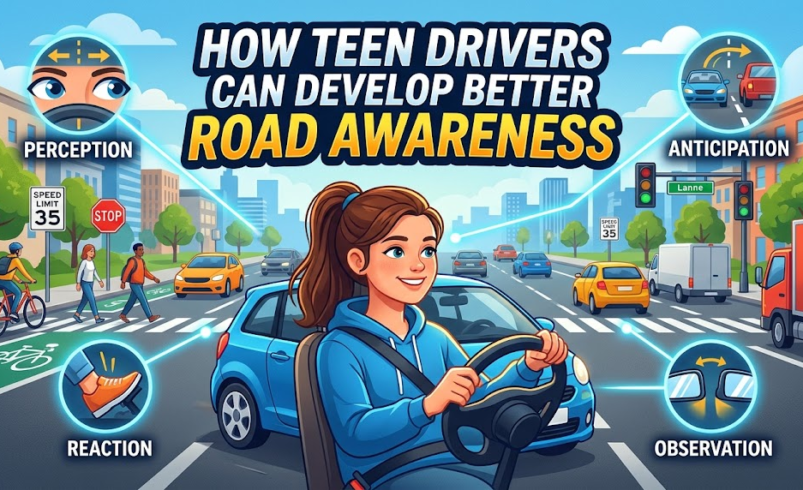

Learning to drive is about much more than controlling a steering wheel, pressing the accelerator, or remembering traffic signs. One of the most important skills a new driver can develop is road awareness. It helps drivers understand what is happening around them, recognize potential hazards, and make safer decisions before situations become dangerous. For teenagers who are still gaining experience behind the wheel, developing this skill can make a significant difference in their confidence and safety.
For young drivers, building road awareness takes time, patience, and regular practice. Enrolling in professional Teen driver training Vancouver can help teenagers understand how to observe traffic conditions, anticipate other road users’ actions, and respond calmly to unexpected situations. With proper guidance and consistent driving experience, teens can gradually become more observant, responsible, and prepared for different road conditions.
What Is Road Awareness and Why Does It Matter?
Road awareness is the ability to understand and respond to everything happening around a vehicle. It involves observing other drivers, pedestrians, cyclists, road signs, traffic signals, weather conditions, and potential hazards.
A driver with good road awareness does not focus only on the vehicle directly ahead. Instead, they regularly check their surroundings and think about what might happen next.
For example, when approaching an intersection, an aware driver looks for pedestrians preparing to cross, vehicles approaching from side streets, cyclists, and changing traffic signals. These observations help the driver make informed decisions rather than reacting at the last moment.
For teenage drivers, road awareness is particularly important because they may not have experienced many different traffic situations. Developing this skill early helps establish safe driving habits that can last a lifetime.
1. Develop the Habit of Scanning the Road
One of the easiest ways to improve road awareness is to stop focusing on just one area of the road.
New drivers sometimes concentrate too heavily on the vehicle directly in front of them. Although maintaining a safe following distance is essential, drivers also need to understand what is happening farther ahead and around their vehicle.
Look Beyond the Vehicle Ahead
Teen drivers should develop the habit of looking farther down the road whenever conditions allow. This provides more time to recognize changing traffic patterns, slowing vehicles, road construction, and potential obstacles.
For example, if several vehicles ahead begin slowing down, noticing this early allows a driver to reduce speed smoothly instead of braking suddenly.
Check Mirrors Regularly
Mirrors help drivers understand what is happening behind and beside their vehicles. Teenagers should learn to check their rear-view and side mirrors regularly, particularly before changing lanes, slowing down, turning, or merging.
However, mirror checks should be brief. Drivers must avoid staring at mirrors for too long because their primary attention needs to remain on the road ahead.
2. Learn to Anticipate Other Road Users
Good road awareness is not just about seeing what is happening. It also involves predicting what other people might do next.
Other drivers, pedestrians, cyclists, and motorcyclists do not always behave exactly as expected. A vehicle might suddenly change lanes, a pedestrian might step onto the road, or a cyclist might move around a parked car.
Teenagers should learn to recognize situations where someone else’s actions could create a potential hazard.
Watch for Early Warning Signs
Small details can provide important clues about what another road user might do.
For example:
- A vehicle slowing near an intersection may be preparing to turn.
- A pedestrian looking toward the road may be considering crossing.
- A cyclist moving away from parked cars may be avoiding a vehicle door.
- A vehicle drifting toward a lane marking may be preparing to change lanes.
- A driver approaching a parking space may suddenly slow down.
Recognizing these signs gives teenage drivers more time to adjust their speed, maintain distance, or prepare to stop.
Never Assume Other Drivers Will Follow the Rules
Even when a driver has the right of way, they should remain alert. Another road user might misunderstand a traffic signal, fail to yield, or make an unexpected movement.
Teaching teens to expect the possibility of mistakes helps them avoid unnecessary risks.
3. Understand and Recognize Blind Spots
Blind spots are areas around a vehicle that cannot be fully seen through mirrors. They are particularly important when changing lanes, merging, or turning.
Teen drivers sometimes assume that checking their mirrors is enough to confirm whether another vehicle is nearby. However, motorcycles, bicycles, and smaller vehicles can remain hidden in certain areas.
Practice Shoulder Checks
Before changing lanes or merging, drivers should:
- Check the relevant side mirror.
- Signal their intention early enough.
- Perform a quick shoulder check to observe the blind spot.
- Confirm that there is enough space.
- Move gradually when it is safe.
These steps should become a natural part of driving rather than something performed only during a driving test.
Be Aware of Your Own Blind Spots
Teenagers should also understand that larger vehicles, such as trucks and buses, have substantial blind spots.
Avoid driving too close to these vehicles or remaining alongside them for extended periods. Giving larger vehicles sufficient space makes it easier for their drivers to see surrounding traffic and reduces unnecessary risks.
4. Minimize Distractions While Driving
Distractions are one of the biggest obstacles to developing strong road awareness. A driver may be looking straight ahead but still fail to notice important information because their attention is somewhere else.
For teenage drivers, common distractions include mobile phones, passengers, music, food, and conversations.
Even a brief distraction can cause a driver to miss a changing traffic signal, a pedestrian entering a crosswalk, or a vehicle braking ahead.
Keep Mobile Phones Out of Reach
Teenagers should put their phones away before starting the vehicle. Notifications, messages, and incoming calls can wait until the car is safely parked.
If navigation is necessary, the route should be set before driving begins. Drivers should never attempt to adjust their phones while the vehicle is moving.
Manage Passenger Distractions
Friends can make driving more enjoyable, but conversations and excitement can sometimes affect concentration.
Teen drivers should understand that being responsible for passengers means keeping their attention on the road. It is perfectly reasonable to ask passengers to lower their voices or avoid distracting behaviour.
5. Pay Attention to Road Signs and Traffic Signals
Road signs provide important information about speed limits, upcoming hazards, lane restrictions, pedestrian crossings, and road conditions.
Teenagers who understand these signs can prepare for changing situations instead of making sudden decisions.
Recognize Important Warning Signs
Warning signs alert drivers to possible hazards ahead. These may include sharp turns, slippery roads, school zones, pedestrian crossings, and merging traffic.
Learning to recognize these signs early helps drivers adjust their speed and positioning before reaching the affected area.
Follow Speed Limits and Road Markings
Speed limits are designed to help drivers travel at appropriate speeds under specific road conditions. However, teenagers should also understand that the posted speed limit is not always the safest speed in every situation.
Rain, snow, poor visibility, heavy traffic, and road construction may require slower driving.
Road markings also provide useful guidance. Solid lines, broken lines, turning arrows, and pedestrian crossing markings all communicate important information about how drivers should position and move their vehicles.
6. Adjust Driving Habits to Weather and Road Conditions
Road awareness becomes even more important when driving conditions change.
A road that feels easy to navigate in clear weather may become challenging during heavy rain, fog, or snowfall. New drivers need to understand that vehicle control and stopping distances can change depending on the environment.
Driving in Rain
Wet roads reduce tyre grip and can increase stopping distances. Teenagers should reduce their speed, leave additional following distance, and avoid sudden braking or sharp steering movements.
They should also watch for standing water, slippery road markings, and reduced visibility.
Driving in Fog
Fog makes it difficult to judge distances and identify other vehicles. Drivers should slow down, use appropriate headlights, and increase their following distance.
High-beam headlights should generally be avoided in dense fog because the light can reflect off the fog and make visibility worse.
Driving in Snow and Ice
Snow and ice can make roads extremely slippery. Teenagers should avoid sudden acceleration, harsh braking, and sharp turns.
If conditions become too dangerous for their experience level, finding a safe place to stop and waiting for conditions to improve may be the best decision.
7. Practice Defensive Driving Techniques
Defensive driving is closely connected to road awareness. It involves identifying possible risks, maintaining safe distances, and making decisions that reduce the likelihood of collisions.
Teen drivers should learn that safe driving is not about reacting aggressively or proving their abilities. It is about staying prepared and making sensible choices.
Maintain a Safe Following Distance
Following too closely reduces the time available to respond when the vehicle ahead suddenly slows down.
A useful starting point is the three-second following rule in favourable conditions. Choose a fixed roadside object and count the time between the vehicle ahead passing it and your vehicle reaching the same point.
Increase this distance when driving in rain, snow, poor visibility, or heavy traffic.
Keep an Escape Space
Whenever possible, teenagers should avoid positioning their vehicles where there is no room to respond to changing traffic conditions.
For example, leaving enough space ahead while stopped in traffic can provide more flexibility if the vehicle in front experiences a problem.
Keeping a safe distance from other road users also reduces pressure and allows smoother decisions.
8. Improve Awareness Through Regular Driving Practice
Road awareness develops through experience. Reading driving guides and watching educational videos can introduce important concepts, but practical experience is necessary to apply them confidently.
Teenagers should practise in different environments while receiving appropriate supervision.
Start With Less Busy Roads
New drivers can begin practising on quieter roads where traffic conditions are easier to manage.
This allows them to concentrate on steering, speed control, mirror checks, road signs, and surrounding traffic without feeling overwhelmed.
As their confidence improves, they can gradually practise in busier areas, at intersections, on multi-lane roads, and in other challenging environments.
Practise Different Driving Situations
A well-rounded learning experience should include exposure to different road conditions, such as:
- Residential streets with parked vehicles.
- Busy intersections with multiple traffic movements.
- Roads with cyclists and pedestrian crossings.
- Multi-lane roads with changing traffic patterns.
- Parking areas with vehicles entering and leaving.
- Highways and merging lanes when appropriate.
Practising these situations under suitable supervision helps teenagers understand how road awareness applies in real life.
9. Learn From Driving Mistakes Without Losing Confidence
Every new driver makes mistakes while learning. A teenager might overlook a road sign, forget to check a mirror, or misjudge the movement of another vehicle.
The important thing is to recognize these mistakes and learn from them.
Instead of becoming frustrated, young drivers should think about what happened, why it happened, and what they could do differently next time.
For example, if a teenager fails to notice a vehicle approaching from behind, they can make mirror checks a stronger part of their driving routine.
Parents and instructors can also help by providing calm, constructive feedback. Criticism or shouting may increase stress and make it harder for teenagers to concentrate.
A supportive learning environment encourages questions, honest discussions, and steady improvement.
10. Build Good Observation Habits Before Every Journey
Road awareness should begin before the vehicle starts moving. A few simple preparations can help teenage drivers feel more organized and ready to drive.
Before setting off, they should:
- Adjust their seat and steering wheel.
- Position the rear-view and side mirrors correctly.
- Fasten their seat belt.
- Check that passengers are wearing seat belts.
- Set navigation and audio controls.
- Remove unnecessary distractions.
- Become familiar with the planned route.
These habits reduce avoidable distractions and allow drivers to focus on the road once the journey begins.
It is also helpful to check weather conditions and consider whether the planned route involves unfamiliar roads, heavy traffic, or challenging driving environments.
Why Parents and Driving Instructors Play an Important Role
Teenagers benefit from consistent guidance while developing road awareness. Parents and professional instructors can help them understand situations that may not be obvious to inexperienced drivers.
However, effective instruction requires more than simply telling teenagers what to do.
Parents and instructors should explain why certain actions matter. For example, instead of only reminding a teenager to check their mirrors, they can explain how mirror checks help identify vehicles approaching from behind.
Asking questions can also encourage independent thinking.
Useful questions include:
- What potential hazards can you see ahead?
- Why is that vehicle slowing down?
- Is there anyone approaching the pedestrian crossing?
- What would you do if the vehicle ahead suddenly stopped?
- Is there enough space to change lanes safely?
These questions encourage teenagers to observe, analyze, and make decisions rather than simply follow instructions.
Conclusion
Developing better road awareness is an essential part of becoming a safe and responsible driver. Teenagers need to learn how to scan their surroundings, recognize potential hazards, anticipate other road users’ actions, manage distractions, and adjust to changing road conditions. These skills become stronger through consistent practice, patience, and constructive guidance.
Parents can support this development by encouraging safe driving habits and creating opportunities for supervised practice. Professional instruction also helps young drivers understand real-world traffic situations and build confidence through structured learning. With the right guidance from Benche Driving School, teen drivers can continue improving their observation skills, making safer decisions, and developing the awareness they need for a lifetime of responsible driving.