

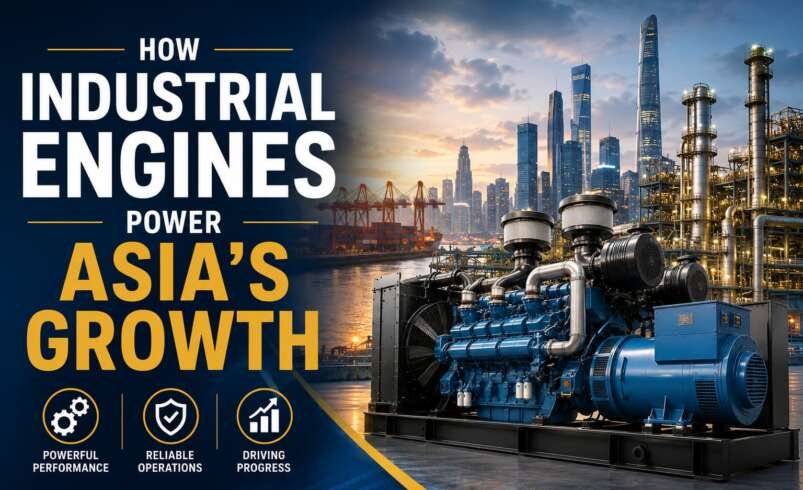

Industrial engines are essential across Asia’s construction, mining, agriculture, manufacturing, power generation, marine, oil and gas, logistics, and infrastructure sectors. They provide mechanical power for machines, pumps, compressors, generators, cranes, excavators, tractors, drilling equipment, and other heavy-duty systems. As industrial activity expands across the region, dependable engines remain important for productivity, mobility, backup power, and equipment performance.
A published study by MarkNtel Advisors reports that the Asia industrial engines sector was valued at around USD 20.21 billion in 2025. It is projected to expand from USD 22.56 billion in 2026 to USD 35.25 billion by 2032, registering a CAGR of around 7.72% during 2026–32. This growth reflects demand from construction equipment, industrial machinery, agriculture, mining, marine applications, and distributed power systems.
Construction Equipment Drives Demand
Construction remains one of the strongest demand areas for industrial engines in Asia. Excavators, loaders, compactors, cranes, concrete equipment, road-building machines, and dewatering pumps all require reliable engine power. As countries invest in roads, bridges, housing, ports, rail, airports, and industrial parks, engine demand rises with heavy equipment deployment.
Project sites often operate in dusty, hot, remote, or high-load conditions. Engines used in these environments must deliver durability, torque, fuel efficiency, and easy serviceability. This makes robust engine design and strong dealer support important for contractors and equipment owners.
Agriculture Needs Reliable Power
Agriculture also supports industrial engine demand across Asia. Tractors, harvesters, irrigation pumps, threshers, sprayers, and small utility equipment depend on engine systems for daily operations. Farmers and agri-businesses need engines that can perform under long working hours and varied field conditions.
In rural areas, engine reliability is especially important because equipment downtime can affect planting, harvesting, and irrigation schedules. Easy maintenance, spare parts availability, fuel efficiency, and simple operation remain key purchase factors for agricultural users.
Mining and Materials Handling Expand Use
Mining, quarrying, and materials handling require engines that can work under heavy load and continuous duty cycles. Haul trucks, drilling rigs, crushers, loaders, conveyors, and compressors use industrial engines to support extraction and processing activity. These operations need high torque, strong cooling systems, and dependable performance.
Engine failure in mining can interrupt production and raise operating costs. Therefore, operators often value preventive maintenance, telematics, engine monitoring, and service contracts. Suppliers that provide lifecycle support can build stronger relationships with mining and industrial customers.
Emission Standards Shape Technology
Emission control is becoming more important for industrial engines, especially in urban construction, ports, industrial zones, and regulated equipment categories. Manufacturers are improving combustion systems, after-treatment, electronic controls, and fuel management to reduce pollutants while maintaining performance.
The U.S. Environmental Protection Agency explains that nonroad engines are used in many applications and that emission standards apply to nonroad engines and equipment. This regulatory context shows why cleaner engine technologies are becoming important in heavy-duty industrial applications.
Power Generation Supports Growth
Industrial engines are widely used in generator sets for backup, standby, and prime power. Factories, hospitals, data centers, telecom sites, commercial buildings, construction camps, and remote facilities use engine-driven generators to maintain operations during outages or where grid access is limited.
In Asia, rapid urbanization and industrial growth increase demand for reliable power support. Generator engines must provide quick start-up, stable output, fuel efficiency, and long operating life. This creates demand for engines designed for dependable performance in critical applications.
Marine and Port Applications Matter
Marine vessels, fishing boats, inland water transport, port equipment, and offshore support systems also use industrial engines. These engines must operate reliably in demanding environments where saltwater exposure, vibration, load variation, and continuous operation are common.
Ports across Asia are expanding to support trade, logistics, and manufacturing supply chains. This increases the need for engines in cranes, reach stackers, terminal tractors, pumps, and auxiliary power systems. Strong service networks are important because port equipment must maintain high uptime.
Energy Efficiency Becomes Important
Energy efficiency is a growing priority because fuel costs influence the operating economics of engine-powered equipment. Better combustion, electronic fuel injection, turbocharging, cooling design, and digital controls can help improve performance and reduce fuel use.
The International Energy Agency notes that upgrading industrial systems is important for efficiency, and its industry energy efficiency analysis highlights industrial efficiency as a key area for improvement. This broader efficiency focus supports demand for engines that can deliver more output with better fuel performance.
Digital Monitoring Improves Uptime
Digital monitoring is becoming more common in industrial engines. Sensors can track temperature, pressure, fuel use, vibration, oil condition, load, and service intervals. This data helps operators detect problems early, schedule maintenance, and reduce unexpected breakdowns.
Telematics also supports fleet management. Construction companies, mines, rental firms, and industrial operators can monitor engine performance across multiple machines. This improves equipment planning, maintenance budgeting, and asset utilization.
Outlook for Industrial Engines
Asia’s industrial engines sector is expected to grow steadily through 2032, supported by construction activity, agricultural mechanization, mining operations, backup power needs, marine applications, and industrial expansion. Engines will remain essential wherever equipment requires dependable mechanical or electrical power.
Future growth will depend on fuel efficiency, emission compliance, durability, digital monitoring, spare parts access, and service support. Companies that combine rugged engine technology with lifecycle maintenance, cleaner performance, and strong regional distribution will remain important in Asia’s industrial engines sector.