
Global Antacids Market Size and Forecast
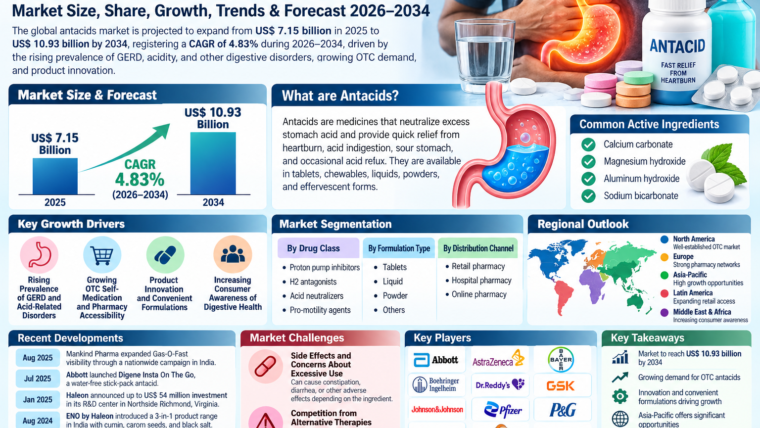
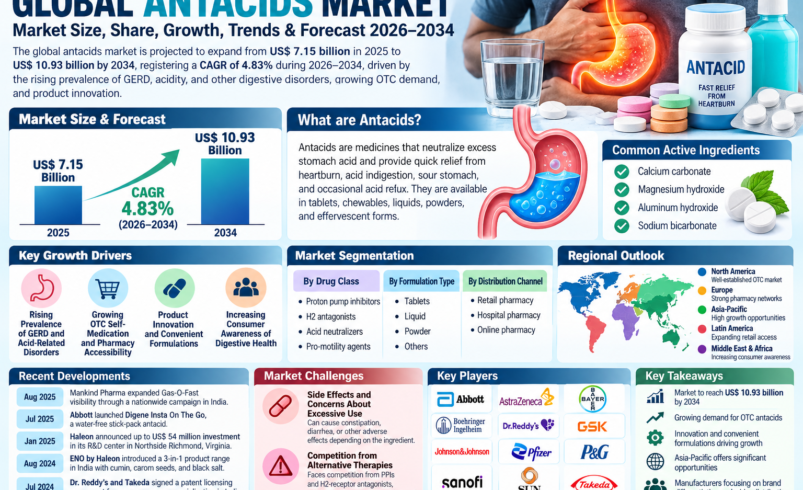
The global antacids market is projected to grow from US$ 7.15 billion in 2025 to US$ 10.93 billion by 2034, registering a compound annual growth rate (CAGR) of 4.83% during 2026–2034. Market expansion is driven by the increasing prevalence of heartburn, acidity, gastroesophageal reflux disease (GERD), and other acid-related digestive disorders. Rising consumer preference for over-the-counter (OTC) medicines, wider pharmacy accessibility, and innovations in convenient formulations are further supporting demand worldwide.
Antacids remain an important category of consumer healthcare products because they offer relatively rapid, short-term relief from occasional heartburn, acid indigestion, and sour stomach. Their availability in chewable tablets, liquids, powders, and other convenient formats supports adoption across different consumer groups.
As healthcare awareness increases and digital pharmacy channels expand, manufacturers are focusing on improved formulations, attractive packaging, and broader distribution. However, competition from alternative acid-reducing therapies and concerns about inappropriate long-term use remain important industry challenges.
What Are Antacids and Why Are They Popular Worldwide?
Antacids are medicines that neutralize excess stomach acid to relieve symptoms such as heartburn, acid indigestion, sour stomach, and occasional acid reflux. Common active ingredients include calcium carbonate, magnesium hydroxide, aluminum hydroxide, and sodium bicarbonate.
These products are available in several dosage forms, including tablets, chewable tablets, liquids, suspensions, powders, and effervescent preparations. Their accessibility and ease of use make them popular options for managing occasional digestive discomfort.
The growing global burden of GERD provides an important demand foundation. Global GERD cases increased from approximately 450.8 million in 1990 to 825.6 million in 2021, representing an increase of more than 83%.
Consumers increasingly seek convenient digestive-health products through retail pharmacies, supermarkets, and online pharmacies. Manufacturers are responding with flavored liquids, fast-dissolving tablets, portable sachets, and differentiated product combinations.
Nevertheless, antacids are primarily intended for short-term symptom relief. Persistent or severe symptoms may require professional medical evaluation rather than repeated self-medication.
Key Growth Drivers of the Antacids Market
1. Increasing Prevalence of GERD and Acid-Related Disorders
The rising prevalence of GERD, heartburn, acid reflux, and indigestion is one of the major factors supporting the global antacids market. Changing dietary habits, irregular meals, consumption of processed and fast foods, obesity, stress, and sedentary lifestyles can contribute to acid-related digestive symptoms.
According to the statistics presented in the market research, approximately 825.6 million people worldwide experienced GERD in 2021, compared with around 450.8 million in 1990. The condition also accounted for approximately 6.34 million disability-adjusted life years (DALYs) in 2021.
This growing disease burden creates opportunities for manufacturers to develop convenient products that address occasional acidity and heartburn. Consumer demand for accessible symptom-relief options is expected to support market growth throughout the forecast period.
2. Growing OTC Self-Medication and Pharmacy Accessibility
The increasing preference for self-care is another significant growth driver. Consumers can purchase many antacid products without a prescription, making them accessible for occasional digestive discomfort.
Retail pharmacies remain important because they provide convenient product availability and opportunities for pharmacist guidance. Supermarkets and convenience stores also contribute to product accessibility, while e-commerce platforms allow consumers to compare brands, prices, ingredients, and dosage forms.
Manufacturers are strengthening distribution networks, improving packaging, and expanding their OTC portfolios to reach consumers across developed and emerging economies.
The combination of accessibility, product variety, and growing awareness of digestive health is expected to support the continued expansion of the antacids market.
3. Product Innovation and Convenient Formulations
Product innovation is helping manufacturers differentiate their offerings in an established consumer healthcare category.
Chewable tablets provide portability, while liquids offer an alternative for consumers who have difficulty swallowing conventional tablets. Powder formulations and single-dose sachets support convenient administration, particularly for consumers seeking portable products.
Flavors, packaging improvements, and fast-dissolving formats are also becoming important product-development priorities. These features can improve the consumer experience and strengthen brand differentiation.
Companies are additionally exploring combination formulations and alternative ingredient profiles to address changing consumer preferences. Continued investment in formulation convenience, product presentation, and digital distribution is expected to support market competitiveness.
Major Challenges Facing the Antacids Market
Side Effects and Concerns About Excessive Use
Although antacids are widely used for occasional symptoms, excessive consumption and inappropriate long-term use can cause adverse effects depending on the active ingredient.
Calcium-based products may contribute to constipation and excessive calcium intake. Magnesium-containing formulations can cause diarrhea, while aluminum-containing products may cause constipation. Certain products can also create additional concerns for individuals with underlying medical conditions.
Clear labeling, appropriate dosage instructions, and consumer education are therefore important for manufacturers. Consumers experiencing frequent or persistent heartburn should seek professional medical advice instead of relying indefinitely on self-medication.
Competition from Alternative Acid-Reducing Therapies
The antacids market faces competition from proton pump inhibitors (PPIs) and H2-receptor antagonists. These medicines reduce stomach-acid production and may provide longer-lasting acid control for appropriate patients.
Conventional antacids primarily neutralize existing stomach acid and generally offer short-term relief. As a result, consumers with recurrent symptoms may require different treatments under professional guidance.
Manufacturers must compete through affordability, convenience, flavor, formulation, and product differentiation. Clear communication about appropriate product use will also remain important for maintaining consumer confidence.
Antacids Market Trends and Recent Developments
Innovation, convenient product formats, and consumer-focused branding are shaping the competitive landscape.
- August 2025 – Mankind Pharma: The company expanded the visibility of Gas-O-Fast through a nationwide Independence Day promotional campaign in India.
- July 2025 – Abbott: Abbott introduced Digene Insta On The Go, a water-free stick-pack antacid designed for convenient use and marketed for rapid relief.
- January 2025 – Haleon: Haleon announced plans to invest up to US$ 54 million in upgrading its research and development center in Northside Richmond, Virginia, supporting innovation across its consumer healthcare portfolio.
- August 2024 – ENO by Haleon: ENO introduced a 3-in-1 product range in India featuring variants incorporating ingredients such as cumin, carom seeds, and black salt.
- July 2024 – Dr. Reddy’s Laboratories and Takeda: The companies entered into a non-exclusive patent licensing agreement for vonoprazan commercialization in India, strengthening Dr. Reddy’s presence in the gastrointestinal treatment segment.
These developments highlight the importance of consumer engagement, product convenience, and continued investment in digestive-health innovation.
Antacids Market Segmentation Analysis
The market can be analyzed by drug class, formulation type, and distribution channel.
By Drug Class
- Proton pump inhibitors
- H2 antagonists
- Acid neutralizers
- Pro-motility agents
Acid neutralizers represent the conventional antacid category, while the other listed classes belong to the broader acid-related treatment landscape used in the report’s segmentation framework.
By Formulation Type
- Tablets
- Liquid
- Powder
- Others
Tablets offer portability and convenience, while liquids provide an alternative for consumers who prefer products that are easier to swallow. Powders remain relevant because of their flexible administration, rapid dissolution, and availability in portable sachets.
By Distribution Channel
- Retail pharmacy
- Hospital pharmacy
- Online pharmacy
Retail pharmacies benefit from widespread accessibility and pharmacist guidance. Online pharmacies are gaining relevance as consumers increasingly use digital platforms to compare products and access home delivery.
One market assessment cited in the source estimates that retail pharmacies accounted for approximately 72.2% of global antacid sales in 2025.
Regional Outlook of the Global Antacids Market
North America
The North American market benefits from established retail pharmacy networks, broad OTC product availability, and consumer awareness of digestive-health treatments. The United States and Canada are key markets, with demand supported by the availability of tablets, liquids, powders, and chewable formulations.
Europe
European demand is supported by pharmacy accessibility, consumer awareness, and the availability of established digestive-health brands. The market assessment covers the United Kingdom, Germany, France, Italy, Spain, Belgium, the Netherlands, and Turkey.
Asia-Pacific
Asia-Pacific offers opportunities associated with its large consumer base, expanding pharmacy networks, and demand for affordable digestive-health products.
India is an important market for OTC antacids, supported by widespread product availability, varied consumer preferences, and competition among local, regional, and international brands. China, Japan, Australia, South Korea, Thailand, Malaysia, Indonesia, and New Zealand are also included in the report’s geographical coverage.
Latin America
Brazil, Mexico, and Argentina form part of the report’s Latin American coverage. Pharmacy accessibility, product affordability, and distribution development are relevant factors to monitor across the region.
Middle East and Africa
Saudi Arabia, the United Arab Emirates, and South Africa are included in the market assessment. Demand opportunities are associated with access to OTC digestive-health products, consumer awareness, and the development of modern healthcare retail channels.
Competitive Landscape and Key Companies
Competition in the global antacids market is shaped by brand recognition, pricing, formulation innovation, distribution reach, and consumer trust.
Major companies covered in the market assessment include:
- Abbott Laboratories
- AstraZeneca plc
- Bayer AG
- Boehringer Ingelheim International GmbH
- Dr. Reddy’s Laboratories Ltd.
- GlaxoSmithKline plc
- Johnson & Johnson
- Pfizer Inc.
- Procter & Gamble Company
- Sanofi S.A.
- Sun Pharmaceutical Industries Ltd.
- Takeda Pharmaceutical Company Limited
The report evaluates these companies through five viewpoints: company overview, key personnel, recent developments, SWOT analysis, and revenue analysis.
Manufacturers are expected to continue emphasizing product differentiation, convenient packaging, retail visibility, and digital distribution to strengthen their market positions.
Future Outlook for the Antacids Market
The global antacids market is expected to maintain steady growth through 2034, supported by the increasing burden of acid-related digestive disorders and continued consumer demand for accessible OTC symptom-relief products.
Convenient dosage forms, improved flavors, portable packaging, and wider online pharmacy access are likely to remain important areas of competition. At the same time, manufacturers must address safety concerns through clear instructions and responsible product positioning.
Companies that combine consumer-focused innovation with strong distribution networks and effective brand communication will be better positioned to compete in this evolving market.
For businesses, investors, healthcare companies, and product manufacturers, understanding changing consumer preferences and regional demand patterns will remain essential to evaluating future opportunities.
Frequently Asked Questions (FAQs)
1. What is the global antacids market size?
The global antacids market is projected to reach US$ 10.93 billion by 2034, increasing from US$ 7.15 billion in 2025.
2. What is the expected CAGR of the antacids market?
The market is forecast to register a CAGR of 4.83% during 2026–2034.
3. What are the major factors driving antacids market growth?
Key factors include the increasing prevalence of GERD and heartburn, growing demand for OTC medicines, improved pharmacy accessibility, product innovation, and the expansion of online pharmacy channels.
4. Which formulations are included in the antacids market?
The main formulation categories covered in the report are tablets, liquids, powders, and other formulations.
5. Which distribution channels are important for antacid sales?
Retail pharmacies, hospital pharmacies, and online pharmacies are the principal distribution channels identified in the market segmentation.
6. What challenges affect the antacids market?
Important challenges include potential side effects from excessive or inappropriate use and competition from alternative acid-reducing therapies, including PPIs and H2-receptor antagonists.
7. Which companies are covered in the global antacids market report?
Major companies include Abbott Laboratories, Bayer AG, Dr. Reddy’s Laboratories, GlaxoSmithKline, Pfizer, Sanofi, Sun Pharmaceutical Industries, Takeda Pharmaceutical Company, and other industry participants.
8. What is the outlook for the antacids market through 2034?
The market is expected to grow steadily as demand for accessible digestive-health products continues. Product innovation, pharmacy distribution, and online purchasing are expected to remain important market developments.
Conclusion
The global antacids market is positioned for continued expansion, with its value projected to rise from US$ 7.15 billion in 2025 to US$ 10.93 billion by 2034. Rising demand for OTC digestive-health products, a growing burden of acid-related disorders, and convenient product formats are supporting this outlook.
However, long-term success will depend on responsible product positioning, effective consumer education, and the ability to differentiate offerings from alternative acid-reducing treatments. Manufacturers that invest in innovation, accessibility, and consumer experience can strengthen their competitive position during the forecast period.
Explore the Global Antacids Market report from Renub Research for detailed market forecasts, segmentation, regional analysis, and competitive intelligence.