
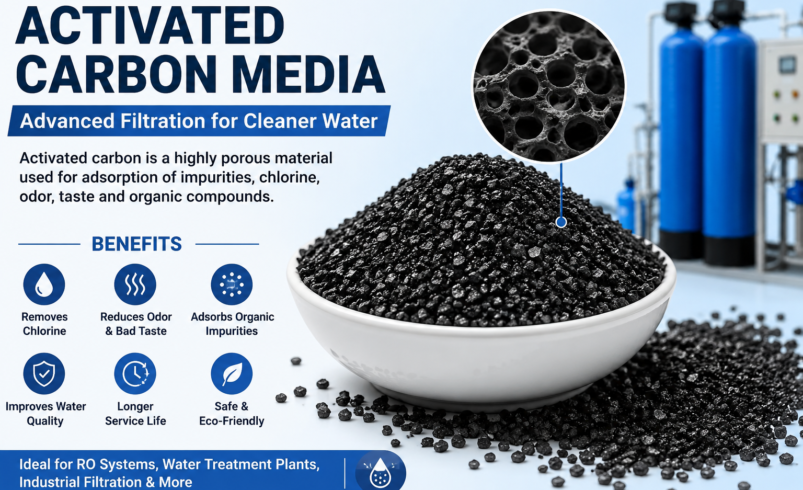

Activated carbon can have an extremely high internal surface area because of its developed pore structure, which is one of the main reasons it is widely used as an adsorption medium in water treatment.
Clean and properly treated water is essential for homes, commercial establishments and industrial operations. Depending on the source, water can contain chlorine, organic compounds, unpleasant odors, taste-causing substances and other impurities. Different treatment technologies are used to address these issues, and Activated Carbon Media is one of the most established options for adsorption-based filtration.
Carbon filtration is commonly found in domestic water purifiers, commercial filtration systems, industrial RO plants and selected wastewater treatment applications. However, effective performance depends on choosing the right carbon and operating the filtration system correctly.
This article explains the role of activated carbon, its working principle, types, applications, benefits, maintenance requirements and important factors to consider before purchasing it.
What Is Activated Carbon Media?
Activated Carbon Media is a carbon-based filtration material that has been specially processed to develop a large number of pores throughout its structure.
These pores create a substantial internal surface area. When water passes through the carbon, certain dissolved compounds can attach to this surface through adsorption.
Activated carbon can be manufactured from several raw materials, including:
- Coconut shells
- Coal
- Wood
- Other carbon-rich materials
The raw material and activation process affect the resulting pore structure and adsorption characteristics. Therefore, different carbon products can perform differently depending on the application.
Activated carbon should also be distinguished from conventional mechanical filter media. Mechanical filters primarily capture suspended particles, while activated carbon primarily works through adsorption.
Featured Snippet: What Does Activated Carbon Media Do?
Activated Carbon Media is primarily used for adsorption in water treatment. It can help reduce chlorine, certain organic compounds, unpleasant taste and odors, depending on the carbon type, water chemistry, flow rate and contact time.
How Activated Carbon Media Works
The basic principle behind carbon filtration is adsorption.
Activated carbon contains a network of microscopic pores that provide a large surface area. As water flows through the carbon bed, suitable contaminants can interact with and attach to the carbon surface.
The performance of this process depends on several variables.
Surface Area
A highly developed pore structure provides more available surface area for adsorption.
Contact Time
Water needs adequate contact with the carbon bed. Excessive flow rates can reduce the available contact time and affect treatment performance.
Contaminant Type
Activated carbon does not remove every contaminant equally. Its effectiveness depends on the chemical characteristics of the substance being targeted.
Water Chemistry
pH, temperature and other compounds in the water can influence adsorption behavior.
Media Quality
The carbon’s raw material, pore structure and physical properties can affect its suitability for a particular application.
This is why carbon selection should always be linked to the actual water-treatment objective.
Activated Carbon for Water Treatment
Activated Carbon for Water Treatment is commonly used as a pre-treatment or polishing stage.
One of its well-known applications is chlorine reduction. In certain RO systems, reducing chlorine before water reaches the membrane can be an important part of protecting membrane performance.
Carbon filtration can also be used to improve taste and odor when the compounds responsible can be adsorbed by the selected carbon.
However, activated carbon should not be considered a complete solution for every water-quality problem.
For example, hardness, high turbidity, dissolved salts and certain inorganic contaminants may require other treatment technologies.
A properly designed treatment system may therefore combine several processes, such as sediment filtration, carbon filtration, softening, RO and post-treatment.
Granular Activated Carbon: A Popular Filtration Choice
Granular Activated Carbon, commonly known as GAC, consists of relatively larger carbon particles that can be loaded into filtration vessels.
It is frequently used in water treatment because it can operate as a fixed-bed filtration medium.
GAC can be used in:
- Domestic filtration systems
- Commercial water treatment
- Industrial RO pre-treatment
- Process water treatment
- Selected wastewater applications
- Taste and odor control
- Chlorine reduction
The appropriate particle size depends on the filter design and operating conditions.
Larger particles can behave differently from finer carbon, affecting pressure drop and contact characteristics. Therefore, the carbon should be matched to the equipment and flow requirements.
Different Types of Activated Carbon Media
Activated carbon is not a single standardized material. Different raw materials and manufacturing processes produce different characteristics.
Coconut Shell Activated Carbon
Coconut shell carbon is widely used in water filtration applications. Its pore structure is often well suited to adsorption of smaller molecules and applications such as chlorine reduction.
Coal-Based Activated Carbon
Coal-based carbon is used across water and wastewater treatment applications and can provide a different distribution of pore sizes.
Wood-Based Activated Carbon
Wood-based carbon tends to have a larger proportion of mesopores and may be suitable for applications involving larger organic molecules.
The selection should be based on the actual treatment objective rather than assuming one carbon source is always superior.
Benefits of Activated Carbon Media
Activated carbon provides several potential advantages when appropriately selected.
Chlorine Reduction
Carbon is commonly used to reduce chlorine in water before downstream treatment stages.
Taste Improvement
Certain compounds responsible for undesirable taste can be adsorbed by suitable carbon.
Odor Control
Carbon filtration may reduce some odor-causing compounds.
Organic Compound Reduction
Activated carbon can adsorb certain organic substances depending on their chemical properties.
Flexible Application
It can be incorporated into residential, commercial and industrial treatment systems.
Compatibility With RO Systems
Carbon filtration can serve as an important pre-treatment stage in suitable RO applications.
Easy Integration
Granular carbon can be placed into appropriately designed filter vessels.
Role of Activated Carbon Filter Media in RO Systems
Activated Carbon Filter Media is commonly used before RO membranes where chlorine reduction is required.
A typical treatment sequence might look like:
Raw Water → Sediment Filter → Activated Carbon Filter → Cartridge Filter → RO System
The actual arrangement varies depending on feed-water quality.
For example, industrial water may require additional pre-treatment for hardness, iron, manganese, turbidity or other parameters.
The carbon stage should therefore be designed as part of the complete treatment process rather than considered independently.
Activated Carbon Media for Industrial Applications
Industrial water treatment systems often operate continuously and process significantly higher water volumes than domestic systems.
This makes correct carbon-bed sizing particularly important.
Industrial users should consider:
- Feed-water quality
- Daily water volume
- Peak flow
- Carbon quantity
- Vessel dimensions
- Empty bed contact time
- Backwashing requirements
- Media replacement schedule
An undersized carbon filter may provide insufficient contact time, while an improperly operated system can reduce the expected benefits of the media.
Industrial users should therefore evaluate the complete system before selecting a carbon product.
How to Choose the Right Activated Carbon Media
Selecting the right carbon should begin with identifying the treatment objective.
1. Identify the Contaminant
Determine which contaminant or water-quality parameter needs to be addressed.
2. Analyze the Feed Water
Water testing can provide useful information about chlorine, organic compounds, turbidity, hardness and other parameters.
3. Select the Carbon Source
Consider whether coconut-shell, coal-based or wood-based carbon is more appropriate.
4. Check Particle Size
Particle size can influence pressure drop, flow characteristics and contact conditions.
5. Evaluate Flow Rate
The system should operate within appropriate flow conditions for the selected carbon bed.
6. Consider Contact Time
Adequate contact between water and carbon is essential for effective adsorption.
7. Plan for Replacement
Carbon eventually becomes exhausted, so replacement should be considered during system planning.
What Is Carbon Exhaustion?
Activated carbon has a finite adsorption capacity.
During operation, contaminants gradually occupy available adsorption sites. As more sites become occupied, the carbon approaches exhaustion.
Once the carbon has reached its practical capacity, it may no longer provide the required level of contaminant reduction.
The service life of carbon varies based on:
- Contaminant concentration
- Water consumption
- Carbon quantity
- Flow rate
- Feed-water chemistry
- Carbon characteristics
- Operating conditions
Because of these variables, there is no universal replacement period for every application.
Signs of Activated Carbon Replacement
Users may need to consider replacing the carbon when treatment performance starts to decline.
Possible indicators include:
- Chlorine begins appearing in treated water
- Taste or odor returns
- Water quality changes
- Media reaches its calculated capacity
- System monitoring indicates reduced performance
For commercial and industrial systems, routine water-quality testing is generally more reliable than relying only on a fixed replacement schedule.
Maintenance of Activated Carbon Filters
Proper maintenance can help support consistent filtration performance.
Depending on the system, maintenance may include:
- Monitoring pressure drop
- Checking flow rate
- Inspecting valves
- Checking for leakage
- Following recommended backwashing procedures
- Monitoring treated-water quality
- Replacing exhausted media
Backwashing may be required for certain granular carbon systems, particularly where suspended solids accumulate within the media bed.
The correct procedure depends on the filter vessel, carbon grade and system design.
Common Mistakes When Using Carbon Media
Selecting Only on Price
Low-cost carbon is not automatically the most economical option. Media performance and service life should also be considered.
Ignoring Feed-Water Quality
Without understanding the incoming water, selecting an appropriate carbon can be difficult.
Incorrect Flow Rate
High flow rates may reduce contact time and negatively affect adsorption performance.
Choosing the Wrong Carbon Type
Different carbon products have different pore structures and adsorption characteristics.
Delaying Replacement
Exhausted carbon may no longer provide the intended treatment.
Why Activated Carbon Quality Matters
The consistency and specifications of carbon can influence the overall performance of a filtration system.
Businesses purchasing carbon should consider:
- Raw material
- Particle size
- Adsorption characteristics
- Moisture content
- Ash content
- Packaging
- Application suitability
- Supply consistency
For RO dealers, distributors and water-treatment companies, consistent product availability can also be important because carbon media may be required for multiple customer installations.
Activated Carbon Media in Water Treatment Business
Water treatment businesses frequently need different filtration media for residential, commercial and industrial projects.
A dedicated B2B marketplace can make it easier to discover relevant products and compare available sourcing options.
RO Mega Mart is focused on RO and water-treatment products, providing businesses with a platform where they can explore different categories of filtration products, RO components, spare parts and related water-treatment products.
For dealers and distributors, having multiple categories available through one platform can simplify procurement.
For technicians, it can provide a convenient way to search for products required for installation and maintenance projects.
For industrial buyers, specialized product categories can help streamline sourcing for larger treatment requirements.
Activated Carbon Media Storage and Handling
Proper storage is another consideration when purchasing carbon in bulk.
Activated carbon should generally be kept in suitable packaging and stored in clean, dry conditions.
Exposure to moisture, dust or other contaminants should be minimized before installation.
For businesses purchasing larger quantities, proper inventory management can help maintain product quality until the media is ready for use.
Storage requirements should always follow the supplier’s product recommendations.
Frequently Asked Questions
Is Activated Carbon Media suitable for drinking water?
Activated carbon is widely used in drinking-water filtration applications, particularly for reducing chlorine, taste, odor and certain organic compounds. The suitability depends on the specific product and application.
Does activated carbon remove hardness?
Activated carbon is not primarily designed for hardness removal. Water hardness generally requires other treatment methods, depending on the source-water chemistry.
Can activated carbon be used before an RO membrane?
Yes. Carbon filtration is commonly incorporated into RO pre-treatment where chlorine reduction or adsorption of certain organic compounds is required.
What is the difference between carbon and activated carbon?
Activated carbon has been processed to develop a highly porous structure and significantly greater surface area, giving it enhanced adsorption properties compared with ordinary carbon materials.
How often should carbon media be replaced?
Replacement frequency varies according to water quality, carbon quantity, contaminant loading, flow rate and water consumption. Monitoring system performance is preferable to applying one fixed schedule to every system.
Is coconut shell carbon good for water filtration?
Coconut shell activated carbon is commonly used in water filtration because of its pore characteristics. However, suitability depends on the specific treatment objective.
Conclusion
Activated Carbon Media remains an important filtration material for a wide variety of water treatment applications. Its highly porous structure allows it to adsorb certain unwanted compounds, making it useful for chlorine reduction, taste and odor improvement and selected organic contaminant applications.
The best results come from treating carbon as one component of a properly designed water treatment system. Feed-water analysis, carbon selection, flow rate, contact time, vessel sizing and timely replacement all have an impact on performance.
For domestic systems, commercial filtration and industrial RO plants, choosing the right carbon can improve the effectiveness of the overall treatment process.
For businesses looking to source filtration media and RO components, RO Mega Mart provides a specialized B2B platform where buyers can explore Activated Carbon Media and other water-treatment products according to their requirements.
The key is simple: select the right carbon, use it under appropriate operating conditions and monitor its performance regularly.