
When a doctor recommends an imaging test, you may wonder which option is right for you. CT scans and MRI scans are two commonly used medical imaging procedures that help doctors examine the inside of the body. However, they work differently and are used for different medical conditions. Understanding their differences can help you feel more confident before your appointment.
Understanding ct scan vs mri scan is important when you want to know which test may be suitable for your symptoms. While a CT scan is often preferred for emergencies, injuries, and certain lung or bone conditions, an MRI scan is particularly useful for examining the brain, spinal cord, joints, and other soft tissues. The right test depends on your symptoms, medical history, and your doctor’s recommendation.
What Is a CT Scan?
A CT scan, or Computed Tomography scan, is a diagnostic imaging test that uses X-rays and computer technology to create detailed cross-sectional images of the body. These images help doctors examine internal organs, bones, blood vessels, and other structures.
Unlike a conventional X-ray, which generally produces a flat image, a CT scan creates multiple detailed images from different angles.
Why Is a CT Scan Performed?
Doctors may recommend a CT scan to:
- Examine fractures and complex bone injuries.
- Identify internal injuries after an accident.
- Evaluate the lungs and chest.
- Investigate certain abdominal or pelvic conditions.
- Detect bleeding or swelling in the brain.
- Help identify and monitor certain tumours.
- Support the planning of specific medical treatments.
How Does a CT Scan Work?
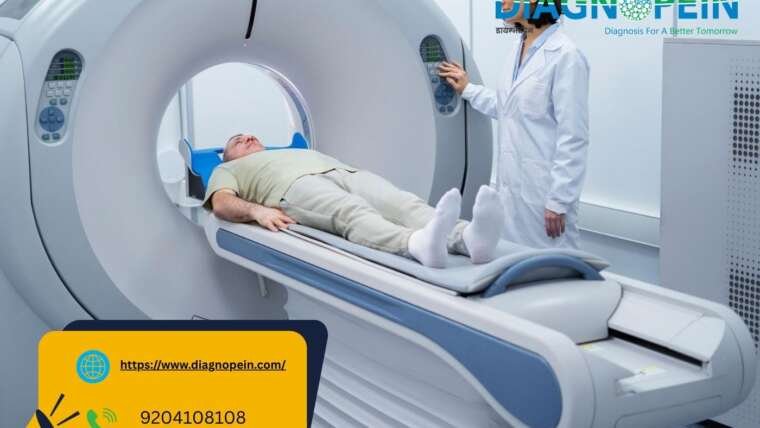
During a CT scan, you lie on a motorised table that moves through a large, ring-shaped scanner. The machine takes X-ray images while rotating around your body. A computer combines these images to create detailed views of the area being examined.
Some CT examinations require a contrast material to make certain organs or blood vessels easier to see. Your healthcare team will explain whether contrast is needed.
A CT scan itself is usually quick, although preparation and contrast procedures may take additional time.
What Is an MRI Scan?
MRI stands for Magnetic Resonance Imaging. It uses a strong magnetic field, radio waves, and computer technology to produce detailed images of internal body structures.
Unlike CT scans, MRI scans do not use ionising radiation. They are especially useful for examining soft tissues, including the brain, spinal cord, muscles, ligaments, and joints.
Why Is an MRI Scan Performed?
A doctor may recommend an MRI scan to:
- Investigate persistent or unexplained neurological symptoms.
- Examine the brain and spinal cord.
- Evaluate back pain and certain spinal conditions.
- Assess knee, shoulder, and other joint injuries.
- Examine muscles, tendons, and ligaments.
- Investigate certain internal organ conditions.
- Help assess and monitor some tumours.
An MRI scan may also be recommended when more detailed soft-tissue images are needed after an initial examination.
How Does an MRI Scan Work?
During an MRI scan, you lie on a table that moves into a scanner. You need to remain as still as possible so that the images are clear. The machine may produce loud tapping or knocking sounds, so ear protection is generally provided.
Some MRI examinations use contrast material to improve image clarity. The procedure usually takes around 20–60 minutes, although the duration depends on the body part being examined and the type of scan.
CT Scan vs MRI Scan: Key Differences
Although both tests create detailed images of the body, they differ in technology, duration, and common uses.
| Feature | CT Scan | MRI Scan |
|---|---|---|
| Technology | Uses X-rays and computer processing | Uses magnetic fields and radio waves |
| Radiation | Uses ionising radiation | Does not use ionising radiation |
| Common uses | Emergencies, injuries, bones, lungs, and internal bleeding | Brain, spine, joints, and soft tissues |
| Scan duration | Usually quicker | Often takes longer |
| Patient experience | Typically a short examination | Requires remaining still for a longer period |
| Metal implants | Usually less restrictive, but screening is needed | Requires careful screening for implants and metal objects |
| Contrast material | Used for selected examinations | Used for selected examinations |
Neither test is automatically better than the other. Each has specific advantages, and the choice depends on the medical question your doctor needs to answer.
Which Is Better: CT Scan or MRI Scan?
The answer depends on the body part being examined, your symptoms, and how quickly the results are needed.
When Is a CT Scan Better?
A CT scan may be preferred when doctors need rapid imaging, particularly in emergencies. It can be useful for detecting certain fractures, internal bleeding, chest conditions, and abdominal problems.
For example, a doctor may recommend a CT scan after a serious accident to assess possible internal injuries.
When Is an MRI Scan Better?
An MRI scan may be more suitable when detailed images of soft tissues are required. It is commonly used to investigate certain brain conditions, spinal problems, ligament injuries, and joint abnormalities.
For example, an MRI of the knee may help doctors examine ligaments and cartilage that are not always clearly assessed with an X-ray.
Important: Your doctor may recommend one test, the other, or occasionally both. Do not choose an imaging test based only on cost or personal preference.