
Agricultural Micronutrients Market Overview
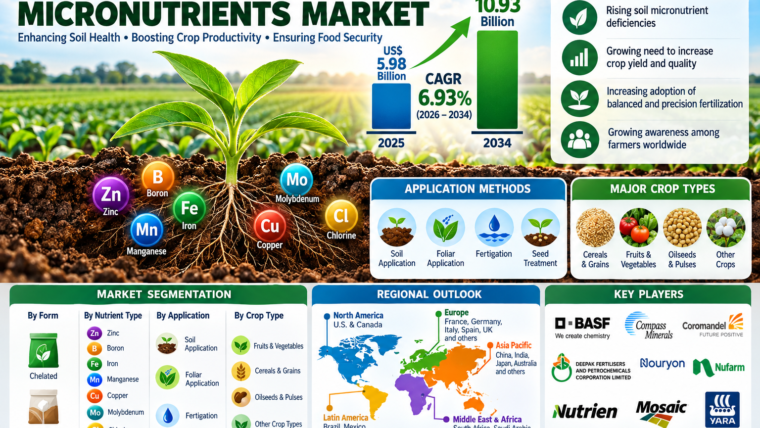
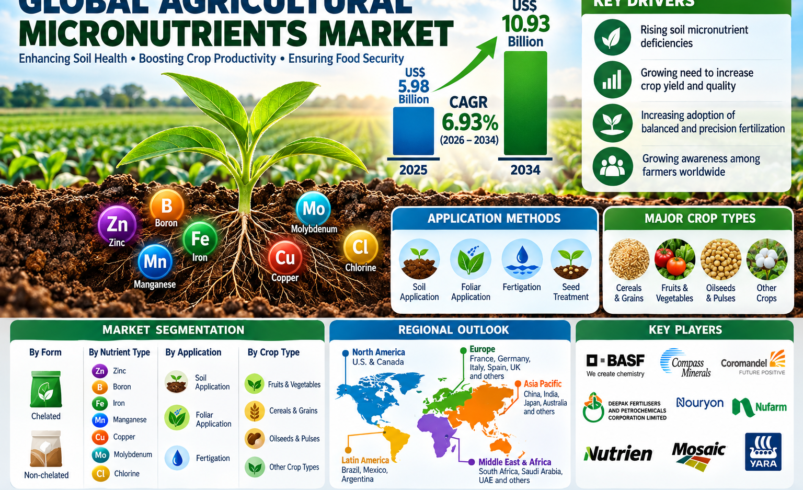
The global agricultural micronutrients market is expected to grow from US$ 5.98 billion in 2025 to US$ 10.93 billion by 2034, expanding at a compound annual growth rate (CAGR) of 6.93% during 2026–2034. Market growth is driven by increasing soil nutrient deficiencies, rising demand for higher crop yields, growing awareness of balanced fertilization, and the adoption of precision agriculture technologies.
Agricultural micronutrients, including zinc, boron, iron, manganese, copper, and molybdenum, are essential for healthy plant development and improved crop quality. Although plants require these nutrients in relatively small quantities, deficiencies can negatively affect root growth, flowering, photosynthesis, nutrient absorption, and agricultural productivity.
As intensive farming practices place greater pressure on soil fertility, farmers are increasingly adopting specialized micronutrient fertilizers. Soil testing, foliar spraying, fertigation, chelated formulations, and micronutrient-enriched fertilizers are becoming important components of modern crop nutrition programs.
Accordingly, agricultural micronutrients are gaining importance across cereals, grains, fruits, vegetables, oilseeds, pulses, and other commercial crops.
What Are Agricultural Micronutrients and Why Are They Important?
Agricultural micronutrients are trace elements required by plants for essential physiological and biochemical functions. Unlike nitrogen, phosphorus, and potassium, which plants require in relatively large quantities, micronutrients are needed in smaller amounts but remain vital for healthy growth and reproduction.
The major agricultural micronutrients include:
- Zinc: Supports enzyme activity, protein synthesis, and plant growth.
- Boron: Contributes to flowering, reproductive development, and fruit formation.
- Iron: Supports chlorophyll formation, photosynthesis, and respiration.
- Manganese: Participates in photosynthesis and enzyme activation.
- Copper: Supports plant metabolism and reproductive development.
- Molybdenum: Helps plants process nitrogen efficiently.
- Chlorine: Contributes to photosynthesis and cellular functions.
These nutrients can be applied through soil fertilizers, foliar sprays, seed treatments, fertigation systems, and enriched fertilizer blends.
The growing use of micronutrients reflects the increasing recognition that conventional NPK fertilizers alone may not address every crop’s nutritional requirements. Targeted micronutrient applications can help correct diagnosed deficiencies, improve nutrient-use efficiency, and support more consistent agricultural production.
Key Growth Drivers of the Agricultural Micronutrients Market
1. Increasing Soil Micronutrient Deficiencies
Widespread soil nutrient deficiencies are among the most important drivers of the agricultural micronutrients market. Continuous cultivation, nutrient removal during harvesting, soil erosion, and imbalanced fertilizer application can gradually reduce the availability of essential trace elements.
India illustrates the scale of the challenge. An assessment covering 242,827 soil samples across 615 districts and 28 states identified zinc deficiencies in 51.2% of analyzed soils and boron deficiencies in 44.7%. Iron, copper, and manganese deficiencies were also identified.
These conditions create demand for targeted nutrient supplementation to improve soil fertility and crop performance.
Zinc is particularly important because its deficiency can restrict plant growth, delay maturity, and reduce yields. Farmers are therefore increasingly incorporating zinc-based fertilizers and other micronutrient formulations into balanced crop nutrition programs.
2. Rising Demand for Higher Crop Yields and Quality
Increasing food demand and limited arable land are encouraging farmers to improve productivity per hectare. Agricultural micronutrients support root development, flowering, enzyme activity, photosynthesis, and reproductive growth.
Correcting nutrient deficiencies can improve crop performance and help farmers obtain better results from conventional fertilizers. Field evidence cited in the supplied research includes long-term zinc application trials at Pantnagar that recorded average yield responses of approximately 285 kg per hectare in rice and 307 kg per hectare in wheat.
Micronutrients are also important in commercial horticulture, where fruit size, appearance, quality, and consistency influence market value.
As growers focus on higher productivity and quality standards, demand for soil-applied fertilizers, foliar formulations, chelated nutrients, and micronutrient-enriched NPK products is expected to increase.
3. Growing Adoption of Precision Agriculture
Precision agriculture is transforming fertilizer application by helping farmers identify nutrient deficiencies and apply inputs according to crop requirements.
Soil testing, plant tissue analysis, field-level data, variable-rate application, and digital agricultural advisory systems enable more targeted nutrient management.
Micronutrients benefit from these practices because their requirements vary according to soil composition, crop variety, climatic conditions, and growth stage. Applying the appropriate nutrient at the correct dosage can improve nutrient-use efficiency and reduce unnecessary fertilizer consumption.
Fertigation is another important development. By delivering water-soluble nutrients through irrigation systems, farmers can manage nutrient application timing and dosage more precisely.
These technologies are expected to create opportunities for specialized agricultural micronutrient manufacturers.
Agricultural Micronutrients Market Challenges
Limited Farmer Awareness and Incorrect Application
Limited awareness of micronutrient deficiencies, application methods, and recommended dosages remains a challenge, particularly among small-scale farmers.
Nutrient deficiencies can produce similar visual symptoms, making accurate diagnosis difficult without soil or plant analysis. Furthermore, nutrient availability is influenced by soil pH, moisture, organic matter, and interactions among different elements.
Both under-application and over-application can reduce effectiveness. Excessive quantities of certain micronutrients may cause toxicity or interfere with the uptake of other nutrients.
Greater investment in farmer education, soil testing, agricultural extension services, demonstration plots, and digital advisory platforms will be important for increasing adoption.
Product Costs and Environmental Concerns
Premium chelated and specialty micronutrient products can be expensive for price-sensitive farmers. Adoption therefore depends partly on whether growers can demonstrate measurable improvements in crop productivity, quality, or input efficiency.
Improper fertilizer application can also contribute to nutrient imbalances and environmental pollution. Manufacturers must develop effective formulations while helping farmers apply nutrients according to soil conditions and crop requirements.
Balanced fertilizer programs, precision application, and improved nutrient management will be essential for sustainable market development.
Key Trends Shaping the Agricultural Micronutrients Market
Increasing Demand for Chelated Micronutrients
Chelated micronutrients are gaining importance because they can help maintain nutrient availability under specific soil conditions.
Chelation involves binding a micronutrient ion to an organic ligand, helping protect it from reactions that may reduce its availability to plants. Common chelating agents include EDTA, DTPA, and EDDHA.
Their effectiveness varies according to soil pH and other conditions. For example, EDDHA-chelated iron is particularly useful in alkaline soils where conventional iron sources may be less effective.
These products are relevant to fruits, vegetables, flowers, and other high-value crops that require precise nutrient management.
Expansion of Foliar Spraying and Fertigation
Foliar application delivers nutrients directly to plant leaves, while fertigation introduces suitable fertilizers through irrigation systems.
Both approaches allow farmers to supplement nutrients when deficiencies are identified or when targeted delivery is beneficial. They are particularly relevant to intensive horticulture, protected cultivation, and commercial farming.
The growing adoption of efficient irrigation and crop-management technologies is creating opportunities for water-soluble and specialized micronutrient formulations.
Innovation in Micronutrient Fertilizer Products
Product innovation is broadening the range of solutions available to farmers.
Examples identified in the supplied research include CHS Inc.’s Trivar EZ, which uses its Levesol chelating agent, and its Soygreen Pro iron formulation for soybean iron deficiency chlorosis. Other examples include zinc and multinutrient formulations designed for blending with dry fertilizers.
These developments demonstrate the industry’s focus on improving nutrient availability, application convenience, and crop-specific performance.
Agricultural Micronutrients Market: Regional Outlook
United States
The United States agricultural micronutrients market benefits from advanced farming practices, established soil-testing services, and the adoption of precision agriculture.
Farmers increasingly use field-level information to guide fertilizer applications and manage nutrient deficiencies in commercial crops. Demand for zinc, boron, iron, manganese, and other specialized nutrients is supported by the need to maintain productivity and crop quality.
France
France represents an important European market because of its extensive agricultural land and production of cereals, fruits, vegetables, and grapes.
Vineyards and other high-value crops require careful nutrient management to support plant development and product quality. Precision farming, soil analysis, and sustainable fertilizer practices create opportunities for targeted micronutrient applications.
India
India is an important growth market because of widespread soil nutrient deficiencies and increasing awareness of balanced fertilization.
The reported deficiencies of zinc, boron, iron, copper, and manganese demonstrate the need for targeted soil management. Soil-applied fertilizers, foliar products, and enriched fertilizer blends are relevant across cereals, pulses, oilseeds, fruits, and vegetables.
Drone-based spraying and digital agricultural advisory services may also support more efficient nutrient application.
Brazil
Brazil’s large-scale production of soybeans, corn, sugarcane, and other commercial crops creates demand for effective crop nutrition solutions.
Soil analysis, precision agriculture, variable-rate application, and foliar nutrition are increasingly relevant to large commercial farms. Zinc, boron, manganese, and other micronutrients can be incorporated into crop-specific fertilizer programs when deficiencies are identified.
The need to improve agricultural productivity and maintain export competitiveness is expected to support demand for specialized micronutrient products.
Agricultural Micronutrients Market Segmentation
The global agricultural micronutrients market can be segmented as follows:
By Form
- Chelated
- Non-chelated
By Crop Type
- Fruits and vegetables
- Cereals and grains
- Oilseeds and pulses
- Other crop types
By Nutrient Type
- Zinc
- Boron
- Iron
- Molybdenum
- Manganese
- Others
By Application
- Soil application
- Foliar application
- Fertigation
By Geography
- North America: United States and Canada
- Europe: France, Germany, Italy, Spain, United Kingdom, Belgium, Netherlands, and Turkey
- Asia Pacific: China, Japan, India, Australia, South Korea, Thailand, Malaysia, Indonesia, and New Zealand
- Latin America: Brazil, Mexico, and Argentina
- Middle East and Africa: South Africa, Saudi Arabia, and the UAE
These segments reflect different crop requirements, nutrient deficiencies, farming practices, and fertilizer application methods.
Competitive Landscape and Major Companies
The agricultural micronutrients market includes established fertilizer manufacturers and specialized crop nutrition companies competing through product innovation, distribution networks, and crop-specific solutions.
Key companies covered in the supplied research include:
- BASF SE
- Compass Minerals
- Coromandel International
- Deepak Fertilisers
- Nouryon
- Nufarm
- Nutrien Ltd.
- The Mosaic Company
- Yara International
Company analysis can include business overviews, key personnel, recent developments, SWOT analysis, and revenue analysis.
Competition is expected to emphasize nutrient efficiency, specialized formulations, farmer education, and products suited to different soil and crop conditions.
Future Outlook for the Agricultural Micronutrients Market
The agricultural micronutrients market is positioned for continued growth as farmers respond to soil nutrient deficiencies, productivity requirements, and the need for more efficient fertilizer application.
The market is forecast to reach US$ 10.93 billion by 2034, compared with US$ 5.98 billion in 2025, representing a CAGR of 6.93% during 2026–2034.
Future opportunities are likely to emerge from chelated nutrient formulations, precision agriculture, soil testing, fertigation, foliar application, and micronutrient-enriched fertilizers.
However, sustained adoption will depend on affordability, accurate deficiency diagnosis, suitable application recommendations, and demonstrable agronomic benefits.
Manufacturers that combine effective products with farmer education and targeted nutrient-management solutions will be well positioned to address evolving agricultural requirements.
Frequently Asked Questions (FAQs)
1. What is the global agricultural micronutrients market size?
The global agricultural micronutrients market is projected to increase from US$ 5.98 billion in 2025 to US$ 10.93 billion by 2034, according to the supplied market research.
2. What is the CAGR of the agricultural micronutrients market?
The market is expected to grow at a CAGR of 6.93% during the forecast period from 2026 to 2034.
3. What are the major agricultural micronutrients?
The major agricultural micronutrients include zinc, boron, iron, manganese, copper, molybdenum, and chlorine. They support plant growth, photosynthesis, enzyme activity, and crop development.
4. What are the key drivers of agricultural micronutrient market growth?
Major growth drivers include widespread soil nutrient deficiencies, increasing demand for higher crop yields, the adoption of precision agriculture, and growing awareness of balanced fertilizer application.
5. What are the main applications of agricultural micronutrients?
Agricultural micronutrients are applied through soil fertilizers, foliar sprays, and fertigation systems. They are used across fruits and vegetables, cereals and grains, oilseeds, pulses, and other crops.
6. What is the difference between chelated and non-chelated micronutrients?
Chelated micronutrients bind nutrients to organic ligands that can help maintain their availability under suitable conditions. Non-chelated products supply nutrients without this type of chelation. The appropriate formulation depends on soil chemistry, crop requirements, and application conditions.
7. Which companies operate in the agricultural micronutrients market?
Major companies covered in the research include BASF SE, Compass Minerals, Coromandel International, Deepak Fertilisers, Nouryon, Nufarm, Nutrien Ltd., The Mosaic Company, and Yara International.
8. Which regions are covered in the agricultural micronutrients market report?
The report covers North America, Europe, Asia Pacific, Latin America, and the Middle East and Africa, including markets such as the United States, France, India, China, Brazil, and South Africa.
9. What are the major challenges facing the agricultural micronutrients market?
Key challenges include limited farmer awareness, incorrect application rates, high costs of some specialty formulations, nutrient imbalances, and environmental concerns associated with improper fertilizer use.
10. What is the future outlook for the agricultural micronutrients market?
The market is expected to expand through 2034, supported by precision nutrient management, chelated products, soil testing, fertigation, and increasing demand for efficient crop nutrition solutions.
Conclusion
The global agricultural micronutrients market is becoming increasingly important as agricultural producers seek to improve soil fertility, increase crop productivity, and manage fertilizer inputs more efficiently. With the market projected to reach US$ 10.93 billion by 2034, targeted nutrient formulations and precision application technologies are expected to create significant opportunities.
Continued market development will depend on effective products, accessible soil testing, farmer awareness, and sustainable fertilizer management. These factors will shape the industry’s ability to support productive and resource-efficient agriculture worldwide.
Explore the full Agricultural Micronutrients Market report from Renub Research for detailed market forecasts, segmentation, regional analysis, competitive intelligence, and company-level insights.