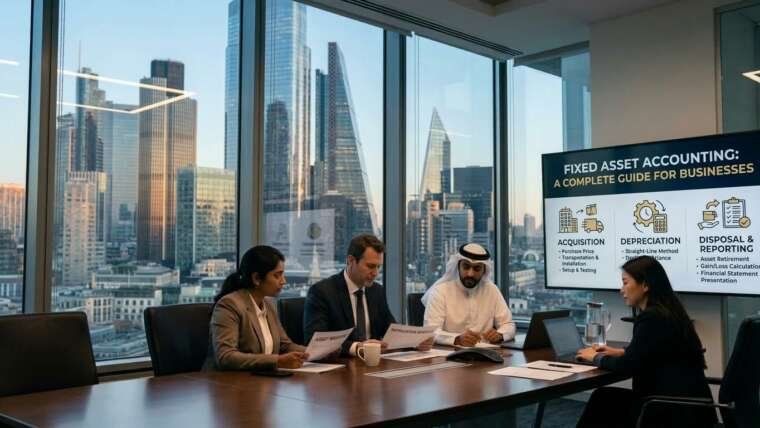


Fixed asset accounting is an important part of financial management for businesses that own long-term assets such as property, machinery, vehicles, computers, furniture, and equipment. Proper accounting for these assets helps companies maintain accurate financial records, calculate depreciation correctly, control their investments, and present reliable information in financial statements.
Unlike everyday business expenses, fixed assets normally provide value over several accounting periods. Therefore, businesses need appropriate procedures for recording their purchase, measuring their value, calculating depreciation, tracking changes, and recognising their disposal.
Whether a company owns a small number of office assets or manages a large portfolio of property and equipment, an organised fixed asset accounting system can improve financial accuracy and asset control.
What Is Fixed Asset Accounting?
Fixed asset accounting is the process of recording, managing, depreciating, and reporting assets that a business expects to use for more than one accounting period.
Fixed assets are commonly referred to as property, plant, and equipment (PP&E). They are generally purchased to support business operations rather than for immediate resale.
Common examples include:
- Land and buildings
- Office furniture
- Computers and IT equipment
- Manufacturing machinery
- Company vehicles
- Tools and specialised equipment
- Warehouse equipment
- Leasehold improvements
- Certain long-term infrastructure assets
For example, if a company purchases a delivery vehicle for business operations, the vehicle may be recorded as a fixed asset rather than treated entirely as an expense in the month of purchase. Its cost may then be allocated over its estimated useful life through depreciation.
Why Fixed Asset Accounting Is Important
Businesses can invest substantial amounts of money in property and equipment. Without proper accounting procedures, these investments can become difficult to monitor and may lead to inaccurate financial statements.
Effective fixed asset accounting helps businesses:
Maintain Accurate Financial Records
Recording assets correctly ensures that the balance sheet reflects the company’s long-term investments. It also helps prevent assets from being omitted or incorrectly classified.
Calculate Depreciation
Most depreciable fixed assets lose value over time because of usage, ageing, technological changes, or physical deterioration. Depreciation allows the cost of an asset to be allocated over its useful life.
Improve Asset Control
A fixed asset register can show what assets the business owns, where they are located, who is responsible for them, and their current accounting value.
Support Financial Reporting
Accurate asset records contribute to reliable financial statements and help management, auditors, investors, and other stakeholders understand the company’s financial position.
Support Business Planning
Management can use asset information to plan maintenance, replacement, capital expenditure, and future investments.
Types of Fixed Assets
Fixed assets can vary significantly depending on the industry and size of a company.
Land
Land is a long-term asset used for offices, factories, warehouses, retail locations, or other business activities. In many accounting frameworks, land is generally not depreciated because it does not have a finite useful life in the same way as buildings or equipment.
Buildings
Buildings used for business operations are normally recorded as fixed assets and depreciated over their estimated useful lives, subject to applicable accounting standards.
Machinery and Equipment
Manufacturing businesses may own machinery, production equipment, tools, and other operational assets. These assets are usually capitalised when they meet the relevant recognition criteria.
Vehicles
Company cars, trucks, vans, forklifts, and other business vehicles may be recorded as fixed assets when they are used in business operations.
Office Equipment
Computers, printers, servers, furniture, communication equipment, and other office assets may qualify for capitalisation depending on the company’s accounting policy and applicable requirements.
Initial Recognition of Fixed Assets
One of the first steps in fixed asset accounting is determining whether an expenditure should be recognised as an asset or recorded as an expense.
When an asset qualifies for recognition, its initial cost generally includes the purchase price and other directly attributable costs necessary to bring the asset to the location and condition required for its intended use.
Depending on the circumstances, these costs may include:
- Purchase price
- Import duties
- Transportation costs
- Installation charges
- Professional fees
- Testing costs
- Directly attributable preparation costs
For example, suppose a company purchases manufacturing equipment for $80,000 and pays $5,000 for transportation and $7,000 for installation. If these costs meet the applicable recognition requirements, the initial recorded cost may be $92,000.
The business should maintain supporting documentation such as invoices, contracts, delivery records, and installation documents.
Capital Expenditure vs Revenue Expenditure
A key part of fixed asset accounting is distinguishing between capital expenditure and revenue expenditure.
Capital expenditure generally relates to acquiring or improving a long-term asset and may be recognised on the balance sheet when the relevant criteria are met.
Revenue expenditure normally relates to the routine costs of operating and maintaining the business and is generally recognised as an expense.
For example, purchasing a new production machine may represent capital expenditure. Routine maintenance to keep an existing machine operating may instead be treated as an operating expense, depending on the nature of the expenditure and applicable accounting requirements.
Making this distinction correctly helps prevent financial statements from overstating or understating assets and expenses.
Depreciation in Fixed Asset Accounting
Depreciation is one of the most important concepts in fixed asset accounting. It represents the systematic allocation of the depreciable amount of an asset over its useful life.
Depreciation does not necessarily mean that the asset’s market value decreases by the same amount each year. Instead, it is an accounting allocation of cost based on the asset’s expected use and useful life.
Factors considered when calculating depreciation include:
- Asset cost
- Estimated residual value
- Useful life
- Depreciation method
- Date the asset becomes available for use
Common Depreciation Methods
Straight-Line Method
The straight-line method allocates the depreciable amount evenly over the asset’s useful life.
A simplified formula is:
Annual Depreciation = (Asset Cost − Residual Value) ÷ Useful Life
For example, if equipment costs $50,000, has an estimated residual value of $5,000, and has a useful life of five years:
($50,000 − $5,000) ÷ 5 = $9,000 annual depreciation
This method is widely used because it is simple and provides a consistent depreciation expense.
Reducing Balance Method
The reducing balance method applies a depreciation rate to the asset’s carrying amount. Consequently, depreciation is generally higher in earlier periods and decreases over time.
This method may be appropriate where an asset is expected to generate greater economic benefits during its earlier years.
Units of Production Method
Under this method, depreciation is based on actual usage or production rather than simply the passage of time.
It can be useful for certain manufacturing equipment where wear and usage are closely connected to production levels.
Businesses should select depreciation methods based on the applicable accounting framework and the pattern in which the asset’s economic benefits are expected to be consumed.
Fixed Asset Register
A fixed asset register is a detailed record of the company’s fixed assets. It can be maintained using accounting software, spreadsheets, or dedicated asset management systems.
A typical fixed asset register may include:
- Asset identification number
- Asset description
- Purchase date
- Supplier
- Original cost
- Location
- Department or asset custodian
- Useful life
- Depreciation method
- Accumulated depreciation
- Net book value
- Disposal date
- Disposal proceeds
Maintaining an accurate register makes it easier to reconcile accounting records with physical assets.
Asset Reconciliation and Physical Verification
Businesses should periodically compare their fixed asset register with the assets physically present at their locations.
Physical verification can help identify:
- Missing assets
- Damaged equipment
- Assets transferred between locations
- Incorrect asset descriptions
- Duplicate records
- Fully depreciated assets still in use
- Assets that have been disposed of but remain in the register
For larger organisations, asset verification may be conducted annually or according to internal control procedures.
Impairment of Fixed Assets
Fixed assets may sometimes lose value unexpectedly. Examples include physical damage, technological obsolescence, significant changes in market conditions, or declining demand for products made using a particular machine.
When there are indicators that an asset may be impaired, businesses may need to perform an impairment assessment under the applicable accounting standards.
Impairment accounting is different from ordinary depreciation. Depreciation is a systematic allocation over an asset’s useful life, while impairment addresses situations where the recoverable amount may be below the carrying amount.
Disposal of Fixed Assets
Businesses may eventually sell, scrap, trade in, or otherwise dispose of fixed assets.
When an asset is disposed of, the business normally needs to:
- Remove the asset’s original cost from the accounting records.
- Remove related accumulated depreciation.
- Record any proceeds received.
- Determine the resulting gain or loss.
- Update the fixed asset register.
For example, if equipment has a carrying amount of $20,000 and is sold for $24,000, the business may recognise a $4,000 gain, subject to the applicable accounting requirements.
Accurate disposal records are important because keeping disposed assets in the register can distort the company’s asset balances.
Fixed Asset Accounting and Internal Controls
Strong internal controls can reduce the risk of asset loss, fraud, inaccurate records, and unauthorised purchases.
Useful controls include:
- Requiring approval for major asset purchases
- Assigning asset identification numbers
- Maintaining supporting purchase documentation
- Restricting access to valuable equipment
- Conducting regular physical verification
- Recording asset transfers
- Separating purchasing and accounting responsibilities
- Reviewing depreciation calculations
- Approving asset disposals
Businesses should establish clear responsibilities for employees involved in purchasing, recording, maintaining, and disposing of fixed assets.
Common Challenges in Fixed Asset Accounting
Businesses can face several challenges when managing fixed assets.
Incomplete Records
Missing invoices, purchase dates, or asset details can make it difficult to determine the correct accounting treatment.
Incorrect Depreciation
Errors in useful lives, residual values, depreciation methods, or start dates can result in inaccurate financial reporting.
Poor Asset Tracking
When assets are moved between departments or locations without updating records, the fixed asset register can become unreliable.
Unrecorded Disposals
Assets that have been sold, scrapped, or replaced may remain on the accounting system if the disposal process is not properly documented.
Large Asset Portfolios
Companies with thousands of assets may find manual tracking time-consuming and more susceptible to errors.
Using appropriate accounting software and clearly defined procedures can help address these challenges.
Role of Accounting Software
Modern accounting and asset management software can simplify fixed asset accounting by automating many routine processes.
Depending on the system, businesses may be able to:
- Create asset records
- Calculate depreciation
- Generate asset reports
- Track locations
- Record transfers
- Process disposals
- Monitor carrying values
- Produce accounting entries
- Maintain audit trails
Automation can reduce manual calculations and provide better visibility over a company’s asset portfolio.
However, software should support well-designed accounting procedures rather than replace proper controls and professional judgement.
Best Practices for Fixed Asset Accounting
Businesses can improve fixed asset management by following several practical practices:
Establish a Clear Capitalisation Policy
Define which expenditures qualify for capitalisation and which should be expensed. The policy should be consistent and aligned with the applicable accounting framework.
Maintain a Detailed Asset Register
Keep asset information complete, accurate, and updated whenever assets are purchased, transferred, improved, or disposed of.
Review Useful Lives
Useful lives and residual values should be reviewed when required by the applicable accounting standards and when circumstances change.
Conduct Regular Physical Checks
Compare accounting records with physical assets to identify discrepancies early.
Document Every Asset Transaction
Maintain invoices, contracts, disposal documents, transfer forms, and other relevant evidence.
Reconcile Regularly
Reconcile the fixed asset register with the general ledger to identify differences and correct them promptly.
Train Responsible Staff
Employees involved in purchasing and managing assets should understand the company’s accounting and documentation procedures.
Fixed Asset Accounting for Growing Businesses
As a business expands, its investment in equipment, technology, vehicles, property, and other long-term assets can increase significantly. Managing these assets manually may become increasingly difficult.
A structured fixed asset accounting process allows growing businesses to understand what they own, how much has been invested, how assets are being used, and when replacement or additional investment may be required.
It can also make financial reporting more organised and support better budgeting and capital expenditure planning.
Conclusion
Fixed asset accounting is essential for businesses that invest in long-term assets. From initial recognition and capitalisation to depreciation, physical verification, impairment, and disposal, every stage requires accurate records and consistent procedures.
A well-maintained fixed asset register, appropriate depreciation policies, regular reconciliations, physical verification, and effective internal controls can help businesses maintain reliable financial information.
As asset portfolios become more complex, accounting software and professional accounting support can make asset management more efficient. By treating fixed asset accounting as an ongoing financial management process rather than a one-time recording exercise, businesses can improve financial accuracy, strengthen controls, and make better-informed decisions about their long-term investments.