
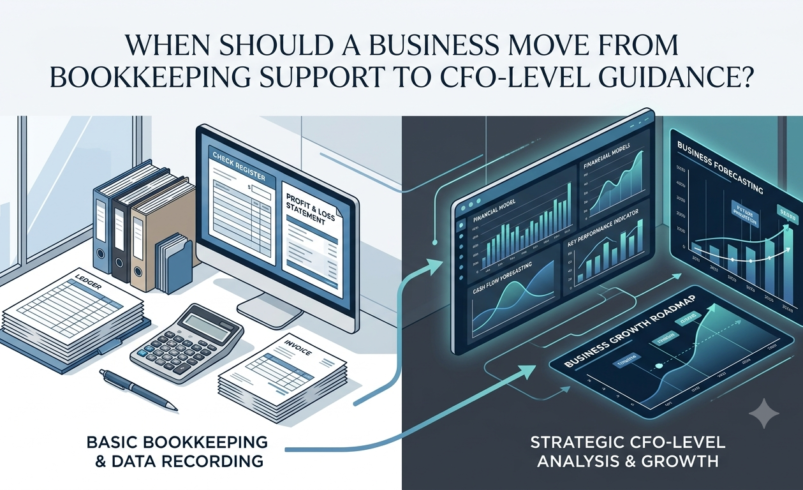

Bookkeeping gives a business a reliable financial record. It keeps transactions organized, reconciles accounts, tracks expenses, and helps produce accurate financial statements.
But as a business grows, accurate records may no longer be enough.
Eventually, owners and managers start facing questions that bookkeeping alone cannot answer:
- Can we afford to hire more employees?
- Why is revenue growing while cash remains tight?
- Which services or departments are actually profitable?
- Should we take on additional debt?
- How much should we budget for expansion?
- What will happen to cash flow if sales decline?
- Are we ready for a major investment or acquisition?
These are CFO-level questions. Knowing when they start appearing regularly can help a business determine when it needs more strategic financial guidance.
Bookkeeping and CFO Guidance Serve Different Purposes
Bookkeeping primarily focuses on maintaining accurate financial records.
A bookkeeper may handle transactions, reconciliations, accounts payable, accounts receivable, payroll information, and month-end reporting.
A CFO looks beyond the records.
The CFO uses financial information to help management understand performance, forecast future conditions, manage risk, and evaluate important business decisions.
Neither function replaces the other. In fact, strong CFO guidance depends on reliable bookkeeping.
The difference is mainly in how the information is used.
Bookkeeping answers: What happened?
CFO guidance asks: Why did it happen, what could happen next, and what should we do about it?
Your Business Is Growing Faster Than Your Financial Processes
Growth is one of the clearest signs that a business may need CFO-level support.
A company that once had a handful of employees, a few customers, and straightforward expenses can become significantly more complicated as it expands.
New locations, departments, employees, vendors, financing arrangements, and revenue streams create additional financial decisions.
At some point, the owner may spend more time trying to understand the numbers instead of running the business.
A CFO can help establish financial systems that are designed around the company’s current size and future goals.
Revenue Is Increasing but Profitability Is Unclear
Higher revenue does not necessarily mean a healthier business.
A company may generate more sales while margins decline because of rising labor costs, discounts, overhead, supplier prices, or inefficient operations.
This is where deeper financial analysis becomes useful.
A CFO can examine profitability by product, service, location, department, customer group, or other relevant categories.
For example, a business may discover that one revenue stream generates substantial sales but very little profit, while another smaller segment produces much stronger margins.
Without this type of analysis, management may continue investing resources in areas that look successful on the surface but contribute relatively little to the bottom line.
Cash Flow Has Become Difficult to Predict
A business can be profitable on paper and still experience cash shortages.
Timing matters.
Customers may take 60 days to pay while suppliers expect payment within 30 days. Payroll may increase before additional revenue is collected. Large annual expenses may arrive during months when cash inflows are lower.
If owners regularly find themselves asking whether there will be enough cash to cover upcoming obligations, basic bookkeeping may no longer provide enough financial visibility.
CFO-level guidance can introduce cash flow forecasting and scenario planning.
Instead of simply looking at the current bank balance, management can evaluate expected cash inflows, upcoming obligations, planned investments, and different possible business conditions.
Major Financial Decisions Are Becoming More Frequent
Another sign is the increasing number of decisions with significant financial consequences.
For example, management may be considering:
- Opening another location
- Purchasing expensive equipment
- Hiring a larger team
- Changing pricing
- Taking on a loan
- Acquiring another company
- Launching a new product
- Entering a new market
These decisions require more than historical financial statements.
Management needs to understand potential returns, cash requirements, risks, and possible outcomes.
A CFO can build financial models that compare different scenarios before the business commits resources.
Budgeting Has Become a Guessing Exercise
A basic annual budget can work for a relatively simple business.
But as operations become more complex, budgeting based on last year’s numbers may not be enough.
A CFO can help create budgets based on operational assumptions, expected growth, staffing plans, pricing changes, capital expenditures, and other business drivers.
The budget can then be compared with actual performance throughout the year.
If expenses are consistently higher than expected, management can investigate why. If revenue is below projections, the business can adjust its plans rather than waiting until the end of the year.
Management Needs Better Performance Metrics
Financial statements are essential, but they do not always provide enough detail for operational decision-making.
A growing business may need specific KPIs to understand what is driving performance.
Depending on the company, these could include:
- Gross margin
- Operating margin
- Revenue per employee
- Customer acquisition cost
- Customer retention
- Accounts receivable days
- Cash conversion cycle
- Labor cost percentage
- Debt coverage
- Department-level profitability
A CFO can help determine which metrics actually matter and build reporting around them.
The objective is not to create more reports. It is to create more useful information.
The Business Has Become More Industry-Specific
Financial management also becomes more complicated when a company operates in an industry with specialized economics, regulations, or reporting requirements.
For example, construction companies may need detailed analysis of job profitability, work in progress, and project cash flow. Auto dealerships may need close monitoring of inventory, floor-plan financing, and departmental performance.
In these situations, Fractional CFO services by industry can provide a more relevant approach than generic financial guidance.
The CFO needs to understand not only accounting concepts but also the financial drivers that affect the specific business model.
The Owner Is Still Making Every Financial Decision
In smaller companies, owners often manage nearly every financial decision themselves.
That may work initially.
But eventually, the owner can become the bottleneck.
Every major expense, hiring decision, financing question, and growth opportunity may require the owner’s direct involvement because nobody else is responsible for evaluating the financial consequences.
A CFO can provide another layer of financial leadership, allowing owners to make decisions with better analysis while spending more time on strategy and operations.
Financial Problems Are Being Identified Too Late
One of the biggest signs that a company needs stronger financial guidance is that problems are discovered after they have already become expensive.
Examples include:
- A major customer becomes seriously overdue
- Margins decline for several months before management notices
- Cash reserves fall unexpectedly
- A department consistently loses money
- Debt payments become difficult to manage
- Expansion costs exceed expectations
CFO-level planning is designed to make financial management more proactive.
Instead of waiting for a problem to appear in the financial statements, management can use forecasts, KPIs, budgets, and scenario analysis to identify potential issues earlier.
The Business Is Preparing for Its Next Stage
A company does not have to be experiencing financial problems before it needs CFO guidance.
Sometimes the best time to bring in strategic financial support is before a major transition.
A business preparing for rapid growth, outside investment, an acquisition, ownership transition, or expansion into new markets may benefit from having financial leadership in place early.
For example, a business preparing for an acquisition may need financial modeling, due diligence support, valuation analysis, and post-acquisition planning.
Those responsibilities go well beyond routine bookkeeping.
When Should You Actually Make the Move?
There is no universal revenue number or employee count that automatically determines when a business needs a CFO.
The better question is whether the company’s financial decisions have become more complex than its current financial support can handle.
Moving from bookkeeping support toward CFO-level guidance may make sense when:
- Growth is creating financial complexity.
- Cash flow is difficult to forecast.
- Profitability is unclear despite growing revenue.
- Major investments require detailed analysis.
- Management needs better KPIs and forecasting.
- The owner is spending too much time on financial decisions.
- Financial problems are repeatedly discovered too late.
- The business is preparing for a significant transition.
A fractional model can be particularly useful when the business needs strategic financial expertise but does not yet require a full-time CFO.
The Goal Is Better Financial Decision-Making
The move from bookkeeping to CFO-level guidance is not really about replacing one service with another.
It is about recognizing that the business has reached a point where recording financial activity is no longer enough.
Accurate books remain the foundation. But once a company needs forecasting, scenario planning, profitability analysis, budgeting, KPI development, risk management, and strategic financial advice, it needs to start using its financial information differently.
The right CFO support helps turn accounting data into a clearer picture of where the business stands, where it could go, and what decisions can help it get there.