

Artificial intelligence is becoming part of everyday enterprise operations. Employees use AI assistants to summarize documents, analyse information, write code, prepare reports, and support customers. Applications also connect directly to AI models through APIs, while newer AI agents can retrieve information and perform tasks across multiple business systems.
This growing adoption creates a difficult security challenge. Sensitive business information can enter an AI workflow through an ordinary, authorized interaction. An employee may paste confidential information into a prompt, upload a document for analysis, or use an AI application connected to internal data.
The problem is not always a cyberattack. In many cases, the information leaves the organization’s intended security boundary simply because an AI workflow was not designed to recognize or protect sensitive content.
This is where an AI Privacy firewall can provide an important layer of protection.
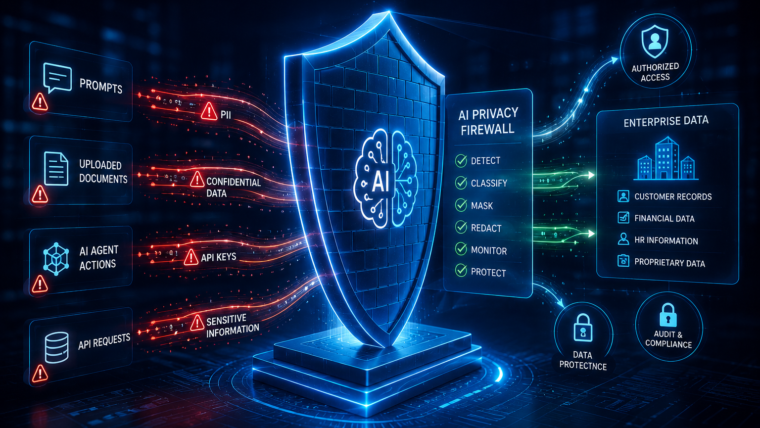
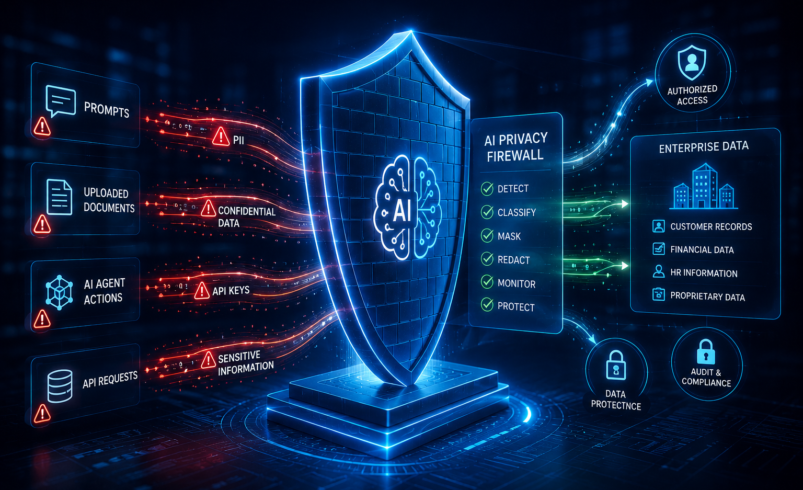
An AI privacy firewall can inspect information moving into and out of AI systems, identify sensitive content, and apply policies before the information reaches a model or downstream application.
What Is an AI Privacy Firewall?
An AI privacy firewall is a security and privacy control layer designed specifically for AI interactions.
Traditional network firewalls primarily evaluate network-level information such as addresses, ports, and protocols. They generally cannot determine whether an authorized AI request contains a customer’s personal information, a confidential contract, an API key, or proprietary source code.
An AI privacy firewall operates at the content and context level.
It can inspect prompts, uploaded documents, retrieved information, API requests, AI agent tool calls, and model outputs. When sensitive information is detected, the system can apply an organization-defined policy.
Depending on the situation, the information may be blocked, masked, redacted, anonymized, or tokenized before the AI interaction continues.
The purpose is not necessarily to prevent employees from using AI. Instead, it provides a controlled layer between sensitive business information and AI systems.
Why AI Creates New Data Leakage Risks
Generative AI has introduced data flows that traditional security tools were not necessarily designed to inspect.
An employee may copy a customer record into an AI assistant to create a response. A developer may submit proprietary source code to an AI coding tool to troubleshoot an error. A finance employee may upload a spreadsheet containing account information to generate a summary.
All of these actions can be legitimate business activities.
The risk comes from the information contained within those interactions.
Enterprise applications create similar challenges. An application calling an AI model through an API may automatically send more information than the model actually needs. A retrieval-augmented generation system can retrieve sensitive documents and include them in a model’s context. An AI agent can pass information between several tools while completing a task.
This means organizations need to understand AI data flows at a deeper level than simply monitoring network connections.
How AI Privacy Protects Sensitive Information
A strong AI Privacy strategy focuses on protecting information throughout the AI workflow.
The first step is identifying sensitive information. Depending on the organization, this could include names, email addresses, government identifiers, financial information, healthcare records, credentials, API keys, source code, customer records, or confidential business information.
After sensitive information is identified, the organization can decide how it should be handled.
Some information may need to be blocked entirely. Other information may only need to be masked or redacted. In certain workflows, anonymization or tokenization may allow the AI system to complete its task without receiving the original sensitive values.
The important point is that protection should be based on the context and business purpose rather than applying the same rule to every AI interaction.
Protecting Both AI Inputs and Outputs
AI privacy protection should not focus only on what enters a model.
AI outputs can also contain sensitive information.
For example, an AI system may receive information from a connected knowledge base and generate a response containing details that the current user should not see.
Similarly, an AI agent could retrieve sensitive information from one system and attempt to pass it to another application.
Output inspection provides an additional control point before the response reaches the user or another business system.
Protecting both directions creates a more complete privacy architecture.
AI Privacy for RAG Applications
Retrieval-augmented generation, or RAG, allows AI applications to retrieve information from enterprise knowledge bases and use that information to generate responses.
RAG can significantly improve the usefulness of enterprise AI, but it creates an important privacy concern.
The user may not explicitly provide sensitive information. Instead, the retrieval system may find it automatically.
For example, an internal AI assistant could retrieve information from an HR document, legal file, or customer record. If document-level permissions are not properly enforced, the AI model could receive information that the requesting user should not be authorized to access.
An AI privacy firewall can provide an additional inspection layer around retrieved content.
However, privacy controls should complement authorization rather than replace it. Proper document permissions and identity controls remain essential.
AI Privacy for AI Agents
AI agents introduce another level of complexity because they can perform multi-step tasks.
An agent might retrieve information from a database, send selected data to an AI model, call an external API, and then return a result to an employee.
Every step creates a potential data exposure point.
Organizations therefore need to consider two separate questions.
First, what is the AI agent allowed to do?
Second, what information is the AI agent allowed to expose while performing those actions?
An agent may legitimately have permission to access a customer database, but that does not mean every field from the database should be passed to an external tool.
This distinction is becoming increasingly important as enterprises adopt more autonomous AI systems.
AI Privacy and Shadow AI
Shadow AI creates another challenge for enterprises.
Employees can access public AI tools quickly and may use them for legitimate productivity tasks without realizing that the information they enter could create privacy risks.
Traditional policies telling employees not to share confidential information may not be enough.
Organizations need visibility into how AI is actually being used.
Browser-level controls, endpoint protection, enterprise AI gateways, and privacy policies can help organizations inspect AI interactions before sensitive information leaves an employee’s environment.
The goal should be to make secure AI adoption practical rather than simply preventing employees from using useful technology.
AI Privacy vs Traditional DLP
Traditional data loss prevention tools remain valuable, but AI introduces different challenges.
DLP systems are often designed around files, emails, endpoints, and structured patterns.
AI interactions are different. Prompts are free-form natural language, documents may be uploaded directly into AI applications, and sensitive information can appear in many different contexts.
An AI privacy firewall can complement traditional DLP by focusing specifically on AI inputs, outputs, RAG content, agent workflows, and AI application traffic.
These technologies do not need to replace one another.
Instead, organizations can use traditional security and DLP controls alongside AI-specific privacy protection.
Where Should an AI Privacy Firewall Be Deployed?
The right deployment depends on how an organization uses AI.
For employees using public AI tools, protection may be positioned at the browser or endpoint level.
For internal applications communicating with external models, an API gateway or AI gateway can provide centralized inspection.
RAG systems may require controls within the retrieval pipeline, while autonomous AI agents may need protection around their execution environment and tool connections.
Larger enterprises may need multiple enforcement points because AI traffic can originate from employees, applications, agents, APIs, and connected tools.
A centralized strategy can help organizations apply consistent privacy policies across these different environments.
How Questa AI Supports AI Privacy
Organizations looking for stronger AI Privacy controls need a solution that can protect sensitive information without preventing legitimate AI usage.
Questa AI takes a privacy-first approach to enterprise AI and focuses on protecting sensitive data during AI processing.
Its approach includes data anonymization and privacy-focused controls designed to reduce unnecessary exposure of sensitive information before it reaches an AI model.
This can be particularly useful for organizations processing customer information, healthcare data, financial records, confidential documents, source code, or other proprietary information.
Questa AI can form part of a broader enterprise architecture that combines identity management, governance, security, DLP, and AI-specific privacy controls.
The objective is to allow businesses to benefit from AI while maintaining stronger control over the information flowing through AI workflows.
Building an Enterprise AI Privacy Strategy
Implementing an AI privacy firewall should begin with understanding how AI is being used across the organization.
Businesses should identify the AI applications, models, agents, APIs, and workflows currently processing enterprise information.
The next step is mapping the data flows.
Organizations need to understand what information moves from users to models, from applications to APIs, from knowledge bases to RAG systems, and between AI agents and external tools.
Once these flows are understood, organizations can classify sensitive information and establish policies for different data types.
Some information may be blocked. Other information may be anonymized, masked, or redacted.
Testing is also important.
Organizations should measure detection accuracy and evaluate false positives and false negatives using realistic business data. Policies should then be adjusted as AI use cases evolve.
Measuring AI Privacy Effectiveness
Organizations should measure whether their privacy controls are actually working.
Useful metrics can include the amount of AI traffic inspected, sensitive-data detection events, blocked requests, anonymized interactions, policy violations, and unresolved privacy incidents.
Coverage is particularly important.
A privacy firewall that only protects a small portion of an organization’s AI usage may leave significant gaps elsewhere.
Organizations should therefore measure both the quality of detection and the percentage of AI interactions passing through privacy controls.
Regular reviews can help security teams identify new AI applications and emerging data flows.
The Future of AI Privacy
Enterprise AI will continue to evolve.
Organizations are moving from simple AI assistants toward RAG applications, autonomous agents, AI-powered business applications, and connected tools.
Each development creates new opportunities for productivity, but also creates additional data flows that organizations need to control.
AI privacy will therefore become increasingly important as businesses expand their use of intelligent systems.
The strongest approach will not be to stop sensitive data from being used with AI altogether.
Instead, organizations will need to understand what data is necessary, protect unnecessary sensitive information, enforce policies in real time, and maintain visibility throughout the AI lifecycle.
Conclusion
AI has created new ways for sensitive business information to move through enterprise systems.
Traditional network security and DLP remain important, but organizations also need controls that understand the content and context of AI interactions.
An AI privacy firewall can provide that additional layer by detecting sensitive information, applying policies, protecting AI inputs and outputs, and helping organizations control data flowing through RAG applications, APIs, and AI agents.
For enterprises building a responsible AI strategy, AI Privacy should be treated as a core architectural requirement rather than an afterthought.
With privacy-first solutions such as Questa AI, organizations can strengthen sensitive-data protection while continuing to adopt AI for business productivity and innovation.
The future of enterprise AI will depend not only on powerful models, but also on how effectively businesses can control, protect, and govern the data those models are allowed to process.