

Technology is now an important part of children’s education and everyday lives. Kids use computers, tablets, apps, games, and online platforms from an early age. Learning how these technologies work can give children an opportunity to become creators rather than simply users.
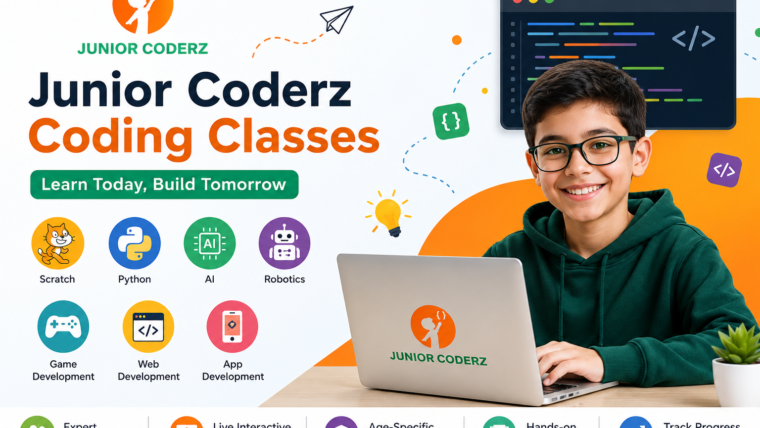
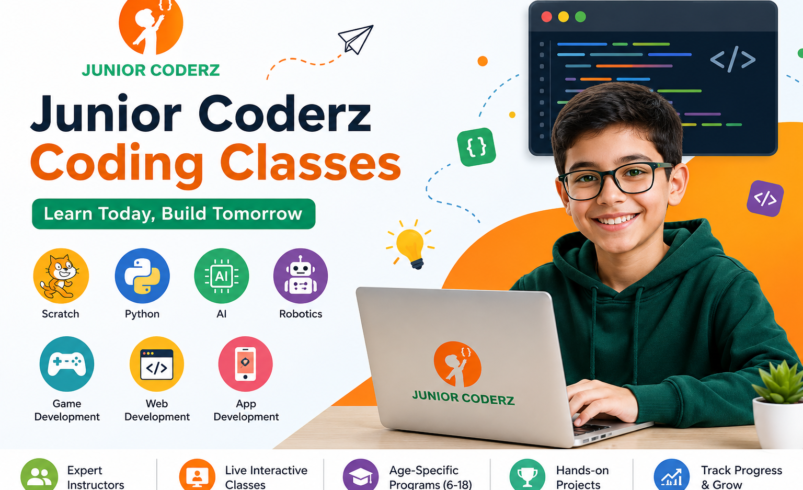
Junior Coderz coding classes are designed to introduce children and teenagers to programming and technology through age-appropriate learning. Students can explore different areas of coding, including Scratch, Python, game development, web development, app development, robotics, artificial intelligence, and more.
Why Should Kids Learn Coding?
Coding is not only about writing lines of programming code. It can help children develop valuable thinking and learning skills that can be useful across different subjects.
Problem-Solving
Programming encourages children to break complicated challenges into smaller steps. They can test different approaches, identify problems, and improve their solutions.
Logical Thinking
Coding introduces concepts such as sequences, conditions, loops, variables, and algorithms. Working with these concepts encourages structured thinking.
Creativity
Children can use programming to turn their ideas into practical projects, including:
- Games
- Animations
- Websites
- Apps
- Interactive stories
- Digital creations
Persistence
When a program does not work as expected, students need to investigate what went wrong. This process can encourage patience and persistence.
Technology Confidence
Creating a project from scratch can help children become more comfortable with technology and develop confidence in their own abilities.
What Makes Junior Coderz Coding Classes Different?
A useful coding program should be suitable for a child’s age and learning level. Children who are just beginning programming need a different approach from teenagers who are ready for advanced Python or artificial intelligence.
Junior Coderz provides age-based technology education that allows students to progress through different levels of coding and STEM learning.
The programs cover a broad range of subjects, including:
- Scratch coding
- Python programming
- Game development
- Web development
- App development
- Robotics
- Electronics
- 3D modeling
- Artificial intelligence
- Machine learning
This variety gives students opportunities to discover which areas of technology interest them most.
Learning Through Different Areas of Technology
Scratch Coding for Beginners
Scratch uses visual programming blocks that allow younger learners to understand programming concepts without immediately dealing with complex syntax.
Students can use Scratch to create games, animations, and interactive stories while learning fundamental concepts such as sequences, events, loops, and conditions.
For young beginners, visual programming can provide a friendly introduction to coding.
Python Programming
Python is a popular programming language that can provide a pathway toward more advanced programming.
Students can learn concepts such as:
- Variables
- Functions
- Loops
- Conditions
- Algorithms
- Debugging
- Object-oriented programming
As students become more comfortable with Python, they can use their skills in projects involving games, applications, automation, and artificial intelligence.
Game Development
Game development combines technical skills with creativity.
Children can explore how characters move, how game rules work, how scores are calculated, and how different interactions are programmed.
Building games can make programming concepts more practical because students can immediately see the results of their work.
Web Development
Web development introduces students to the technologies used to create websites.
As learners progress, they can explore:
- HTML
- CSS
- JavaScript
- Webpage structure
- Styling
- Interactive features
Creating a webpage can help students understand how the websites they use every day are built.
App Development
App development allows students to transform ideas into digital applications.
They can explore programming, functionality, user interaction, and basic application design while working toward practical projects.
Robotics and Electronics
Robotics connects programming with engineering and physical systems.
Students can explore concepts related to robots, electronics, sensors, circuits, automation, and programming.
This can help children understand that coding is not limited to computers and websites.
Artificial Intelligence
Artificial intelligence is another important area of modern technology.
Age-appropriate AI education can introduce students to concepts such as machine learning, generative AI, automation, and prompt engineering.
Learning about AI can help students understand some of the technologies that are increasingly becoming part of everyday life.
Age-Appropriate Coding Education
Children develop their skills at different rates, which is why age and experience are important when selecting a coding course.
Junior Coderz offers programs designed for different stages of learning.
Younger Beginners
Young learners can begin with foundational computer and coding concepts, visual programming, logical thinking, and beginner-friendly projects.
Intermediate Learners
As students gain experience, they can explore programming languages such as Python along with game development, robotics, AI, web development, and app development.
Advanced Students
Older learners can progress into more advanced programming, web technologies, artificial intelligence, and complex technology projects.
This gradual approach can make it easier for students to build upon knowledge they have already developed.
Benefits of Project-Based Coding
One of the most useful aspects of learning programming is being able to apply concepts through projects.
Instead of only memorizing programming rules, students can use what they learn to create something.
For example:
Learning loops → using repeated actions in a game.
Learning conditions → deciding what happens when a player completes an action.
Learning Python → building a small program.
Learning web development → creating an interactive webpage.
Learning AI → experimenting with an age-appropriate AI project.
Projects can make lessons more meaningful because students can see how individual programming concepts work together.
Skills Children Can Develop Through Coding
Coding education can support the development of several transferable skills.
Critical Thinking
Students need to understand a problem before deciding how to approach it.
Attention to Detail
Programming often requires careful attention because a small mistake can affect how a project works.
Creativity
Children can develop original ideas and decide how they want their projects to look and behave.
Organization
Large projects can be divided into smaller tasks, helping students understand how complex work can be managed.
Persistence
Debugging encourages students to investigate problems and try alternative solutions.
Independent Learning
As children become more familiar with programming concepts, they can experiment with their own ideas and discover new solutions.
How Parents Can Support Coding Education
Parents do not need to be programmers to encourage their children to learn coding.
Choose an Appropriate Starting Point
A beginner should have an introduction suited to their age and experience rather than being placed immediately into advanced programming.
Follow the Child’s Interests
If a child enjoys games, game development may be motivating. Another child may prefer robotics, websites, apps, Python, or AI.
Encourage Creativity
Allow children to experiment with their own project ideas instead of expecting every project to look the same.
Celebrate Progress
Finishing a first game, webpage, or programming project can be an important milestone for a young learner.
Encourage Questions
Curiosity is an important part of technology education. Asking how and why something works can lead to deeper understanding.
Why Start Coding at a Young Age?
Early exposure to coding can give children more time to explore technology and gradually develop their abilities.
A child might start by creating a simple Scratch animation and later move into Python, web development, robotics, or AI.
The important part is progression.
Children do not need to master everything at once. They can develop their skills step by step while discovering the technology areas they enjoy most.
Exploring Junior Coderz Coding Classes
Junior Coderz coding classes provide children and teens with opportunities to explore programming and different technology fields through structured learning.
The platform’s technology-focused education includes areas such as Scratch, Python, game development, web development, app development, robotics, electronics, 3D modeling, artificial intelligence, and machine learning.
This broad curriculum can help students explore different interests while building foundational programming knowledge.
Rather than focusing exclusively on one programming language, children can gradually discover how coding connects with games, websites, applications, robotics, design, and emerging technologies.
From Learning Code to Creating Projects
The most exciting part of coding is being able to create something from an idea.
A child may begin with a simple question:
“Can I make my own game?”
Another student might ask:
“Can I build a website?”
Someone else may want to create an application, experiment with a robot, or explore artificial intelligence.
Coding gives students a way to turn these questions into projects.
With guidance and consistent practice, young learners can move from understanding basic programming concepts to creating increasingly complex digital projects.
Preparing Kids for a Technology-Focused Future
Technology will continue to change. Programming languages, software, and digital tools may evolve, but fundamental skills such as logical reasoning, creativity, problem-solving, and adaptability can remain valuable.
Learning coding can therefore be about more than preparing for a particular technology career.
It can help children develop a mindset for:
- Understanding problems
- Breaking challenges into manageable steps
- Creating solutions
- Testing ideas
- Finding mistakes
- Improving projects
- Learning from experience
These habits can be useful both in technology and in everyday learning.
Final Thoughts
Learning to code can open up a world of creativity and technology for children. With the right learning environment, students can move from simple programming concepts toward games, websites, apps, robotics, Python, artificial intelligence, and other exciting technology projects.
Junior Coderz coding classes provide an age-focused approach to coding and STEM education, giving young learners opportunities to explore different areas of technology while developing logical thinking, creativity, problem-solving, and technical confidence.
The goal of children’s coding education is not simply to teach programming commands. It is to encourage young learners to think, experiment, create, solve problems, and build with technology.