
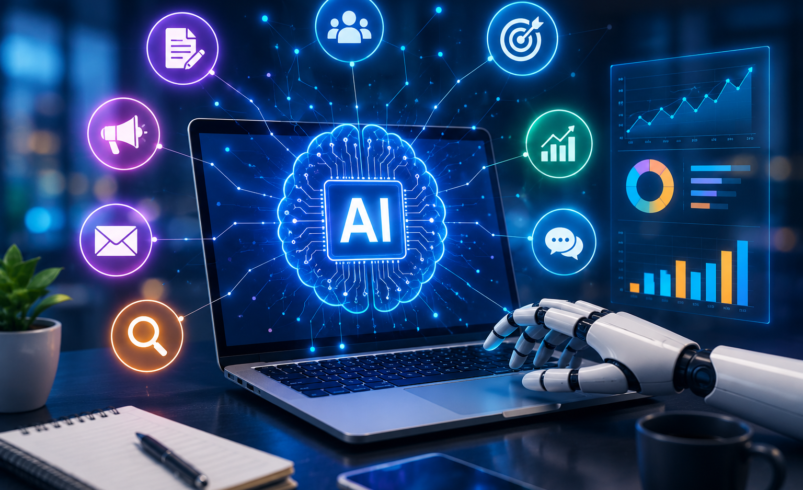

Artificial intelligence is no longer a concept limited to technology companies. It is now becoming part of everyday marketing, from content creation and customer support to advertising, personalization, search, and data analysis.
For businesses in the United States, this shift creates a major opportunity. Marketing teams can use AI to understand customers faster, produce content more efficiently, identify patterns in campaign data, and deliver more relevant experiences. At the same time, businesses need to understand where AI helps and where human judgment remains essential.
This guide explains AI in digital marketing, how businesses can use it, what benefits and challenges to consider, and how marketers can build an effective AI-supported strategy without sacrificing quality or trust.
Table of Contents
- What Is AI in Digital Marketing?
- Why AI Matters for Modern Businesses
- How AI Is Used in Digital Marketing
- AI and Personalized Customer Experiences
- AI in SEO and Search
- AI for Paid Advertising
- Benefits of AI for Marketing Teams
- Challenges Businesses Should Consider
- How to Implement AI Responsibly
- The Future of AI in Digital Marketing
- Final Thoughts
What Is AI in Digital Marketing?
AI in digital marketing refers to using artificial intelligence technologies to analyze information, automate repetitive tasks, predict customer behavior, personalize experiences, and support marketing decisions.
Instead of replacing the entire marketing process, AI can work as an additional layer of intelligence. It can process large amounts of information much faster than a person and identify patterns that may otherwise take hours to discover.
For example, an AI-powered marketing system can analyze website behavior, email interactions, purchase history, and campaign performance to identify customer segments. Marketers can then use those insights to create more relevant campaigns.
AI is already widely used by marketing professionals. HubSpot’s research found that 66% of marketers globally were using AI in their roles, while concerns around data privacy, training, and disconnected tools remained significant barriers to adoption.
Why AI Matters for Modern Businesses
Traditional marketing often requires teams to manually collect data, analyze performance, create content, segment audiences, and adjust campaigns.
AI can reduce the time required for many of these activities.
This does not mean businesses should automate everything. The real advantage comes from combining machine efficiency with human strategy.
Google’s guidance on AI and marketing highlights the ability to create campaign variations more efficiently, improve relevance, and use data to refine marketing activity.
For a small business, this can mean doing more with a limited marketing team. For a larger organization, it can help marketing departments manage complex campaigns across multiple channels.
How AI Is Used in Digital Marketing
AI can support almost every stage of the marketing process.
1. Content Creation
Generative AI can help marketers create initial drafts for:
- Blog posts
- Email campaigns
- Social media captions
- Ad copy
- Product descriptions
- Video scripts
- Content outlines
- Headlines
However, AI-generated content should not simply be published without review.
Human marketers still need to check facts, add original insights, understand the audience, and make sure the content reflects the brand’s voice.
Google’s current Search guidance also emphasizes that SEO best practices remain relevant for content appearing in AI-powered search experiences. It specifically encourages useful, original content rather than content created simply to manipulate search visibility.
2. Customer Personalization
One of the strongest applications of AI is personalization.
AI can analyze customer behavior and adjust marketing experiences based on interests, browsing activity, previous purchases, and engagement patterns.
For example, an ecommerce company can recommend products based on what a customer has previously viewed. An email campaign can present different products or messages to different audience segments.
HubSpot describes AI personalization as the ability to adapt customer experiences in real time based on behavior and available data.
The key is balance. Personalization should make an experience more useful, not make customers feel that their privacy has been ignored.
3. Data Analysis
Marketing generates enormous amounts of data.
AI can help analyze:
- Website traffic
- Conversion rates
- Customer behavior
- Ad performance
- Email engagement
- Social media activity
- Sales trends
- Audience segments
Instead of manually reviewing every report, marketers can use AI to identify patterns and highlight areas that deserve attention.
This allows marketing teams to spend more time making decisions and less time sorting through spreadsheets.
4. Chatbots and Customer Support
AI-powered chatbots can answer common customer questions, provide basic product information, qualify leads, and direct customers to the right resources.
For businesses that receive inquiries outside normal working hours, this can provide faster initial responses.
However, complex or sensitive customer issues should still be transferred to a human representative.
AI and Personalized Customer Experiences
Customers increasingly expect brands to understand their needs.
Salesforce’s 2026 State of Marketing research found that 83% of marketers reported that customers increasingly expect two-way conversations with brands, while 75% of marketers said they were using AI to help meet the growing demand for personalized content.
This shows why AI is becoming important beyond simple automation.
A business can use AI to identify where a customer is in the buying journey and provide information that matches that stage.
For example:
Awareness: Educational content
Consideration: Comparisons and case studies
Decision: Product information, demonstrations, or consultations
Retention: Support, recommendations, and personalized offers
The goal is not to send more messages. It is to make each interaction more relevant.
AI in SEO and Search
Search behavior is changing rapidly.
Google now provides AI-powered experiences through features such as AI Overviews and AI Mode. Google has also published guidance specifically addressing how websites can appear in generative AI features.
This means businesses need to think beyond traditional rankings.
Strong SEO fundamentals still matter. Websites should provide clear information, demonstrate expertise, answer user questions, maintain technical quality, and publish genuinely useful content.
AI search also makes brand authority increasingly important. If a business is consistently mentioned across credible sources, publications, industry websites, and its own high-quality content, it can strengthen its overall online presence.
For marketers, the goal should not be to create content specifically for machines. The goal is to create useful content that people can understand and search systems can interpret accurately.
AI for Paid Advertising
Paid advertising is another area where AI can improve efficiency.
Advertising platforms increasingly use machine learning to help with audience targeting, bidding, creative variations, and campaign optimization.
Google’s marketing research highlights AI’s potential to create multiple creative variations and adjust campaigns based on consumer needs and real-time signals.
For marketers, this means the role is shifting from manually controlling every campaign setting toward setting clear goals, providing quality inputs, reviewing performance, and making strategic decisions.
AI can optimize a campaign, but it still needs accurate tracking, strong creative assets, good offers, and a clear understanding of the target audience.
Benefits of AI for Marketing Teams
When implemented properly, AI can provide several practical benefits.
Faster Workflows
Repetitive tasks can be completed faster, giving marketers more time for strategy and creative thinking.
Better Personalization
AI can help businesses tailor content and experiences to different customer groups.
Smarter Decision-Making
Large datasets can be analyzed more efficiently, helping marketers identify patterns and opportunities.
Improved Productivity
Marketing teams can use AI for research, brainstorming, reporting, content development, and campaign analysis.
Scalable Marketing
AI makes it easier to manage personalization and content variations as businesses grow.
Maninder Wave focuses on combining technology with human marketing judgment so that AI supports the strategy instead of becoming the strategy itself.
Challenges Businesses Should Consider
AI also introduces important risks.
Data Privacy
Customer information must be handled responsibly. HubSpot’s research found that 42% of marketers cited data privacy concerns as a barrier to adopting new AI tools.
Businesses should understand what information an AI platform collects, how it is stored, and how it may be used.
Accuracy
AI can produce incorrect or outdated information. Every important piece of content should be reviewed before publication.
Brand Voice
Automatically generated content can sound generic. Human editing is necessary to maintain personality, originality, and consistency.
Over-Automation
Customers still value human interaction. Automating every communication can make a brand feel impersonal.
Too Many Tools
Using several disconnected AI platforms can create more complexity rather than reducing it. HubSpot found that 35% of surveyed marketers considered having too many similar AI tools a barrier to adoption.
How to Implement AI Responsibly
Businesses do not need to introduce dozens of AI tools at once.
A better approach is to start with one or two specific problems.
For example:
- Identify a repetitive marketing task.
- Choose an AI tool that addresses that task.
- Create clear guidelines for its use.
- Keep human review in the workflow.
- Measure the results.
- Improve the process before expanding it.
Businesses should also create internal rules for privacy, fact-checking, brand voice, and acceptable AI use.
The most successful approach is usually AI-assisted marketing, not completely automated marketing.
The Future of AI in Digital Marketing
The role of AI in marketing will continue expanding.
Search engines are becoming more conversational. Customers are using AI tools to research products and services. Marketing platforms are becoming more automated. At the same time, businesses are expected to provide faster and more personalized experiences.
Salesforce’s 2026 research found that 85% of marketers surveyed said AI was reshaping their SEO strategy, while 88% had started optimizing for AI-generated responses such as ChatGPT and Google’s AI Overview.
This suggests that marketers will increasingly need skills across SEO, content, analytics, customer experience, automation, and AI.
But human expertise will remain important.
AI can analyze patterns, generate drafts, and automate workflows. It cannot independently understand every business’s customers, reputation, culture, positioning, and long-term goals.
Final Thoughts
AI in digital marketing is not simply about using the newest tool. It is about finding practical ways to improve marketing performance while protecting quality, accuracy, privacy, and the human connection.
Businesses can use AI to create content faster, analyze customer behavior, personalize campaigns, improve advertising, support customers, and adapt to changes in search.
The companies that benefit most will not necessarily be the ones using the most AI tools. They will be the ones that understand where AI creates genuine value and where human expertise should remain in control.
As search, advertising, content, and customer experiences continue to evolve, businesses need a marketing strategy that can adapt with them.
Maninder Wave helps businesses approach modern digital marketing with a combination of strategy, content, SEO, social media, and emerging AI capabilities.