

Retrieval-Augmented Generation (RAG) systems are increasingly used by organizations to connect large language models with proprietary documents, knowledge bases, product catalogs, policies, and other business information. However, a RAG application can appear accurate during a few manual tests while still failing on important questions, missing relevant documents, or generating unsupported answers. Synthetic test data for RAG evaluation provides a practical way to create realistic, repeatable test cases without depending entirely on limited production data.
A well-designed synthetic dataset can help teams evaluate retrieval quality, answer accuracy, citation behavior, hallucination resistance, and system reliability before and after deployment. Instead of waiting for real users to expose weaknesses, we can deliberately generate scenarios that represent common questions, difficult edge cases, ambiguous requests, and known failure patterns.
For organizations building conversational AI systems, systematic RAG testing can also complement professional AI chatbot development services by providing a measurable way to validate whether an AI application retrieves and uses business knowledge correctly. The goal is not to create artificial data simply for volume; it is to create purpose-built evaluation scenarios that expose meaningful weaknesses.
What Is Synthetic Test Data for RAG Evaluation?
Synthetic test data is artificially generated information designed to simulate realistic inputs and expected outcomes.
For RAG evaluation, synthetic test data commonly includes:
- User questions
- Reference answers
- Relevant document identifiers
- Expected citations
- Retrieval targets
- Difficulty levels
- Metadata
- Ground-truth facts
- Adversarial questions
- Expected failure behavior
For example, suppose a company maintains a 500-page employee handbook. We can create synthetic evaluation questions such as:
“How many days of parental leave are available to eligible full-time employees?”
The evaluation record could specify the expected answer, the document section containing the policy, and the source that should be retrieved.
This gives us a controlled test case rather than an informal prompt.
Why Synthetic Data Matters for RAG Evaluation
A RAG system generally has two major responsibilities:
- Retrieve relevant information.
- Generate an accurate response using that information.
These responsibilities can fail independently.
An agent may retrieve the correct document but misunderstand it. Conversely, the model may produce a plausible response even though the retrieval system selected irrelevant content.
Synthetic test data allows teams to evaluate both components separately and together.
A comprehensive dataset can help answer questions such as:
- Did the system retrieve the correct document?
- Did it retrieve enough relevant context?
- Did it ignore irrelevant documents?
- Did the generated answer match the available evidence?
- Did the system cite the correct source?
- Did it hallucinate information that was not retrieved?
- Did it handle questions with no answer in the knowledge base?
These measurements are especially valuable for U.S. organizations using RAG for customer support, internal documentation, financial information, product knowledge, legal workflows, and enterprise search.
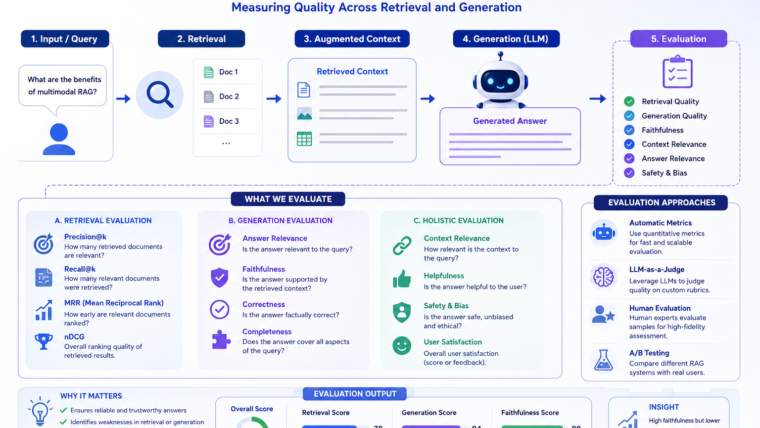
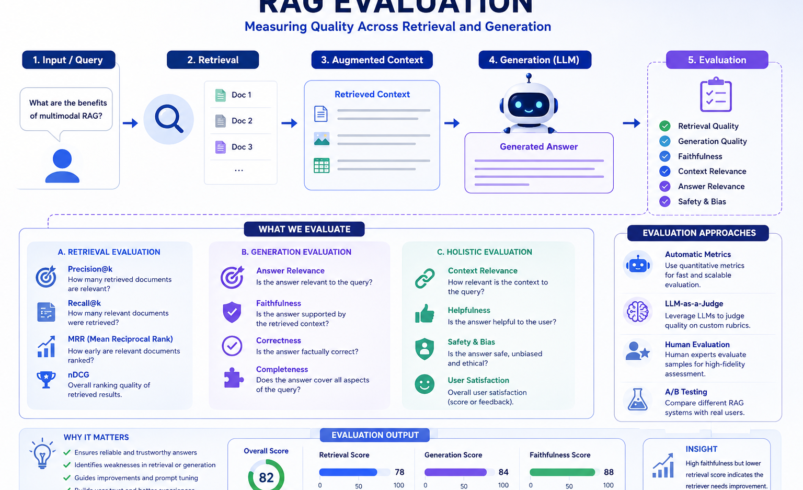
Understand the RAG Evaluation Pipeline
Before generating synthetic data, we should understand the complete RAG workflow.
A typical RAG architecture looks like this:
User Question
      ↓
Query Processing
      ↓
Embedding / Search
      ↓
Document Retrieval
      ↓
Reranking
      ↓
Context Assembly
      ↓
LLM Generation
      ↓
Answer + Citations
      ↓
Evaluation
Synthetic evaluation data should test multiple points in this pipeline.
For example, a question may be intentionally phrased differently from the wording used in the source document. This allows us to determine whether semantic retrieval can identify the correct information.
Step 1: Define the RAG Evaluation Objectives
The first step is to establish exactly what we want to measure.
Different RAG systems have different requirements.
A customer support system may prioritize:
- Correct answers
- Relevant retrieval
- Citation accuracy
- Low hallucination rates
- Fast responses
An internal enterprise search system may prioritize:
- Recall
- Source relevance
- Document permissions
- Comprehensive answers
A research assistant may prioritize:
- Source quality
- Evidence grounding
- Citation completeness
- Factual accuracy
Therefore, we should define evaluation objectives before generating test data.
A useful evaluation plan might include:
| Evaluation Area | Key Question |
|---|---|
| Retrieval relevance | Did the system find the right information? |
| Retrieval recall | Did it find all important sources? |
| Answer correctness | Is the response factually correct? |
| Groundedness | Is the answer supported by retrieved content? |
| Citation accuracy | Do citations support the claims? |
| Hallucination | Did the model invent unsupported information? |
| Refusal quality | Does the system correctly say when information is unavailable? |
Step 2: Build a Source Knowledge Base
Synthetic questions should be generated from the actual content the RAG system is expected to retrieve.
This means we should begin with a representative knowledge base.
Possible sources include:
- Product documentation
- Employee policies
- Technical manuals
- Frequently asked questions
- Customer support articles
- Legal policies
- Financial documents
- Internal procedures
- Product catalogs
The quality of synthetic evaluation data depends heavily on the quality of the source material.
If the source documents are outdated, contradictory, or poorly structured, synthetic questions may inherit those problems.
Therefore, document preparation should happen before large-scale test generation.
Step 3: Generate Multiple Question Types
One of the biggest mistakes in RAG evaluation is creating only straightforward questions.
Real users rarely phrase every question exactly as expected.
A strong synthetic dataset should include different question categories.
Direct Questions
These closely correspond to information contained in the source.
Example:
“What is the standard return period for this product?”
These test basic retrieval and answer generation.
Paraphrased Questions
The question uses different wording from the source.
For example, a policy might say:
“Employees must submit expense reports within 30 calendar days.”
A synthetic question could be:
“How long do employees have to file their expenses?”
This tests semantic retrieval.
Multi-Hop Questions
These require combining information from multiple passages or documents.
For example:
“Which subscription includes priority support, and what is the cancellation requirement for that plan?”
The answer may require retrieving two separate pieces of information.
Ambiguous Questions
These test whether the system recognizes uncertainty.
Example:
“What is the company’s refund policy?”
If several products have different refund policies, the agent should ask for clarification rather than confidently choosing one.
Unanswerable Questions
These are essential for hallucination testing.
For example:
“What discount does the company offer to employees of airlines?”
If the knowledge base contains no such policy, the correct behavior may be to state that the information is unavailable.
Adversarial Questions
These attempt to manipulate the system.
Examples include:
- Prompt injection attempts
- Requests to ignore system instructions
- Questions containing misleading assumptions
- Instructions hidden inside retrieved documents
These cases help evaluate RAG security and robustness.
Step 4: Generate Ground-Truth Answers
Synthetic questions are useful only when we can determine what constitutes a correct result.
For each test case, we should ideally maintain:
- Question
- Expected answer
- Supporting document
- Supporting passage
- Document ID
- Relevant metadata
- Answerability status
For example:
Question:
How many vacation days are available after five years?

Expected Answer:
Employees receive 20 vacation days after completing five years of service.

Source:
Employee Handbook, Section 4.2

Answerable:
Yes
The ground truth does not necessarily need to match the model’s answer word for word.
Instead, evaluation should determine whether the response contains the correct meaning and sufficient supporting evidence.
Step 5: Create Difficult Synthetic Test Cases
A useful evaluation dataset should challenge the system.
We can systematically introduce difficulty by changing:
- Question wording
- Number of required documents
- Amount of irrelevant information
- Query length
- Vocabulary
- Context complexity
- Ambiguity
- Number of reasoning steps
For example, instead of testing:
“What is the warranty period?”
we might test:
“If a customer purchased the device through an authorized retailer last year, does the standard warranty still apply, and what exclusions should they know about?”
The second question is more representative of real-world complexity.
Step 6: Generate Negative and Unanswerable Examples
Negative examples are particularly important because a RAG system should not answer every question.
Consider a company knowledge base containing information about software products.
A user asks:
“What is the company’s physical store return policy in Texas?”
If the knowledge base contains no physical retail policy, the system should not invent one.
Synthetic datasets should therefore contain questions for which no valid answer exists in the source material.
This allows teams to measure whether the model knows when to abstain.
A useful metric can be:
Correct Abstention Rate = Correctly Refused Unanswerable Questions ÷ Total Unanswerable Questions × 100
This is especially important for high-risk business applications.
Step 7: Add Retrieval Ground Truth
RAG evaluation should not focus exclusively on final answers.
We should also specify which documents or passages should be retrieved.
For each synthetic query, define:
- Relevant document IDs
- Relevant chunks
- Primary source
- Secondary sources
- Irrelevant but similar documents
This enables retrieval metrics such as:
Recall@K
Measures whether the relevant document appears within the top K retrieved results.
Precision@K
Measures how many retrieved results are actually relevant.
Mean Reciprocal Rank
Measures how highly the first relevant result appears.
These metrics help identify whether a problem originates in retrieval rather than generation.
Step 8: Use Controlled Variations
Synthetic test generation becomes much more useful when we create controlled variations of the same underlying question.
Suppose the source states:
“Customers may return unopened products within 30 days.”
We can create variations such as:
- “How long can I return an unopened product?”
- “What’s the return window for unopened items?”
- “Can I send back a sealed product after three weeks?”
- “Does the 30-day return policy apply to unused products?”
These variations test whether the RAG system understands intent rather than matching exact phrases.
Step 9: Test Metadata and Access Controls
Enterprise RAG systems often use metadata such as:
- Department
- Location
- Document type
- Customer account
- Date
- Permission level
- Product category
Synthetic data should test whether retrieval respects these constraints.
For example, a U.S. company may have different policies for employees in California, Texas, and New York.
A synthetic query could test whether the system retrieves the correct regional policy rather than returning a generic company-wide document.
This is particularly important when document-level permissions are involved.
A technically accurate answer can still be a serious security failure if it comes from information the user should not be allowed to access.
Step 10: Introduce Temporal Test Cases
Business information changes over time.
Policies, prices, product specifications, regulations, and procedures may be updated.
Synthetic RAG evaluation should therefore include temporal questions.
For example:
“What was the subscription price in 2024?”
The system should distinguish between historical and current information.
A dataset can include:
- Old documents
- New documents
- Effective dates
- Expiration dates
- Version numbers
- Conflicting historical information
This tests whether retrieval prioritizes the appropriate version.
How to Evaluate Synthetic RAG Data Quality
Creating thousands of synthetic examples does not guarantee a high-quality evaluation set.
Synthetic data itself must be validated.
Check Question Diversity
Avoid generating hundreds of questions that follow the same linguistic pattern.
Check Ground-Truth Accuracy
Every answer should be traceable to authoritative source material.
Remove Duplicates
Near-duplicate questions can distort evaluation scores.
Verify Difficulty Distribution
The dataset should contain a balanced mixture of easy, moderate, complex, ambiguous, and adversarial examples.
Conduct Human Sampling
Human reviewers should inspect a sample of generated cases to identify:
- Incorrect answers
- Ambiguous questions
- Unsupported assumptions
- Poorly constructed scenarios
- Incorrect source mappings
Human review is especially valuable before using the dataset as a benchmark.
Synthetic Data vs. Real-World RAG Evaluation Data
Synthetic data should complement, not necessarily replace, real user data.
Synthetic Data Advantages
- Easy to scale
- Controlled scenarios
- Reproducible
- Useful for rare edge cases
- No dependence on large production datasets
- Easier privacy management when generated correctly
Real Data Advantages
- Captures genuine user behavior
- Reveals unexpected questions
- Includes natural language variation
- Reflects real business workflows
- Exposes production-specific problems
The strongest strategy is often a hybrid evaluation dataset.
We can use synthetic data to systematically test known requirements and real-world examples to discover unexpected failure modes.
Common Mistakes When Creating Synthetic RAG Data
Generating Data Without Ground Truth
Synthetic questions without reliable answers are difficult to evaluate objectively.
Creating Only Easy Questions
A benchmark containing simple queries can make a weak RAG system appear stronger than it is.
Ignoring Unanswerable Queries
A system must know when information is unavailable.
Overusing Templates
Excessive templates can produce artificial linguistic patterns that do not represent real users.
Ignoring Retrieval Quality
A correct answer does not prove that the retrieval system worked correctly.
Forgetting Data Security
Synthetic datasets should still be managed carefully, especially when they are generated from proprietary source material.
Best Practices for Synthetic RAG Evaluation
A strong process should follow several principles.
1. Start With Real Requirements
Generate tests from actual user journeys and business objectives.
2. Preserve Traceability
Every expected answer should connect to authoritative source material.
3. Mix Question Types
Include direct, paraphrased, multi-hop, ambiguous, unanswerable, temporal, and adversarial cases.
4. Evaluate Retrieval and Generation Separately
This makes root-cause analysis easier.
5. Version Your Dataset
When source documents or business requirements change, update the evaluation dataset and preserve historical versions.
6. Automate Regression Testing
Run the benchmark whenever you change:
- Embedding models
- Retrieval algorithms
- Chunking strategies
- Rerankers
- Prompts
- Foundation models
- Knowledge bases
7. Track Failure Categories
Instead of simply reporting that the system failed, classify failures as:
- Retrieval miss
- Incorrect ranking
- Missing context
- Hallucination
- Citation error
- Reasoning error
- Metadata error
- Permission violation
- Refusal failure
This provides much more actionable information.
A Practical Synthetic RAG Evaluation Workflow
We can organize the entire process into eight stages:
Stage 1: Collect Source Documents
Gather representative and authoritative knowledge.
Stage 2: Identify Facts and Concepts
Extract important policies, entities, relationships, dates, and procedures.
Stage 3: Generate Questions
Create multiple question types and difficulty levels.
Stage 4: Generate Ground Truth
Map each question to the correct answer and supporting source.
Stage 5: Validate the Dataset
Use automated checks and human sampling.
Stage 6: Run the RAG System
Submit each question and capture retrieved documents, generated responses, and citations.
Stage 7: Score Performance
Measure retrieval and generation metrics independently.
Stage 8: Analyze and Improve
Identify recurring failures and modify the RAG pipeline accordingly.
Building a Continuous RAG Evaluation Program
RAG evaluation should not be a one-time exercise.
As organizations update their knowledge bases and AI models, previously successful behavior can change.
A continuous evaluation program should maintain:
- Versioned test datasets
- Automated benchmark runs
- Retrieval metrics
- Answer-quality metrics
- Citation checks
- Hallucination tests
- Security evaluations
- Production failure examples
- Human review samples
Teams can then compare results between system versions.
For example:
| Metric | Version A | Version B |
| Retrieval Recall@5 | 91% | 95% |
| Answer Accuracy | 89% | 94% |
| Citation Accuracy | 92% | 96% |
| Correct Abstention | 84% | 91% |
| Critical Security Failures | 2 | 0 |
The exact targets will vary by application, but tracking performance over time makes improvements measurable.
Conclusion
Synthetic test data for RAG evaluation gives development teams a controlled and scalable way to test retrieval-augmented generation systems. By generating realistic questions, reliable ground-truth answers, relevant document mappings, difficult scenarios, and unanswerable cases, we can identify weaknesses that simple manual testing may overlook.
The most effective approach evaluates the entire RAG pipeline. We should measure retrieval relevance, recall, answer correctness, groundedness, citation accuracy, hallucination resistance, refusal behavior, metadata filtering, and security rather than relying on a single score.
For U.S. organizations deploying RAG-powered applications, synthetic evaluation can also reduce dependence on limited production examples while making regression testing more systematic. However, synthetic data works best when combined with carefully selected real-world interactions and human review.
The objective is not to create the largest possible test dataset. It is to build a diverse, traceable, challenging, and continuously maintained evaluation benchmark that reflects the risks and requirements of the real application. With that foundation, teams can improve RAG systems more confidently and determine whether a new model, retrieval strategy, or prompt actually delivers better performance.