

For many businesses, water is not simply a basic utility. It is part of everyday operations. Restaurants use it for food preparation, offices need it for employees and visitors, schools require safe drinking water for students, and small industries may depend on treated water for specific processes. As demand increases, relying on ordinary domestic water purifiers can become inconvenient and inefficient.
This is where a commercial 100 LPH RO Plant can provide a more organized solution.
A 100 LPH system is designed to produce approximately 100 litres of treated water per hour under appropriate operating conditions. While this capacity may appear modest compared with large industrial RO systems, it can be highly practical for facilities with regular and predictable water requirements.
The important point is that commercial water treatment should not be approached as a simple equipment purchase. A successful installation combines water analysis, treatment technology, storage, distribution, maintenance, and responsible water use.
Why Businesses Are Moving Toward Centralized Water Treatment
In a small workplace, individual water purifiers may appear convenient. One purifier can be installed in a pantry, another near a reception area, and perhaps another in a staff room.
As the facility grows, this arrangement can become difficult to manage.
Different machines may require different filters. Maintenance schedules can become confusing. Employees may have to wait for purified water during busy periods. Some units may operate continuously while others remain underused.
A centralized RO plant changes this model.
Instead of treating water independently at several locations, the facility can produce purified water from one dedicated treatment system and distribute it through an appropriate storage and piping arrangement.
This can make maintenance more structured and allow the business to monitor water treatment from a central point.
A 100 LPH RO Plant can be particularly relevant where water demand is higher than a household purifier can comfortably handle but lower than the requirements of a major industrial installation.
Capacity Should Match Consumption, Not Building Size
A common misconception is that larger buildings automatically need larger RO plants.
That is not necessarily true.
A 10-storey office with limited purified-water consumption may require less treated water than a smaller restaurant serving hundreds of customers.
The correct capacity depends on how water is actually consumed.
Businesses should consider:
- Number of users
- Daily operating hours
- Drinking-water requirements
- Kitchen requirements
- Production requirements
- Peak consumption
- Storage capacity
- Future expansion
For example, a facility that needs purified water steadily throughout an eight-hour working day may be able to use a 100 LPH system effectively, especially when supported by suitable storage.
On the other hand, an operation requiring a large volume within a short period may need a higher-capacity system.
The objective should always be to select equipment according to the application’s water profile.
What Happens Inside a 100 LPH RO System?
Although the final product is simply purified water, the treatment process can involve several carefully selected stages.
The first stage usually focuses on protecting the main RO membrane.
Raw water may contain sand, dust, suspended particles, chlorine, hardness, iron, and other substances. Allowing these contaminants to reach the membrane without appropriate pre-treatment can affect performance.
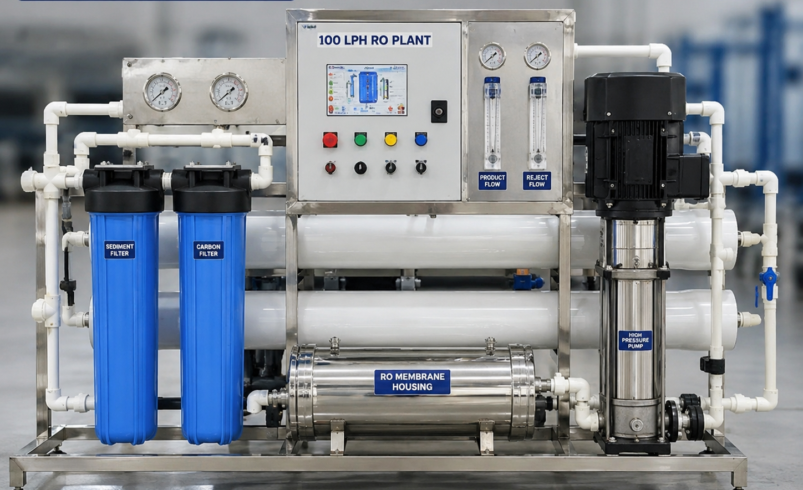
A typical system may therefore include sediment filtration and activated carbon treatment before the RO stage.
The water is then pressurized and passed through the RO membrane.
The membrane separates a purified stream from a concentrated stream. The purified water moves toward storage or final treatment, while the concentrated stream is discharged or considered for suitable reuse.
Depending on the application, additional treatment can be added after RO.
UV treatment may be considered for microbial control, while other technologies can be used when a particular water-quality requirement exists.
There is no universal treatment combination that works perfectly for every site. The design should follow the raw-water analysis and the intended use of the treated water.
The Role of Pre-Treatment
Pre-treatment is sometimes viewed as an optional part of an RO plant. In reality, it can be critical to protecting the membrane and maintaining consistent performance.
Consider a facility using borewell water with high hardness and suspended particles.
If that water is sent directly toward an RO membrane without suitable protection, scaling and fouling can become significant problems.
Similarly, chlorine in the feed water can damage certain types of RO membranes.
Pre-treatment is therefore designed to reduce specific problems before the water reaches the main purification stage.
Possible pre-treatment arrangements can include:
Sediment Filtration
This stage helps remove suspended particles and protects downstream components from physical contamination.
Activated Carbon
Carbon filtration can reduce chlorine, odour, colour, and certain organic compounds depending on the water conditions and media used.
Softening
Where hardness is a concern, a softening stage may be incorporated to reduce scaling potential.
Iron Removal
If iron levels are elevated, specialized treatment may be required before RO.
The important lesson is simple: RO performance begins before the water reaches the RO membrane.
Why Water Testing Should Come First
A business should ideally conduct a raw-water test before finalizing an RO plant.
The test can reveal important parameters such as:
- TDS
- pH
- Total hardness
- Turbidity
- Iron
- Chloride
- Alkalinity
- Microbiological characteristics
The results can then be used to determine the appropriate treatment configuration.
This is especially important because the same 100 LPH capacity may be installed at facilities with completely different water sources.
A plant designed for relatively clean municipal water may not be suitable without modification for highly mineralized borewell water.
Buying first and testing later can lead to unnecessary component replacement, poor performance, and higher operating costs.
Storage Makes Commercial Water Supply More Flexible
Production capacity and consumption timing do not always have to match.
Suppose a business consumes most of its purified water during lunch hours but has relatively low demand in the morning.
If the RO plant operates continuously, water can be produced during lower-demand periods and stored for later use.
This is one reason storage capacity is an important part of commercial RO planning.
The storage tank should be appropriately sized and designed for hygienic operation. It should also be accessible for cleaning and inspection.
There is little benefit in producing high-quality RO water if it is subsequently stored in an unsuitable or poorly maintained environment.
Water treatment should therefore be viewed as a complete chain:
Source → Pre-treatment → RO → Post-treatment → Storage → Distribution → Consumption
Every stage matters.
Where a 100 LPH RO Plant Can Fit Into Business Operations
Different industries can use commercial RO systems for different reasons.
Offices
A centralized system can supply purified water for employees, visitors, pantry operations, and general drinking requirements.
Restaurants
Restaurants need reliable water not only for drinking but also for food preparation and beverage production. The exact treatment requirements depend on the source water and intended use.
Hotels and Guest Houses
Smaller hospitality facilities may benefit from centralized purification rather than maintaining multiple domestic units.
Schools and Training Centres
Educational facilities can use treated water for students and staff, particularly where water quality from the incoming source is inconsistent.
Clinics
Clinics and healthcare establishments may require treated water for specific applications. The treatment specification should be based on the intended use rather than assuming an ordinary commercial RO plant is sufficient for every purpose.
Small Industries
Some manufacturing units use treated water in processes where dissolved solids or specific contaminants need to be controlled.
In industrial applications, process-water specifications should determine the treatment design.
The Hidden Cost of Poor Maintenance
One of the biggest mistakes businesses make is treating maintenance as an expense rather than part of the system.
A commercial RO plant operates through several interconnected components. When one component begins to deteriorate, the impact can spread to other parts of the system.
A clogged pre-filter can increase pressure loss.
Poor pre-treatment can accelerate membrane fouling.
Membrane fouling can reduce production.
Reduced production can cause the plant to operate for longer periods.
Longer operation can increase electricity consumption and component wear.
What began as a small maintenance issue can therefore become a larger operational problem.
Routine inspection helps identify such issues earlier.
Businesses should maintain records of filter changes, membrane performance, pressure readings, cleaning activities, and water-quality results.
Understanding RO Recovery
RO systems do not convert every litre of feed water into purified water.
Part of the incoming water leaves as reject or concentrate.
The recovery rate indicates the proportion of feed water converted into product water.
For example, if a system has a 50% recovery rate, approximately half of the feed water becomes product water while the remaining portion leaves as concentrate.
Actual recovery depends on the system design and feed-water characteristics.
High recovery may sound attractive, but pushing recovery too far can increase the concentration of salts near the membrane and raise the risk of scaling.
The goal should therefore be an appropriate recovery rate—not simply the highest possible number.
Can RO Reject Water Be Reused?
This is an increasingly important question for businesses looking to reduce water waste.
RO reject water has a different composition from the original feed water because dissolved substances become concentrated in the reject stream.
Depending on its quality, it may be suitable for certain non-potable purposes.
Potential applications can include selected cleaning activities, toilet flushing, gardening, or other uses where the water quality is acceptable.
However, reuse should be evaluated carefully. It should not be assumed that RO reject water is suitable for drinking, food preparation, or other applications requiring high-quality water.
Testing and site-specific evaluation are important before implementing a reuse system.
Choosing Components for Long-Term Reliability
When comparing different RO plants, businesses often focus heavily on the quoted price.
A better comparison examines the quality and serviceability of the complete system.
Important components include:
- RO membrane
- High-pressure pump
- Pre-treatment filters
- Flow controls
- Pressure gauges
- Valves
- Electrical controls
- Piping
- Storage arrangement
A low-cost system may appear attractive initially, but if replacement parts are difficult to source or service support is poor, the total cost can increase over time.
Businesses should ask suppliers about component specifications, maintenance requirements, warranty coverage, and availability of spare parts before making a decision.
Manual or Automatic Operation?
A 100 LPH RO Plant can be configured for manual, semi-automatic, or automatic operation depending on the application.
Manual systems can be straightforward and economical, but they require more attention from operators.
Automatic systems can control functions such as water-level sensing, pump operation, flushing, and protective shutdowns.
For facilities without dedicated operators, automation can reduce the possibility of basic operating errors.
Nevertheless, automatic equipment still needs inspection. Sensors can fail, valves can develop faults, and electrical components can require servicing.
Automation should make maintenance easier—not replace it.
Space and Installation Planning
Commercial RO equipment requires more than a physical footprint.
Before installation, the facility should consider where raw water will enter, where purified water will be stored, where reject water will go, and how technicians will access the equipment.
Electrical supply, drainage, ventilation, and pipeline routing also need consideration.
An installation that looks compact on paper can become difficult to service if there is insufficient working space around the equipment.
For this reason, installation planning should include both the machine’s dimensions and the space required for maintenance.
What Businesses Should Ask Before Purchasing
A supplier’s quotation may list capacity and price, but buyers should ask deeper questions.
What is the raw-water requirement?
The supplier should understand the actual water source and its test results.
What recovery can be expected?
The answer helps estimate both product-water production and reject-water generation.
How frequently do filters need replacement?
Replacement intervals depend on water quality and usage, but a maintenance estimate helps businesses budget realistically.
What happens when the membrane performance drops?
Understanding cleaning and replacement procedures can prevent unexpected downtime.
Is service available locally?
Technical support can be just as important as equipment quality.
Can the system be expanded?
Future capacity requirements should be considered where business growth is expected.
These questions help turn a product purchase into a properly evaluated investment.
Why the Cheapest RO Plant May Not Be the Cheapest Solution
Price matters, but it should not be the only selection criterion.
Suppose one plant has a low purchase price but uses components that require frequent replacement. Another system costs more initially but has better pre-treatment, stronger components, easier servicing, and more reliable technical support.
The first option may appear cheaper on the day of purchase.
Over several years, however, the second option could potentially have a lower total operating cost.
This is why businesses should compare total cost of ownership rather than purchase price alone.
Electricity consumption, water usage, consumables, servicing, replacement parts, downtime, and expected equipment life should all be considered.
Preparing for Business Growth
A water-treatment system should ideally support the business rather than become a limitation.
If the organization expects significant growth, it may be worth planning the installation with expansion in mind.
This could involve leaving sufficient space for additional equipment, selecting compatible storage tanks, designing pipelines with future capacity in mind, or choosing a modular configuration.
Planning ahead does not mean paying for unused capacity today.
It means creating an installation that can adapt when requirements change.
A Better Way to Think About a 100 LPH RO Plant
A commercial RO plant should not be viewed simply as a large version of a household water purifier.
It is part of a broader water-management system.
The plant receives raw water, conditions it through pre-treatment, purifies it through RO, may provide additional treatment, stores the finished water, and distributes it to the points where it is needed.
The performance of the entire system depends on how well these stages work together.
That is why two businesses using the same nominal 100 LPH capacity can experience very different results.
One may have properly tested feed water, suitable pre-treatment, adequate storage, regular maintenance, and trained operators.
The other may have purchased equipment based only on price.
The difference is not the capacity. It is the planning behind the capacity.
Final Thoughts
For businesses with moderate but consistent requirements for purified water, a 100 LPH RO Plant can provide a practical balance between capacity and infrastructure.
It can help move water purification from scattered domestic units toward a centralized and more manageable system.
But choosing the right plant requires more than checking the litres-per-hour rating. Raw-water quality, daily consumption, peak demand, recovery, storage, component quality, maintenance, and future expansion all deserve attention.
A well-planned RO installation is an investment in reliable water management. When the system is correctly matched to the site’s requirements and maintained consistently, it can provide dependable treated water while helping businesses manage their resources more efficiently.
The best RO plant is therefore not necessarily the largest or the cheapest. It is the one that is properly designed for the water entering the facility and the work that water needs to perform.