

Water quality can have a direct impact on the performance of commercial equipment, maintenance requirements, and overall operating efficiency. In areas where the water supply contains high levels of calcium and magnesium, businesses may experience persistent problems caused by hard water. Scale deposits inside pipes and heating equipment, reduced cleaning efficiency, and frequent servicing are just some of the challenges associated with untreated hardness.
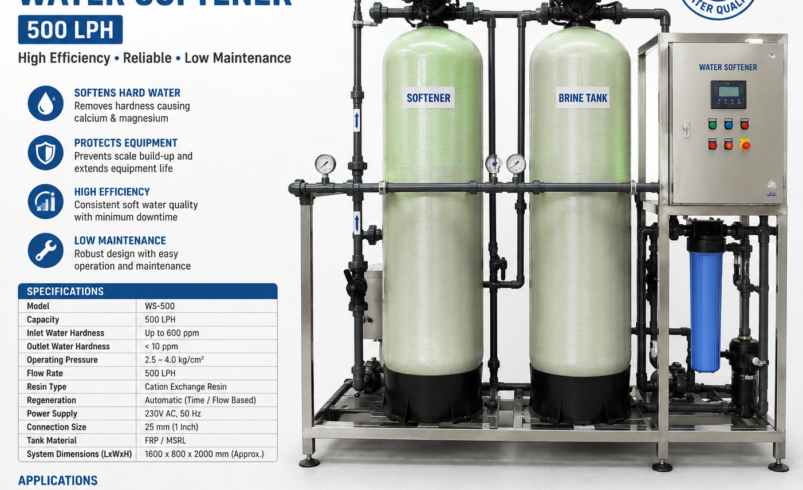
For businesses with moderate water requirements, a commercial water softener 500 LPH can be an effective solution. Designed to treat approximately 500 litres of water per hour, this type of softener can be used in various commercial establishments where hardness control is important.
Unlike ordinary filtration systems, a water softener is specifically designed to reduce hardness-causing minerals. When correctly sized and maintained, it can help protect water-dependent equipment and create better operating conditions throughout a commercial facility.
Why Water Quality Matters in Commercial Facilities
Commercial facilities consume water for many different purposes. A hotel may require water for guest rooms, laundry, kitchens, housekeeping, and hot-water systems. A restaurant may depend on water for dishwashing, cooking support, cleaning, and equipment operation. A laundry facility can use thousands of litres every day.
When hard water is used continuously, mineral deposits can gradually develop inside equipment and plumbing.
The problem can become particularly serious in systems where water is heated. As hard water is heated, calcium and magnesium can form deposits on surfaces. These deposits can reduce heat-transfer efficiency and increase the amount of maintenance required.
For businesses, water treatment is therefore not simply about improving water quality. It can also be part of an equipment-protection and operational-efficiency strategy.
What Is a Commercial Water Softener 500 LPH?
A commercial water softener 500 LPH is a hardness-reduction system with a nominal treatment flow of approximately 500 litres per hour.
The system generally uses an ion-exchange resin. As hard water passes through the resin bed, calcium and magnesium ions are exchanged with sodium ions. This reduces the hardness of the treated water.
Once the resin has reached its operating capacity, it must be regenerated. Regeneration is normally performed using a concentrated salt solution, commonly called brine. The brine restores the resin’s ion-exchange capacity so that it can continue treating water.
Depending on the design, regeneration may be controlled manually or automatically. Automatic systems can initiate regeneration according to time or water consumption.
The 500 LPH capacity makes this category of softener suitable for selected small and medium-sized commercial applications, but actual system selection should always be based on site-specific water demand.
How Does a 500 LPH Water Softener Work?
The operation of a commercial softener can be understood through a few basic stages.
Hard Water Entry
Hard water enters the softener through an inlet connection and passes into the treatment vessel.
Ion Exchange
Inside the vessel is a bed of cation-exchange resin. Calcium and magnesium ions attach to the resin while sodium ions are released into the water.
Soft Water Production
After passing through the resin, the water has reduced hardness and exits through the treated-water outlet.
Resin Regeneration
After treating a certain volume of water, the resin becomes saturated with hardness minerals. A brine solution is introduced to regenerate the resin.
Rinsing
The resin is rinsed to remove remaining brine and displaced minerals.
Return to Service
After regeneration is complete, the softener returns to normal operation.
This cycle allows the same resin bed to be used repeatedly.
The Problem of Scale in Commercial Equipment
Scale is one of the most common consequences of hard water.
When mineral-rich water passes through equipment, deposits can accumulate on internal surfaces. In a water heater or boiler, these deposits can develop on heating elements and heat-transfer surfaces.
A thick layer of scale can reduce heat transfer. Equipment may need to operate for longer periods to achieve the desired temperature.
In addition, scale can accumulate in pipes and valves, potentially reducing water flow.
Commercial businesses can be especially vulnerable because their equipment often operates for long periods and processes large volumes of water.
Reducing hardness at the water-treatment stage can help limit the formation of these deposits.
Benefits of Using a Commercial Water Softener
1. Helps Control Scale
The primary purpose of a softener is to reduce calcium and magnesium hardness. This can help reduce the potential for hardness-related scale in downstream equipment.
2. Protects Water-Using Equipment
Water heaters, boilers, dishwashers, washing machines, and heat exchangers can all be affected by hard-water deposits.
Softened water can help create better conditions for these systems and potentially reduce hardness-related maintenance.
3. Supports Energy Efficiency
Scale deposits can interfere with heat transfer. By reducing the hardness that contributes to scale, a softener may support more efficient operation of heating equipment.
Actual energy savings depend on the equipment, scale level, operating conditions, and other factors.
4. Improves Cleaning Performance
Hard water can reduce the effectiveness of soaps and detergents. Softened water generally allows cleaning products to perform more effectively.
This can be valuable in commercial laundries, kitchens, hotels, and cleaning operations.
5. Reduces Mineral Deposits
Softened water can help reduce visible mineral deposits on taps, sinks, glassware, shower fittings, and other surfaces.
6. Supports Preventive Maintenance
Controlling hardness can become part of a broader preventive-maintenance program for commercial water systems.
Applications of a 500 LPH Commercial Water Softener
A 500 LPH system can be used in many settings where the flow requirement matches its capacity.
Hotels and Resorts
Hotels require water across guest rooms, kitchens, laundry departments, housekeeping, and hot-water systems.
Hardness control can help protect water heaters and laundry equipment while reducing mineral deposits in bathrooms and fixtures.
Restaurants and Food-Service Businesses
Restaurants use water extensively for cleaning, dishwashing, food-service support, and hot-water applications.
A commercial softener can help reduce scale in dishwashers and water-heating equipment.
Laundry Facilities
Water quality is particularly important in commercial laundry operations. Hard water can interfere with detergent performance and contribute to deposits inside washing equipment.
Softened water can support consistent washing operations and help reduce mineral buildup.
Hospitals and Clinics
Healthcare facilities use water for cleaning, laundry, kitchens, and support services.
A softener can be incorporated into the water-treatment system where hardness reduction is required. Specialized medical applications may require additional purification technologies.
Educational Institutions
Schools, colleges, hostels, and training centers use water for kitchens, washrooms, cleaning, and accommodation facilities.
Where water demand is moderate, a 500 LPH softener may be suitable after proper assessment.
Commercial Buildings
Offices and commercial properties may use softened water for kitchens, bathrooms, hot-water systems, and maintenance operations.
Industrial Applications
Small and medium-sized industrial units may require hardness-controlled water for boilers, utility systems, cooling applications, or specific processes.
The exact treatment requirements should be determined based on the industrial process and water-quality specifications.
How to Determine Whether 500 LPH Is Suitable
The biggest mistake businesses can make is choosing a softener based solely on the stated LPH rating.
A proper assessment should include average consumption and peak demand.
Consider a facility that consumes approximately 3,500 litres of water per day. If its operating schedule is spread over 10 hours, the average consumption is around 350 litres per hour.
At first glance, a 500 LPH system may appear suitable. But if the facility experiences periods where water demand suddenly increases to 700 litres per hour, the nominal capacity may not be enough for those periods.
This is why peak flow should always be considered.
Water hardness is equally important. Higher hardness means the resin will reach its capacity sooner.
A professional supplier should calculate the required resin capacity based on water hardness and expected consumption.
Water Testing Before Installing a Softener
A water test is one of the most important steps in selecting the right treatment equipment.
The analysis should generally include total hardness and may also include other parameters depending on the water source.
Useful parameters can include:
- Total hardness
- Calcium
- Magnesium
- pH
- Total dissolved solids
- Iron
- Manganese
- Turbidity
- Chlorine
- Other site-specific contaminants
This information helps determine whether a softener alone is appropriate or whether pre-treatment is required.
A conventional softener is primarily a hardness-removal system. It should not be considered a complete water-purification solution.
Importance of Pre-Treatment
The performance and service life of a water softener can be affected by the quality of incoming water.
If the source water contains significant sediment, suspended particles, iron, or other substances, suitable pre-treatment may be necessary.
For example, sediment filtration can help prevent particulate matter from entering the resin vessel.
In some applications, additional treatment may be required to address specific water-quality problems.
The treatment train should therefore be designed according to actual water analysis rather than using the same configuration for every installation.
Automatic Regeneration and Commercial Convenience
Automatic regeneration is one of the useful features available in modern commercial water softeners.
Instead of requiring an operator to manually start each regeneration cycle, an automatic control valve can manage the process.
Depending on the system, regeneration can be based on a programmed schedule or the amount of water treated.
Metered regeneration can be advantageous in applications where water consumption varies because the system can regenerate based on actual usage.
Automation does not eliminate the need for maintenance, however. Operators should continue checking salt levels, treated-water hardness, leaks, and control-valve performance.
Maintenance Requirements
Like any commercial water-treatment system, a softener requires regular maintenance.
The brine tank should be checked periodically to ensure that sufficient salt is available.
Operators should also watch for salt bridging, which can prevent proper brine formation.
The control valve should be inspected according to the manufacturer’s recommendations.
The treated-water outlet should be tested periodically for hardness. An unexpected increase in hardness can indicate problems with regeneration, resin capacity, flow rate, or equipment settings.
The resin may eventually require replacement depending on its operating conditions and service life.
Keeping maintenance records can make it easier to identify changes in system performance.
Salt and Regeneration Efficiency
Salt consumption is an important consideration when evaluating a commercial softener.
A system that regenerates too frequently may use unnecessary amounts of salt and water. On the other hand, insufficient regeneration can result in hardness breakthrough.
The ideal regeneration setting depends on the resin capacity, incoming hardness, treated-water volume, and system design.
Businesses should ask suppliers for estimated salt and regeneration-water consumption under their specific operating conditions.
This information can help calculate long-term operating expenses more accurately.
Installation Considerations
The installation location should provide enough room for the treatment vessel and brine tank.
There should also be sufficient access for servicing the control valve and inspecting the equipment.
Typical installation requirements include:
- Raw-water inlet
- Soft-water outlet
- Drain connection
- Brine connection
- Suitable water pressure
- Electrical supply for automatic controls
- Adequate service space
A bypass arrangement can be useful during maintenance.
The drainage system should be designed to safely handle regeneration wastewater in accordance with applicable site requirements.
Professional installation is recommended because incorrect plumbing or control-valve configuration can affect system performance.
Choosing a Reliable Commercial Water Softener
When comparing suppliers, businesses should look beyond the initial price.
A reliable system should have an appropriate resin capacity, suitable control valve, durable vessel, and efficient regeneration process.
Important specifications to compare include:
- Rated flow capacity
- Resin volume
- Resin type
- Operating pressure
- Regeneration method
- Salt consumption
- Regeneration water consumption
- Valve specifications
- Warranty
- Availability of spare parts
- Service support
A supplier should also be willing to size the system according to water analysis and actual usage.
A properly sized system may provide better long-term value than a cheaper system that is not designed for the site’s operating conditions.
Long-Term Value of Hardness Control
The cost of hard water is not limited to visible deposits.
For commercial businesses, it can influence maintenance schedules, cleaning requirements, equipment performance, and operational downtime.
A water softener addresses hardness before the water reaches downstream equipment. This preventive approach can be more practical than repeatedly dealing with scale after it has formed.
The actual return on investment depends on the facility’s water quality and equipment. Businesses with very hard water and extensive hot-water usage may see greater benefits than facilities with lower hardness levels.
Conclusion
A commercial water softener 500 LPH can provide an effective hardness-control solution for commercial facilities with moderate water-treatment requirements. By using ion-exchange technology to reduce calcium and magnesium, the system can help control scale and support the performance of water-dependent equipment.
Hotels, restaurants, laundries, schools, offices, healthcare facilities, and selected industrial units can all benefit from hardness reduction when the system is correctly sized for their application.
However, the 500 LPH rating should only be the starting point. Incoming water hardness, peak flow, daily consumption, resin capacity, regeneration requirements, and pre-treatment needs should all be evaluated before installation.
A reliable water test, professional system sizing, quality equipment, and regular maintenance can help businesses get the most from their commercial water-softening investment. For facilities where water quality directly affects equipment performance, a properly designed softening system can be a valuable part of a long-term water-management strategy.