

Introduction
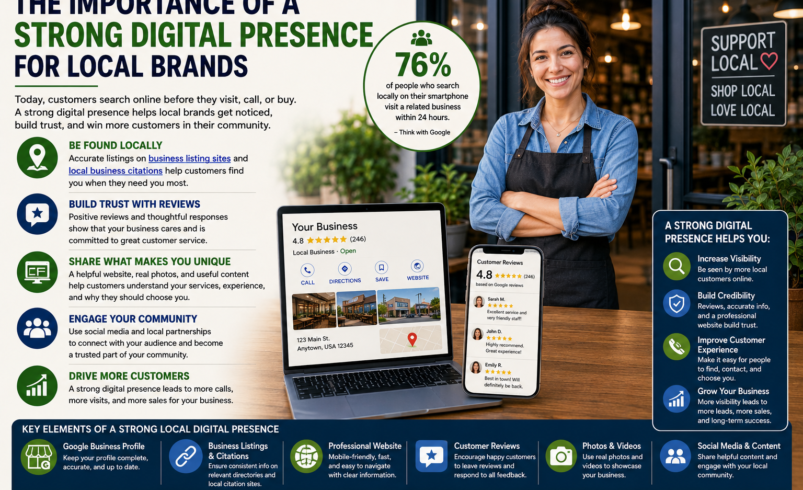
For a local brand, being known in the community has always mattered. But today, being known locally also means being easy to find online. A potential customer may hear your business name from a friend, see your storefront while driving, or discover you through social media. Yet before making a decision, they may still search for your business online. This is why maintaining accurate information across business listing sites and local business citations has become an important part of building a trustworthy local presence.
Think about the last time you needed a nearby restaurant, contractor, healthcare provider, salon, retailer, or professional service. You probably did not walk around the neighborhood looking for one. You searched online. You checked the location, opening hours, reviews, photographs, website, and perhaps social media profiles before deciding what to do next.
That simple behavior explains why digital visibility has become so important for local brands.
A strong digital presence does not mean being active on every platform or spending thousands of dollars on advertising. It means creating a reliable online environment where customers can discover your business, understand what you offer, evaluate your reputation, and contact you without unnecessary friction.
Google says local search results are primarily influenced by relevance, distance, and prominence. It also recommends keeping business information complete and accurate because this helps customers understand what a business does, where it is located, and when they can visit.
For local brands in the United States, this creates a major opportunity. A small company with a well-managed online presence can compete for attention in its own community without having the resources of a national corporation.
What Does a Strong Digital Presence Actually Mean?
A digital presence is much more than having a website.
It includes every place where customers can encounter your business online.
Your website is one part of it. Your Google Business Profile is another. Reviews, social media accounts, online directories, industry websites, local publications, maps, and business listings all contribute to the overall picture customers see.
Imagine that someone searches for your business.
They find your Google profile, but the phone number is outdated.
They visit your website, but it does not clearly explain your services.
They look at reviews and find several unanswered complaints.
Then they discover an online directory with a different address.
None of these problems alone necessarily means you will lose the customer. Together, however, they create uncertainty.
Now imagine the opposite.
The business information is accurate. The website is professional and easy to navigate. Recent photographs show the actual business. Reviews are genuine and thoughtfully answered. Services are clearly explained. Contact information is easy to find.
That experience creates confidence.
A strong digital presence essentially tells customers, “We are here, we are legitimate, we understand what we do, and we are ready to help.”
Your Digital Presence Often Becomes the First Impression
Local brands sometimes assume that their storefront, office, employees, or reputation within the community are their first impression.
Online, that may no longer be true.
For many customers, the first interaction with your company happens before they ever speak to an employee.
They may encounter your business in a search result.
They may see a map listing.
They may read a review.
They may view a photograph.
They may visit your website.
They may find a social media post.
All of these moments contribute to their first impression.
This is particularly important for businesses operating in competitive markets.
If five local companies offer similar services, customers need reasons to choose one over another.
A strong online presence helps communicate those differences.
Accurate Business Information Builds Confidence
One of the simplest ways to improve a digital presence is to make sure your business information is accurate everywhere.
Your business name, address, phone number, website, hours, services, and other important details should be reviewed regularly.
This is where business listing sites and local business citations can become part of a local brand’s digital foundation.
A local citation can appear on a directory, mapping service, industry platform, professional organization website, local resource, or other relevant online property.
The objective should not be to create hundreds of listings simply for the sake of having them.
Quality matters more than quantity.
A local restaurant should prioritize relevant food, hospitality, travel, and community platforms. A law firm should focus on appropriate professional and legal resources. A contractor might benefit from relevant home-service, trade, and local business platforms.
The information should be consistent.
If your address has changed, update it.
If your phone number has changed, update it.
If your business hours have changed, update them.
Customers should not have to investigate which version of your information is correct.
Make Google Business Profile a Priority
For many local brands, Google Business Profile is one of the most important digital assets.
Google recommends verifying your business and keeping its information up to date. It explains that complete and accurate information can make a business more likely to appear for relevant local searches.
Start with the basics.
Make sure the business name is accurate.
Choose an appropriate category.
Add the correct address or service area.
Verify your phone number.
Link to the correct website.
Keep hours updated.
Add relevant services and products where appropriate.
Upload useful photographs.
You should also pay attention to seasonal or temporary changes.
For example, if your business has different holiday hours, customers should be able to find that information before visiting.
A neglected profile can create unnecessary frustration.
A well-maintained profile can make the customer journey much smoother.
Build a Website That Helps, Not Just a Website That Looks Good
A beautiful website is useful, but design alone is not enough.
Your website should answer the questions customers actually have.
What do you offer?
Who do you serve?
Where do you operate?
How much experience do you have?
What makes your business different?
How can someone contact you?
What should they expect after contacting you?
The answers should be easy to find.
A local brand does not need a website filled with complicated animations and technical features. It needs a website that communicates clearly.
Your homepage should quickly explain your primary offering.
Service pages should provide useful details.
Your contact page should make communication easy.
If you have a physical location, provide clear directions and location information.
If you operate as a service-area business, clearly explain the communities you serve.
Optimize for Mobile Customers
A significant portion of local research happens on mobile devices.
Customers may search for your business while commuting, shopping, traveling, or standing outside your location.
That means your website needs to work well on smartphones.
Text should be easy to read.
Buttons should be easy to tap.
Phone numbers should be clearly visible.
Forms should be simple.
Navigation should not require excessive scrolling or searching.
A customer who finds your business but struggles to use your website may simply return to search results and choose a competitor.
Mobile usability is therefore not just a technical concern.
It is part of customer service.
Reviews Are a Major Part of Your Online Reputation
Reviews provide something businesses cannot create entirely on their own: independent customer experiences.
BrightLocal’s research reports that 96% of consumers read reviews when researching local businesses, highlighting how important reviews have become in the local decision-making process.
Customers want to know what it is actually like to work with your company.
They want to know whether you deliver on promises.
They want to know whether employees are helpful.
They want to know whether products or services match expectations.
That is why genuine reviews can be so valuable.
Instead of viewing reviews as something you simply collect, view them as a source of customer insight.
Positive reviews can reveal what customers appreciate.
Negative reviews can reveal where your business has room to improve.
Both can be useful.
Ask for Honest Feedback the Right Way
If your customers are happy, make it easy for them to provide honest feedback.
A simple request after a completed service or purchase can be effective.
You might send an email, provide a review link, or politely ask in person.
However, businesses should be careful not to manipulate reviews.
The Federal Trade Commission’s Consumer Reviews and Testimonials Rule, which took effect in October 2024, addresses deceptive practices involving fake reviews and testimonials. The rule prohibits businesses from buying or selling fake reviews and certain incentives conditioned on a particular review sentiment.
The best strategy is straightforward:
Deliver a good experience, ask for honest feedback, and let customers speak for themselves.
A strong reputation is not created by asking customers to say something positive. It is created by giving them an experience worth talking about.
Respond to Positive and Negative Reviews
Your review strategy should not end when someone posts feedback.
Responding demonstrates that your business is paying attention.
When someone leaves a positive review, thank them.
When someone raises a legitimate concern, acknowledge it professionally.
Avoid becoming defensive.
Avoid arguing publicly.
Avoid sharing private customer information.
Instead, show that you take feedback seriously and provide a way for the conversation to continue when necessary.
Potential customers may read your responses even when they are not the person who originally left the review.
They are evaluating your business.
A thoughtful response can demonstrate professionalism and accountability.
Use Authentic Photos and Videos
Local customers want to know what your business actually looks like.
Stock photography can make a website look polished, but authentic images can make a business feel more real.
Show your storefront.
Show your team.
Show your products.
Show your workspace.
Show completed projects.
Show the customer experience where appropriate.
For a restaurant, photographs of the actual dining space and food can help customers understand what to expect.
For a contractor, project photographs can demonstrate experience.
For a professional office, photographs can help potential clients become familiar with the environment.
Authentic visual content supports trust because customers can see evidence rather than simply reading claims.
Demonstrate Real Experience
Google’s broader search guidance emphasizes helpful, reliable content and signals of experience and expertise.
For local brands, demonstrating experience does not require complicated language.
Show what you have done.
A construction company can publish project case studies.
A dentist can explain common patient questions in educational content.
A financial professional can provide general educational guidance.
A retailer can demonstrate how products are used.
A restaurant can share its preparation process and local story.
The important thing is to provide information based on genuine knowledge.
Instead of writing:
“We are the most experienced company in the city.”
Explain what your team has actually accomplished.
Specific evidence is more convincing than broad claims.
Create Helpful Local Content
Content marketing can strengthen a local brand by answering questions before customers are ready to buy.
Think about the conversations your employees have every day.
What do customers ask?
What confuses them?
What mistakes do they make?
What information would help them make better decisions?
Those questions can become blog posts, guides, videos, FAQs, social media posts, or downloadable resources.
For example, a local HVAC company could explain how homeowners can prepare their systems for summer.
A landscaping company could explain seasonal lawn-care considerations.
A local attorney could publish educational information about common legal questions relevant to its audience.
A healthcare practice could provide general educational information about preparing for appointments.
The purpose is not to turn every article into a sales pitch.
The purpose is to become useful.
When a brand consistently answers customer questions, it begins to build authority.
Make Your Content Truly Local
Local content should not simply repeat a city name throughout an article.
It should demonstrate actual knowledge of the community.
Discuss local seasonal conditions.
Explain regional customer concerns.
Mention local regulations when appropriate.
Highlight community events that are genuinely relevant.
Discuss neighborhood-specific considerations when useful.
For example, a landscaping business in Florida may discuss weather-related lawn concerns that are different from those faced by a company in Colorado.
A roofing company in an area affected by severe storms can provide relevant preparation and maintenance advice.
Local expertise makes content more useful and more believable.
Use Social Media to Humanize Your Brand
Social media gives local brands an opportunity that large corporations often struggle to replicate: personality.
Show the people behind the business.
Introduce employees.
Share behind-the-scenes moments.
Highlight community involvement.
Answer common questions.
Show new products.
Share customer stories when appropriate and with proper permission.
Social media should not become a nonstop stream of promotions.
People follow local businesses because they want information, entertainment, education, community connection, or useful updates.
Give them something worth following.
Build Local Relationships Online and Offline
A strong digital presence does not mean ignoring the physical community.
Local relationships can strengthen online visibility naturally.
Partner with complementary businesses.
Join relevant professional organizations.
Support appropriate community events.
Participate in local initiatives.
Work with nonprofit organizations.
Collaborate with local creators or publications when the relationship makes sense.
These activities can lead to legitimate mentions, referrals, partnerships, and community awareness.
The important word is genuine.
Do not participate in an event simply because you want a backlink.
Participate because you want to contribute.
Online visibility often becomes stronger when it is supported by real-world relationships.
Earn Relevant Local Links
Links from reputable, relevant websites can help strengthen a brand’s online authority.
Rather than purchasing questionable backlinks, focus on earning legitimate mentions.
Local organizations, industry associations, community websites, educational institutions, nonprofit groups, event organizers, and local publications may provide relevant opportunities depending on your business.
You can also create resources that people genuinely want to reference.
A useful local guide.
An original survey.
A community resource.
A detailed educational article.
A helpful checklist.
When something is genuinely useful, other websites have a reason to mention it.
That is much healthier than creating artificial links.
Make Your Business Easy to Contact
Visibility means little if customers cannot take the next step.
Make your contact information obvious.
A phone number should be easy to find.
Your email address should work.
Forms should be simple.
Appointment instructions should be clear.
If you offer estimates, explain how customers can request one.
If customers visit a physical location, provide accurate directions and hours.
If you serve customers at their locations, clearly explain your service area.
The easier you make the next step, the less likely customers are to abandon the process.
Create a Clear Brand Message
A digital presence should communicate more than your business name.
It should communicate why your business exists and who it helps.
A customer should be able to understand your primary value quickly.
Avoid generic statements such as “We provide the highest-quality service.”
Instead, explain what you actually do.
Perhaps you specialize in a particular service.
Perhaps you focus on a particular type of customer.
Perhaps your company has a unique process.
Perhaps convenience is your advantage.
Perhaps you have extensive experience in a specialized field.
Whatever your genuine strength is, communicate it clearly.
Make Local Search Part of Your Overall Marketing
Local SEO should not operate separately from everything else.
Your website, reviews, social media, listings, email marketing, advertising, content, and customer service should support the same brand message.
For example, if your website says your business closes at 6 p.m., your business listings should not say 8 p.m.
If your website emphasizes a specific service, your Google Business Profile and other relevant profiles should accurately represent that service.
If customers consistently praise your communication, consider making that strength more visible in your marketing.
Consistency makes a brand easier to understand.
Track What Customers Actually Do
A strong digital presence should be measurable.
Do not focus exclusively on search rankings.
Look at meaningful actions.
How many people visit your website?
How many call?
How many request appointments?
How many submit contact forms?
How many request estimates?
How many ask for directions?
How many reviews are you receiving?
Where do new customers say they found you?
These metrics can help you understand what is actually working.
A local business may discover that its Google Business Profile generates many calls while its social media generates brand awareness but few direct inquiries.
Another business may discover that local referral partnerships generate highly qualified customers.
Use the data to decide where your time and resources should go.
Keep Your Digital Presence Updated
Creating a digital presence is not a one-time task.
Businesses change.
Employees change.
Services change.
Locations change.
Hours change.
Websites change.
Customer expectations change.
Review your online information regularly.
Check your important listings.
Review your Google Business Profile.
Test your website.
Update old content.
Replace outdated photographs.
Check your contact forms.
Respond to recent reviews.
Look for inaccurate information.
A few minutes of maintenance can prevent customers from encountering information that no longer reflects your business.
Avoid Trying to Be Everywhere
One of the biggest mistakes local brands make is spreading themselves too thin.
You do not need to post on every social platform.
You do not need hundreds of directories.
You do not need to publish five blog posts every week.
You do not need to run every type of advertisement.
Start with the channels that matter most to your customers.
Build a strong foundation.
Then expand gradually.
A small business that consistently manages its website, Google Business Profile, reviews, listings, and one or two useful social channels can have a stronger presence than a company that creates dozens of neglected profiles.
Consistency beats complexity.
Make Trust the Foundation
Every part of your digital presence should contribute to trust.
Accurate information builds confidence.
Real photographs create familiarity.
Reviews provide social proof.
Helpful content demonstrates knowledge.
Professional responses show accountability.
Credentials demonstrate expertise.
Community involvement creates recognition.
A secure and usable website demonstrates professionalism.
Together, these signals create a digital reputation.
This is especially important for local brands because customers often have alternatives.
They can choose another restaurant.
Another contractor.
Another retailer.
Another professional.
Another service provider.
Trust can become the deciding factor.
Local visibility gets people to notice your brand. Trust gives them a reason to choose it.
The Long-Term Value of a Strong Digital Presence
A strong digital presence is not simply a way to get more clicks.
It can become a long-term business asset.
When customers repeatedly encounter accurate information, helpful content, authentic reviews, recognizable branding, and positive experiences, your business becomes easier to remember.
Over time, that recognition can lead to repeat purchases, referrals, reviews, recommendations, and stronger community awareness.
This is why local digital marketing should be viewed as an investment rather than a quick promotional campaign.
You are building an online representation of your business.
The stronger that representation becomes, the easier it is for customers to understand and trust your brand.
Conclusion
For local brands, a strong digital presence is no longer optional.
Customers increasingly research businesses before deciding where to spend their money. They want accurate information, genuine reviews, useful websites, convenient contact options, and evidence that a company knows what it is doing.
The foundation starts with accurate business information.
Maintain your Google Business Profile.
Keep your information consistent across relevant business listing sites and local business citations.
Build a useful and mobile-friendly website.
Create content that answers real customer questions.
Use authentic photographs.
Develop a genuine review strategy.
Respond professionally to feedback.
Demonstrate experience through real examples.
Build relationships within your community.
Use social media to humanize your brand.
Earn relevant local mentions naturally.
Most importantly, make customer experience part of your digital strategy.
Google’s own guidance confirms that local search visibility depends mainly on relevance, distance, and prominence, with complete information helping Google understand and match businesses to relevant searches.
At the same time, reputation needs to be built honestly. The FTC’s consumer review rule addresses deceptive practices involving fake or misleading reviews and certain review incentives.
The lesson is simple.
You do not need to be the biggest brand in your city.
You need to be a brand that customers can easily find, understand, trust, and contact.
A strong digital presence makes that possible.
And when your online reputation accurately reflects the quality of your real-world business, local search becomes more than a marketing channel.
It becomes a bridge between your brand and the people in your community who need what you offer.
Frequently Asked Questions
1. Why is a digital presence important for a local business?
A digital presence helps local customers discover, research, evaluate, and contact your business. It also gives you opportunities to demonstrate expertise, showcase customer experiences, and build trust before someone visits your location or contacts your team.
2. What should a local brand include in its digital presence?
A strong foundation should include a professional website, Google Business Profile, accurate business listings, relevant local citations, customer reviews, social media where appropriate, useful content, and consistent contact information.
3. Why are business listing sites and local business citations important?
They can help customers discover and verify your business across relevant online platforms. Keeping information accurate and consistent can also create a stronger overall local presence. The priority should be reputable and relevant platforms rather than creating large numbers of low-quality listings.
4. How can local businesses build more online trust?
Focus on genuine customer reviews, accurate information, real photographs, helpful content, transparent communication, professional review responses, clear credentials, and evidence of real experience. Trust develops through consistency rather than one marketing tactic.
5. How often should a business update its online information?
Review important information regularly and whenever something changes. Business hours, phone numbers, addresses, services, website pages, photographs, and holiday schedules should all be updated when necessary.
6. Can social media help a local brand?
Yes. Social media can help local brands build familiarity, showcase products and services, introduce employees, share useful information, highlight community involvement, and communicate with customers. It should complement rather than replace your website and local search presence.
7. Should a small business be listed on every online directory?
No. Focus on relevant, reputable directories and platforms that customers may actually use. A smaller collection of accurate, relevant profiles is more useful than a large number of neglected or unrelated listings.
8. Are online reviews really important for local brands?
Yes. Reviews can influence how potential customers evaluate a local business. BrightLocal’s 2025 research reports that 96% of consumers read reviews when researching local businesses.
9. Can a business buy positive reviews?
Businesses should not buy fake reviews or use deceptive review practices. The FTC’s Consumer Reviews and Testimonials Rule addresses fake reviews and certain incentives tied to specific review sentiment.
10. What is the most important goal of a local digital marketing strategy?
The goal is not simply to rank higher or collect more website visitors. The real objective is to help the right local customers discover your business, understand what you offer, trust your reputation, contact you, and ultimately become loyal customers or recommend your brand to others.