

Adult acne doesn’t get nearly as much honest attention as it deserves. It’s persistent, often hormonally driven, and frustrating in a way that teenage breakouts simply aren’t because the expectation, somewhere in the back of the mind, is that skin should have figured itself out by now. The reality is quite different. Approximately 50% of women in their 20s, 33% in their 30s, and 25% in their 40s continue to experience acne, numbers that make it far from an outlier condition. What’s less discussed is how poorly many standard acne treatments serve adult skin, and where a mandelic acid serum fits into a more considered approach to managing breakouts without wrecking the skin in the process.
Why Adult Acne Behaves Differently Than Teenage Breakouts
The acne that shows up in adulthood tends to follow a different pattern than the widespread, oil-driven breakouts of adolescence. Adult acne is more commonly hormonal and inflammatory in nature, clustering along the lower third of the face – the jawline, chin, and lower cheeks, rather than across the forehead and nose where sebaceous gland density is highest in teenagers.
The underlying driver is often androgenic hormonal fluctuation. Androgens stimulate the sebaceous glands to increase sebum production, which feeds Cutibacterium acnes (formerly Propionibacterium acnes), the anaerobic bacterium implicated in inflammatory acne lesions. But adult skin has an added layer of complexity: it’s simultaneously managing acne and the early signs of aging – reduced collagen synthesis, uneven pigmentation, and declining cell turnover. This is why the aggressive, drying ingredients that worked at 17 tend to cause more problems than they solve at 35. The skin doesn’t have the same resilience or oil production to compensate, and stripping it aggressively in the name of acne control creates a damaged barrier that actually makes inflammation worse.
What Makes Mandelic Acid Particularly Well-Suited for Adult Acne
Mandelic acid is an alpha-hydroxy acid (AHA) derived from bitter almonds. Among the AHA family which includes glycolic acid, lactic acid, and citric acid, mandelic acid stands out for a single structural reason: its molecular weight is significantly larger than the others. That larger molecular size translates to slower epidermal penetration, which means it exfoliates the skin at a more controlled rate and with considerably less risk of irritation, redness, or post-exfoliation sensitivity.
For adult skin managing breakouts alongside an already-sensitized or aging baseline, this matters enormously. Glycolic acid, the smallest AHA, delivers fast and dramatic results but can over-sensitize skin that isn’t in robust condition. Mandelic acid achieves the same fundamental mechanism, loosening the desmosomes that bind dead corneocytes to the stratum corneum, accelerating their natural shedding but does so in a way that the skin can tolerate consistently over time.
The benefits relevant to adult acne go beyond exfoliation. Mandelic acid has demonstrated antibacterial properties against C. acnes, meaning it addresses one of the primary biological drivers of inflammatory breakouts rather than simply clearing the surface. It also inhibits the enzyme tyrosinase, which catalyzes melanin synthesis making it effective at fading post-inflammatory hyperpigmentation (PIH), the dark spots that adult acne tends to leave behind far more stubbornly than teenage breakouts do.
What a 25% Mandelic Acid Peel Serum Actually Does to the Skin
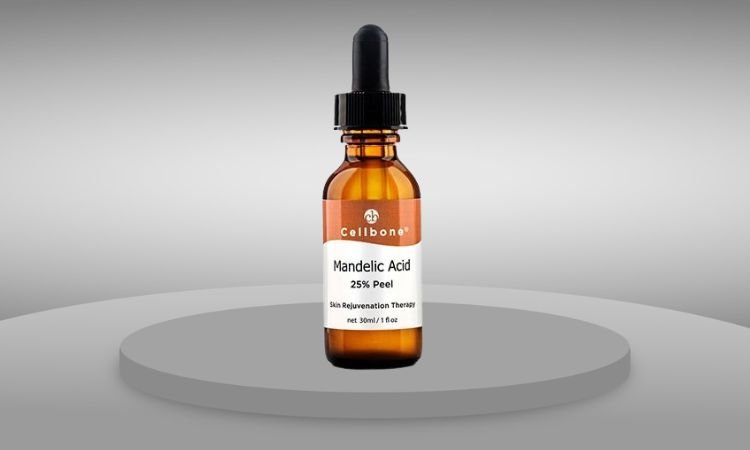
A mandelic acid serum formulated at 25% concentration functions as a leave-on chemical peel rather than a daily exfoliant. At this concentration, it penetrates into the skin to exfoliate the outer layers of dead skin cells that dull the complexion and expose the clearer, softer surface underneath. Importantly, it simultaneously stimulates the growth of new cells which means the benefit isn’t just the removal of dead cell buildup but an active push toward healthier, renewed skin over time.
For adult acne specifically, this dual action matters. The exfoliation prevents the accumulation of dead corneocytes that contributes to comedone formation – the clogged follicular openings that precede both whiteheads and deeper inflammatory lesions. The cell renewal component supports the skin’s long-term resilience, which tends to decline with age and is further compromised by ongoing inflammation.
A well-formulated mandelic acid peel serum will also address the downstream damage that adult acne leaves behind: age spots, post-inflammatory hyperpigmentation, and uneven skin tone. The tyrosinase-inhibiting action of mandelic acid combined with accelerated cellular turnover creates a visible tone-evening effect over consistent use. For adult acne sufferers who are simultaneously dealing with PIH and texture irregularity, this makes mandelic acid one of the more versatile active ingredients available.
Formulations that include soothing agents – menthol and cucumber flower extract, for example – add a cooling, anti-inflammatory dimension to the experience, which is particularly useful given that inflamed acne-prone skin tends to run warm and reactive after exfoliation.
How to Use a Mandelic Acid Serum Correctly
Getting the protocol right is as important as choosing the right formulation. Because mandelic acid at peel-grade concentrations is an active exfoliant, the application process is specific and should be followed precisely to avoid over-exfoliation or barrier disruption.
Before any first use, a patch test on a small area of skin behind the ear is essential. If redness or irritation develops, the product should not be used on the face. Assuming the patch test is clear, the serum is applied to clean, dry skin – a few drops spread across the face and left on for three to five minutes before being rinsed thoroughly with cold water. Cold water helps close the follicular openings and calm the skin post-exfoliation. After rinsing, a hydrating moisturizer should be applied immediately to restore surface hydration. A barrier-supporting option like a copper peptide gel or a deeply hydrating moisturizer works particularly well here.
Frequency should be kept to two to three times per week, not daily. This is one of the most common mistakes made with chemical exfoliants, assuming that more frequent use accelerates results. In practice, over-exfoliation degrades the stratum corneum faster than it can regenerate, leading to a sensitized, reactive skin state that worsens acne rather than improving it. Two to three sessions per week is the evidence-supported range for achieving consistent cellular turnover improvement without compromising barrier integrity.
Sunscreen is non-negotiable when using any AHA. Mandelic acid increases photosensitivity by removing the protective layer of dead cells that partially shields the epidermis from UV exposure. Using mandelic acid without a broad-spectrum SPF in the morning routine substantially increases the risk of UV-induced hyperpigmentation, the exact opposite of what the treatment is intended to achieve.
What to Avoid Stacking With a Mandelic Acid Serum
Adult acne routines often accumulate a number of active ingredients over time – salicylic acid, benzoyl peroxide, retinoids, vitamin C and knowing which combinations are problematic matters. Applying multiple exfoliating or keratolytic actives in the same session compounds the rate of barrier disruption without meaningfully compounding the benefit.
On mandelic acid serum days, other exfoliating acids and retinoids should be avoided in the same application window. A BHA toner or retinol serum can remain in the routine simply on alternate evenings. Niacinamide, ceramide-based moisturizers, and hyaluronic acid are compatible and actively supportive alongside mandelic acid, helping to offset any transient dryness that high-concentration exfoliation can introduce. Fragrance-heavy products and high-alcohol formulations should also be avoided directly after a peel session, as the newly exfoliated skin is temporarily more permeable and therefore more susceptible to sensitizer absorption.
A skin peel serum works best when the routine around it is deliberately kept simple: gentle cleanser, peel, moisturizer, SPF. The more aggressive the surrounding routine, the more likely the peel is to tip the skin into an over-exfoliated state.
Conclusion
Adult acne is a legitimate dermatological condition that affects a significant portion of women well into their 30s and 40s, and it calls for a more nuanced approach than the blunt, high-strength treatments designed for teenage skin. Mandelic acid serum, particularly at peel-grade concentrations, addresses the core mechanisms of adult acne: follicular congestion, bacterial activity, surface cell buildup, and post-inflammatory hyperpigmentation, all without the barrier-stripping aggression that makes many conventional acne treatments counterproductive on more mature skin. Used correctly and consistently, it’s one of the more clinically rational choices available for managing breakouts while simultaneously supporting a clearer, more even complexion.