

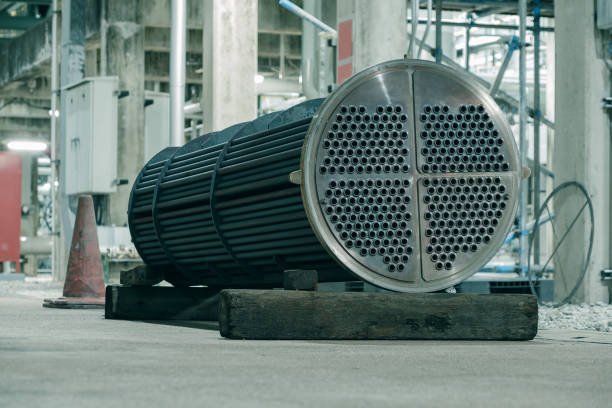

Heat exchangers have become indispensable across industries that rely on efficient thermal management, including power generation, oil and gas, chemical processing, food and beverage, pharmaceuticals, HVAC, marine, and renewable energy. As industries pursue lower energy consumption, reduced operating costs, and improved process efficiency, demand for advanced heat transfer equipment continues to expand worldwide. Continuous investments in industrial modernization and sustainable infrastructure are supporting the Heat Exchangers Market growth across both established and emerging economies.
According to a study published by Vyansa Intelligence, the Heat Exchangers Market was valued at USD 21 Billion in 2025 and is projected to reach USD 30 Billion by 2032, registering a CAGR of 5.23% during 2026-2032.
Heat Exchangers Remain Fundamental to Industrial Operations
Heat exchangers are engineered systems that transfer thermal energy between two or more fluids without allowing them to mix. They play a vital role in heating, cooling, condensation, evaporation, refrigeration, and waste heat recovery processes. Common configurations include shell-and-tube, plate-and-frame, air-cooled, spiral, and finned heat exchangers, each designed for specific operating conditions and industries. Their broad applicability continues to strengthen the Heat Exchangers Market size across industrial, commercial, and infrastructure applications.
Industrial Decarbonization Is Increasing Equipment Demand
Manufacturers across energy-intensive industries are prioritizing technologies that improve thermal efficiency and reduce fuel consumption. Heat exchangers enable facilities to recover waste heat, optimize process temperatures, and improve energy utilization, making them essential components of industrial decarbonization strategies.
The American Society of Mechanical Engineers (ASME) highlights that high-performance heat exchangers play a critical role in improving energy efficiency across power generation, manufacturing, refrigeration, transportation, and industrial processing. Advances in materials and manufacturing technologies are enabling more compact and efficient heat exchanger designs capable of operating under demanding conditions.
Engineering Standards Continue to Improve Performance and Reliability
As industrial processes become increasingly sophisticated, standardized performance testing has become essential for ensuring heat exchanger reliability and operational efficiency. Industry standards help manufacturers evaluate thermal performance, pressure drop, and overall heat transfer characteristics under consistent testing conditions.
The ASME PTC 12.5 Performance Test Code establishes recognized methods for measuring heat exchanger performance, including heat transfer rates, pressure loss, and thermal efficiency. These standardized testing procedures support quality assurance while encouraging continual engineering improvements across the industry. These developments continue to influence evolving Heat Exchangers Market trends.
Advanced Manufacturing Is Transforming Heat Exchanger Design
Technological innovation is enabling manufacturers to develop lighter, more compact, and higher-performing heat exchangers through advanced computational design and additive manufacturing. Three-dimensional printing allows engineers to produce intricate internal flow channels that significantly improve heat transfer while reducing equipment size and material consumption.
Recent engineering research published by the American Society of Mechanical Engineers (ASME) demonstrated that topology-optimized heat exchanger designs produced through additive manufacturing achieved substantially higher thermal performance and power density than conventional straight-channel designs. Such innovations are expanding opportunities across aerospace, energy, chemical processing, automotive, and industrial manufacturing. These advancements are expected to strengthen the long-term Heat Exchangers Market forecast.
Sustainability Initiatives Support Broader Adoption
Global efforts to improve energy efficiency and reduce greenhouse gas emissions continue to increase investment in efficient thermal management systems. Heat exchangers enable industries to recover waste heat, reduce primary energy consumption, and improve overall process sustainability while supporting circular energy utilization.
Their growing application within renewable energy systems, district heating networks, hydrogen production, geothermal facilities, and industrial heat recovery projects further expands their importance within the global energy transition. As sustainability objectives become increasingly integrated into industrial investment decisions, advanced heat transfer technologies continue to gain strategic importance.
Competition Centers on Efficiency and Technological Innovation
Competition within the industry increasingly focuses on thermal performance, corrosion resistance, compact equipment design, advanced materials, and digital monitoring capabilities. Manufacturers continue investing in computational fluid dynamics, intelligent manufacturing, predictive maintenance technologies, and next-generation fabrication techniques to improve product reliability and operational efficiency.
Companies are also expanding customized engineering solutions that address application-specific requirements across power generation, petrochemicals, HVAC, food processing, marine engineering, and renewable energy installations. These innovations continue to reinforce the Heat Exchangers Market growth by improving system performance and lowering lifecycle operating costs.
Future Outlook Remains Strong
The future of heat exchanger technology will be shaped by industrial electrification, energy efficiency initiatives, digital manufacturing, and advanced thermal engineering. Growing investments in clean energy infrastructure, process optimization, and sustainable industrial development will continue expanding demand for highly efficient heat transfer equipment across multiple sectors.
Supported by technological innovation, increasingly stringent efficiency requirements, and expanding industrial applications, the Heat Exchangers Market forecast remains favorable over the coming years. Companies that continue investing in advanced materials, intelligent engineering, additive manufacturing, and high-efficiency thermal solutions are expected to strengthen their position within the broader heat exchangers industry.