


Introduction
Choosing a Vastu consultant can be challenging when different professionals offer different consultation methods, reports, and service packages.
Some consultants focus on residential properties, while others assess offices, commercial buildings, or industrial premises.
Their services may include site visits, online reviews, floor-plan assessments, written reports, and follow-up discussions.
For people searching for the best Vastu Shastra consultant in India, the important question is not simply who offers the most recommendations.
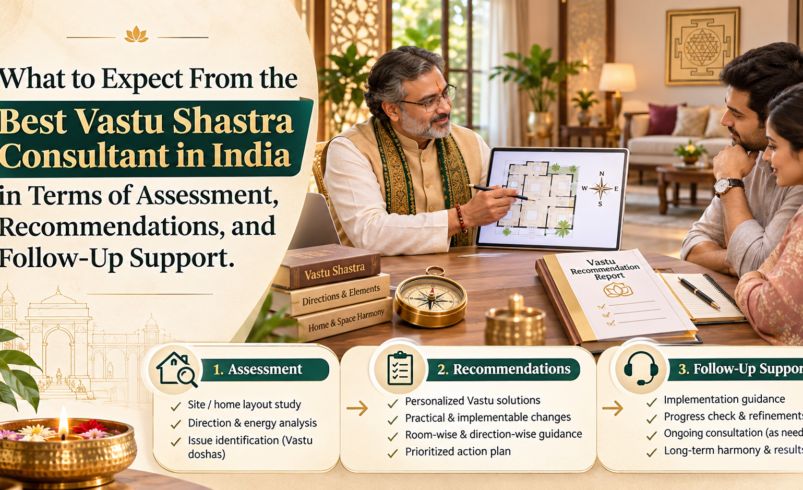
It is whether the consultant follows a transparent process, understands the property, explains the guidance clearly, and provides appropriate support after the initial assessment.
Understanding what a professional consultation may include can help clients compare services more effectively.
Why the Consultation Process Matters
A Vastu assessment should begin with an understanding of the property and the client’s requirements.
Every property has different dimensions, orientation, surroundings, and functional needs.
An independent house, apartment, commercial office, and industrial facility cannot be evaluated as though they were identical.
A structured process helps the consultant gather relevant information before making recommendations.
It also allows the client to understand how the assessment will be conducted and what deliverables to expect.
Step 1: Understanding the Client’s Requirements
The consultation should begin with a discussion about the property and its intended use.
For residential properties, the consultant may ask about the number of occupants, room requirements, and construction or renovation plans.
For commercial properties, the discussion may include functional areas, employee movement, operational requirements, and building constraints.
This initial conversation helps define the assessment scope.
A Vastu Shastra consultant should clarify the client’s expectations before recommending a service package.
Step 2: Collecting Property Information
Accurate property information is important.
Depending on the assessment, the consultant may request a site plan, architectural drawings, room dimensions, orientation details, photographs, or videos.
For properties under construction, proposed floor plans may provide the primary reference.
For completed buildings, existing drawings and a walkthrough can help establish the current arrangement.
Clients should understand which documents are necessary and how their information will be handled.
A professional should avoid requesting unrelated personal information.
Step 3: Establishing the Property’s Orientation
Traditional Vastu Shastra uses directional references when evaluating different spaces.
The assessment may involve determining north, south, east, west, and the intermediate directions.
Correct orientation is important because traditional recommendations often relate to specific directional zones.
The consultant should explain how the orientation was established.
Clients should be cautious about conclusions based solely on an assumed entrance direction or incomplete information.
Step 4: Reviewing the Complete Layout
A comprehensive assessment should consider the property as an interconnected space.
For residential buildings, the consultant may review the entrance, living areas, kitchen, bedrooms, bathrooms, staircase, and prayer space.
For commercial buildings, relevant areas may include entrances, reception spaces, workstations, meeting rooms, storage, and operational zones.
The specific review depends on the property type and agreed consultation scope.
A consultant should avoid applying a generic checklist without considering how the building actually functions.
Step 5: Identifying Relevant Traditional Considerations
After reviewing the property, the consultant can explain the traditional Vastu principles being applied.
This may include directional preferences, room arrangements, or other spatial considerations.
However, different Vastu traditions and practitioners may use different interpretations.
The client should understand the reasoning behind the recommendations.
Clear explanations are more useful than unexplained instructions.
A reliable consultant should also distinguish traditional beliefs from established architectural or engineering requirements.
Step 6: Understanding Practical Limitations
Not every recommendation will be feasible.
A completed apartment may have fixed structural walls and plumbing shafts.
A commercial office may have limited control over common entrances or building services.
An independent house may need to comply with setbacks, access requirements, and structural constraints.
The best Vastu Shastra consultant in India for a particular project should be able to acknowledge these limitations.
Recommendations should not compromise structural safety, accessibility, or applicable building regulations.
Step 7: Receiving Property-Specific Recommendations
After completing the assessment, the consultant may suggest changes or alternatives.
For proposed construction, recommendations may concern room placement or layout options.
For existing properties, the discussion may focus on practical interior adjustments.
The consultant should explain the nature of each recommendation.
Clients need to know whether it involves furniture placement, room usage, interior modifications, or substantial construction work.
This distinction helps them evaluate feasibility and potential costs.
Step 8: Understanding the Difference Between Recommendations and Guarantees
Traditional Vastu principles are cultural and belief-based.
They should not be presented as scientifically proven methods for guaranteeing wealth, health, business growth, or relationship outcomes.
A professional consultation can help clients consider these traditional preferences while planning a property.
However, a consultant should avoid promising specific personal or financial results.
Clear communication about the limits of the service is an important sign of professional responsibility.
Step 9: Receiving a Written Assessment
A written report can make Vastu guidance easier to review and implement.
Depending on the service package, the document may include property observations, relevant recommendations, and notes about practical limitations.
A marked floor plan may also be useful.
Clients can share the agreed recommendations with architects or interior designers when appropriate.
Before booking, ask whether documentation is included and what level of detail it provides.
Step 10: Coordinating With Architects and Designers
Some recommendations may influence the architectural or interior layout.
In these situations, professional coordination is important.
An architect can evaluate whether a proposed change is structurally and technically feasible.
An interior designer can assess furniture arrangements, circulation, storage, and space utilization.
A Vastu consultant can explain the traditional preferences the client wishes to consider.
This collaborative approach helps prevent conflicting instructions.
Step 11: Understanding Follow-Up Support
The consultation process may not end when the initial recommendations are delivered.
Clients may have questions after discussing the report with their architect or reviewing alternative floor plans.
Some consultants offer follow-up calls, revised assessments, or additional site visits.
However, these services are not automatically included in every package.
The client should confirm the scope and cost of follow-up support before booking.
Step 12: Reviewing Changes During Implementation
For construction and renovation projects, design adjustments may arise after the initial assessment.
A staircase may need repositioning, a room size may change, or a service requirement may affect the layout.
If such changes influence an agreed Vastu preference, a follow-up review may be useful.
The purpose should be to clarify the implications of the new layout.
Technical changes must still be assessed and approved by the appropriate qualified professionals.
Step 13: Choosing Between Online and In-Person Consultation
Both online and in-person services may be suitable, depending on the project.
A Vastu Shastra consultant online can review drawings, photographs, and videos through digital communication.
An on-site consultation allows direct observation of the property.
For complex properties, a physical visit may provide useful additional information.
Clients should choose the assessment method according to their needs rather than assume that one format is always superior.
Step 14: Evaluating Relevant Experience
Experience should be assessed in relation to the property type.
A consultant who regularly works with apartments may understand the practical restrictions of residential buildings.
A professional experienced in independent houses may be familiar with early-stage architectural coordination.
Commercial or industrial properties can involve different functional requirements.
Clients should ask about relevant project experience and the types of assessments the consultant regularly performs.
Step 15: Comparing Consultation Packages
Consultation packages may differ in scope.
One service may include a basic online review, while another offers a site visit, written report, and follow-up discussion.
Clients should confirm what the quotation covers.
They should also ask about additional charges for travel, revisions, repeat visits, or assessments of extra floors.
Comparing complete services provides a more useful basis for decision-making than comparing headline fees alone.
Step 16: Looking for Transparency and Clear Communication
A professional consultant should explain the assessment process before work begins.
Clients should understand which information is required, what recommendations will be provided, and whether follow-up support is available.
The consultant should also communicate practical limitations clearly.
Unexplained instructions, pressure to purchase expensive items, and guaranteed outcome claims should be treated cautiously.
Step 17: Reviewing Client Feedback Carefully
Client feedback can provide useful information about communication, punctuality, documentation, and service quality.
However, testimonials should be evaluated carefully.
A positive review does not necessarily establish the technical suitability of the recommendations.
Clients can also ask for examples of the consultant’s reporting format or project approach, where available.
These details may provide a clearer understanding of the service.
Step 18: Preparing for a Successful Consultation
Before booking, clients should identify their main concerns and gather relevant property documents.
They should also decide whether they need guidance before purchase, during construction, before interior design, or after moving into an existing property.
The consultation will generally be more focused when the client communicates these requirements clearly.
It is also useful to identify any restrictions involving structural changes, budgets, rental agreements, or building regulations.
What Defines a Suitable Vastu Consultant?
There is no single universally applicable definition of the best Vastu Shastra consultant.
The right professional depends on the property’s complexity, the client’s expectations, and the consultation services required.
A suitable consultant should offer a clear process, relevant experience, understandable recommendations, and transparent service terms.
The ability to acknowledge practical limitations is particularly important.
Clients should feel able to ask questions and understand the reasoning behind the guidance.
Conclusion
Choosing the best Vastu Shastra consultant in India requires more than comparing fees, online ratings, or promotional claims.
A useful consultation should involve property assessment, relevant traditional recommendations, practical explanations, and clearly defined deliverables.
Follow-up support and coordination with architects or interior designers may also be important, depending on the project.
Whether a client chooses an in-person professional or a Vastu Shastra consultant online, the service should reflect the property’s actual conditions and the client’s requirements.
By evaluating the consultation process carefully, homeowners and businesses can select a professional who communicates clearly, respects practical constraints, and provides guidance consistent with their traditional Vastu preferences.