
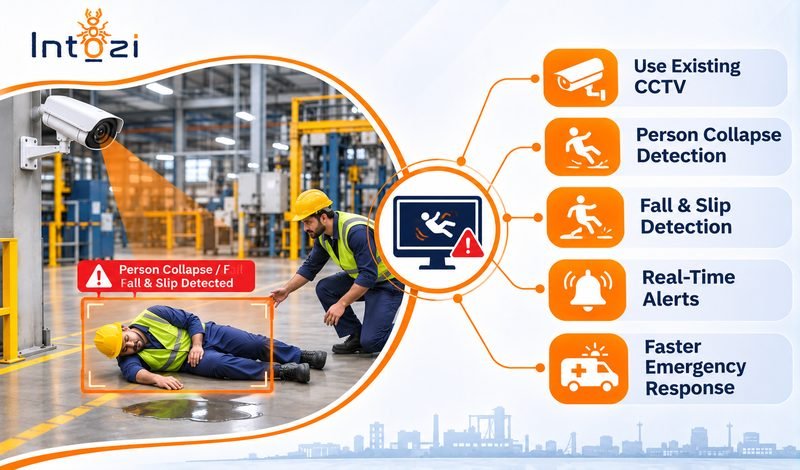

Workplace falls are among the incidents that can create serious safety concerns across factories, warehouses, manufacturing facilities, and other industrial environments. When an employee slips, trips, or falls, delayed identification can affect how quickly assistance reaches the affected person. Businesses already using CCTV cameras may be able to extend their existing infrastructure with AI-powered video analytics to identify potential fall incidents and support faster responses.
A person fall detection system uses computer vision to analyse video footage and recognise visual patterns associated with a person falling. Instead of relying entirely on someone watching a CCTV screen, AI analytics can identify configured fall-related events and generate alerts for further review. This makes existing camera infrastructure a potential resource for improving workplace safety, provided the cameras and video quality meet the system’s requirements.
Can Existing CCTV Cameras Be Used for Workplace Fall Detection
In many cases, existing CCTV cameras can support AI-based fall detection without requiring businesses to replace their entire surveillance infrastructure. However, compatibility depends on the camera system, video quality, network connectivity, camera positioning, and analytics requirements.
AI video analytics can process compatible camera feeds and analyse human movement, posture, and changes in body position to identify possible fall incidents.
Before deploying a fall detection application, businesses should evaluate:
- Camera resolution: Footage should provide enough visual detail to recognise a person’s posture and movement.
- Camera angle: The camera should capture the monitored area from a suitable perspective.
- Field of view: Employees should remain visible during normal workplace activities.
- Lighting conditions: Shadows, low light, and changing illumination can affect detection.
- Obstructions: Machinery, shelves, equipment, and other workers should not consistently block the camera view.
- Video accessibility: Existing CCTV infrastructure should provide compatible video streams for analytics processing.
For example, a warehouse with cameras covering its main walking areas may be able to use those feeds for fall detection after evaluating camera placement and image quality. Additional cameras may be needed in areas with blind spots.
How AI Slip and Fall Detection Works Through CCTV Cameras
Traditional CCTV records workplace activity, but identifying a fall often requires someone to notice the incident while observing the footage. AI slip and fall detection adds automated video analysis to this process.
A computer vision model analyses video frames to recognise human movement and identify patterns that may indicate a fall.
A typical detection process involves:
- Person identification: The system identifies a person within the monitored camera view.
- Movement analysis: It observes changes in body position and movement over successive video frames.
- Fall pattern recognition: The model evaluates visual patterns associated with sudden loss of balance or a person falling.
- Event identification: If the detected movement matches configured criteria, the system identifies a potential fall event.
- Alert generation: The event can be communicated to designated personnel for verification and response.
The system may also use contextual information, such as whether the person remains on the floor after the detected movement, depending on the analytics model.
This approach helps reduce dependence on continuous manual observation, although human verification remains important because activities such as bending, kneeling, sitting, or lying down may sometimes resemble a fall.
Why Worker Fall Detection Software Matters in Industrial Environments
Factories and warehouses contain several conditions that can increase the risk of workplace falls. Wet floors, uneven surfaces, obstacles, stairs, elevated platforms, and busy material-handling areas can all create potential hazards.
Worker fall detection software can help safety teams identify possible incidents across monitored locations and direct attention towards areas where assistance may be needed.
Its applications can include:
- Monitoring employee movement in designated production areas.
- Identifying potential falls near machinery and equipment.
- Observing incidents in warehouse aisles and loading areas.
- Supporting monitoring of stairways and access routes.
- Highlighting possible falls in isolated or less frequently supervised locations.
- Providing recorded footage for incident investigation.
For example, if an employee falls in a warehouse aisle outside the immediate view of supervisors, an AI-enabled camera may identify the event and alert the designated safety team. This can help reduce the time between incident occurrence and awareness.
However, detection performance depends on the visibility of the person and the conditions in the monitored area. It should complement employee reporting procedures and established emergency response arrangements.
How Real-Time Fall Detection Supports Faster Emergency Response
Identifying an accident is only the first step. Businesses also need a process to ensure that the right people receive information and respond appropriately.
Real-time fall detection can help shorten the time between a potential incident and its identification by analysing compatible video feeds continuously or according to the configured processing schedule.
When a potential fall is detected, the system can support:
- Generating alerts for designated safety personnel.
- Identifying the camera and location associated with the event.
- Providing relevant footage for immediate verification.
- Supporting communication with on-site supervisors.
- Maintaining event records for later investigation.
Consider a manufacturing facility where employees work across multiple production zones. If a fall occurs in an area without direct supervisor visibility, an automated alert can help bring the event to the attention of the responsible team.
The actual response time depends on system processing, network availability, alert delivery, and the organisation’s response procedures. AI detection alone does not guarantee that emergency assistance will arrive immediately.
How AI Workplace Fall Detection Helps Monitor Different Work Areas
Different workplace environments require different monitoring approaches. A camera arrangement suitable for a warehouse aisle may not provide the right viewing angle for a manufacturing workstation or staircase.
AI workplace fall detection can be configured for selected areas according to their layout, risk profile, and camera coverage.
| Workplace area | Potential monitoring application |
| Manufacturing floors | Identify possible falls near production equipment. |
| Warehouses | Monitor falls in aisles and material-handling zones. |
| Loading docks | Identify potential falls around loading and unloading areas. |
| Stairways | Monitor visible fall-related events on access routes. |
| Corridors | Support detection across employee movement paths |
| Storage areas | Improve visibility in locations with limited supervision. |
Businesses should prioritise locations where falls could have serious consequences or where employees may not be immediately visible to supervisors.
Camera positioning should be tested in real working conditions, particularly where employees frequently bend, crouch, lift materials, or work behind equipment.
What Is the Difference Between CCTV Monitoring and AI-Based Fall Detection
Traditional CCTV and AI-based fall detection use camera infrastructure differently. CCTV primarily provides visual recording and live monitoring, whereas AI analytics can automatically identify configured events within video feeds.
| Area | Traditional CCTV | AI-based fall detection |
| Video recording | Records workplace activity | Can use compatible recorded or live video streams |
| Fall identification | Usually depends on human observation | Analyses movement for configured fall patterns |
| Alerts | Often manually raised | Can generate event-based alerts |
| Incident review | Requires manual footage search | Can help identify relevant event footage |
| Monitoring approach | Primarily visual observation | Automated analysis with human verification |
AI analytics does not make every CCTV camera suitable for fall detection. Camera compatibility, image quality, placement, and system configuration must be evaluated before deployment.
How Worker Fall and Slip Detection Can Support Workplace Safety Improvements
Detecting a fall helps businesses respond to an incident, but reviewing the event can also provide information for preventing similar occurrences.
Worker fall and slip detection can contribute to workplace safety reviews by helping organisations identify where and under what conditions incidents occur.
Safety teams can use recorded event information to:
- Identify locations where potential falls occur repeatedly.
- Review whether walkways or work areas contain visible obstacles.
- Examine incidents involving wet or obstructed surfaces.
- Identify areas that may require improved lighting or signage.
- Evaluate whether existing safety procedures need attention.
- Support documentation and investigation of reported incidents.
For instance, repeated fall-related alerts in one warehouse aisle may indicate a need to inspect the flooring, housekeeping practices, or movement arrangements in that area.
AI video analytics can provide supporting evidence, but it cannot independently establish the cause of a fall. Safety investigations should consider employee accounts, physical inspections, workplace conditions, and other relevant evidence.
Important Factors Before Implementing CCTV-Based Fall Detection
Before introducing AI fall detection, businesses should assess whether their existing infrastructure can support reliable video analysis.
Key considerations include:
- Existing camera compatibility: Check video-stream formats, resolution, and connectivity.
- Coverage planning: Identify blind spots and areas where people may be obscured.
- Model accuracy: Test detection under actual workplace conditions.
- False alerts: Evaluate whether normal activities such as bending, kneeling, or lying down trigger incorrect detections.
- Alert escalation: Define who receives alerts and how incidents are verified.
- Privacy requirements: Establish appropriate camera access, footage retention, and employee privacy safeguards.
- System reliability: Consider network interruptions, power availability, and monitoring continuity.
A pilot deployment in selected high-risk areas can help businesses assess detection performance before extending the system across the entire facility.
How Intozi and Ikshana Support AI-Based Workplace Monitoring
Improving workplace safety requires monitoring systems that can identify relevant activities and provide useful information to safety teams. Intozi provides AI video analytics solutions, while Ikshana is its Vision AI platform for supporting configurable video analytics applications. With compatible camera infrastructure and suitable application-specific configuration, these capabilities can support workplace monitoring workflows, including fall-related event identification where deployed and validated. By making existing video infrastructure more informative, Intozi and Ikshana can help organisations strengthen workplace visibility and support more informed incident investigation.
Frequently Asked Questions (FAQs)
1. Can existing CCTV cameras detect workplace falls?
Yes, compatible CCTV cameras can be used with AI video analytics to identify potential fall incidents. Suitability depends on camera resolution, viewing angle, lighting, and coverage. Intozi provides AI video analytics solutions through Ikshana, its Vision AI platform, for configurable monitoring applications.
2. How does a person fall detection system work?
A person fall detection system analyses video to identify people, observe their movement, and recognise visual patterns associated with falling. When a configured event is detected, it can generate an alert for verification. Intozi and Ikshana support configurable video analytics applications for relevant monitoring requirements.
3. Can AI slip and fall detection work in warehouses?
Yes, AI slip and fall detection can be deployed in warehouses where cameras provide suitable views of employee movement areas. It can help identify potential incidents in aisles, loading zones, and other monitored locations. Intozi’s AI video analytics solutions and Ikshana platform can support relevant applications, subject to deployment and validation.
4. Does real-time fall detection require new cameras?
Not necessarily. Existing CCTV cameras may be suitable if they provide compatible video streams, adequate image quality, and appropriate coverage. Some locations may require additional cameras to address blind spots. Intozi and Ikshana support configurable video analytics applications based on infrastructure and deployment requirements.
5. Can AI workplace fall detection prevent accidents?
AI workplace fall detection primarily helps identify potential fall incidents and support faster awareness and response. It can also provide footage for safety investigations that may help organisations identify recurring hazards. Intozi and Ikshana can support relevant video analytics workflows, but detection does not replace preventive safety measures.
6. What factors affect the accuracy of worker fall detection software?
Accuracy can be affected by camera positioning, lighting, video resolution, obstructions, employee movement, and the detection model. Testing under actual workplace conditions is important. Intozi’s AI video analytics solutions and Ikshana platform support configurable applications that should be validated for the intended environment.