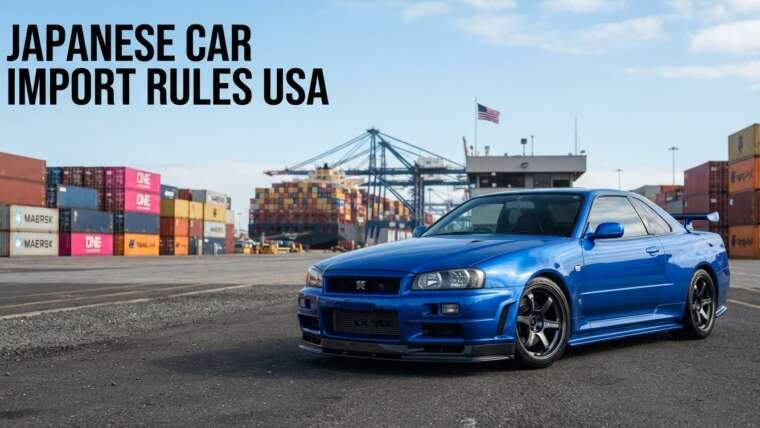


Japanese performance cars have earned a strong following among American enthusiasts for their distinctive engineering, turbocharged engines, lightweight chassis, motorsport heritage, and increasingly rare configurations. From legendary Nissan Skyline models and Toyota Supras to Mitsubishi Lancer Evolutions and Honda sports cars, the Japanese market offers vehicles that can be difficult to find in the United States.
However, purchasing a car from Japan is only the first step. Before committing to an auction bid or overseas purchase, buyers need to understand the Japanese car import regulations USA authorities enforce, particularly the rules governing vehicle safety, emissions, customs clearance, and eligibility for permanent importation.
A car that is perfectly legal to drive in Japan may not be immediately eligible for registration in the United States. Understanding the requirements beforehand can help buyers avoid unexpected expenses, delays, and potentially costly import mistakes.
The 25-Year Import Rule: Why It Matters
One of the most important regulations for importing Japanese performance cars into the United States is the 25-year exemption from Federal Motor Vehicle Safety Standards (FMVSS). Under this rule, a vehicle that is at least 25 years old, calculated from its date of manufacture, can generally be imported without undergoing the modifications required to meet current US safety standards.
This exemption makes older Japanese sports cars particularly attractive to American collectors. Models such as the Nissan Skyline GT-R, Mazda RX-7, Toyota Supra, and Mitsubishi Lancer Evolution from eligible production years may qualify, depending on their manufacturing dates.
The vehicle must be at least 25 years old at the time of importation to qualify for the NHTSA age-based exemption.
Buyers should verify the exact manufacturing date rather than relying solely on the model year listed in auction documents. A vehicle manufactured late in 2001, for example, may not become eligible until its exact 25-year anniversary in late 2026.
This distinction is especially important when purchasing a vehicle in advance of its eligibility date.
Understanding DOT Requirements
The US Department of Transportation (DOT), through the National Highway Traffic Safety Administration (NHTSA), regulates vehicle safety and compliance with Federal Motor Vehicle Safety Standards.
Vehicles originally manufactured for the Japanese domestic market generally do not carry the same safety certification as cars produced for the US market. Consequently, importing a nonconforming vehicle that is younger than 25 years requires a more complicated process.
Depending on the vehicle’s eligibility, buyers may need to work with a Registered Importer (RI). These businesses are authorized to bring eligible nonconforming vehicles into compliance with applicable US safety standards.
The process may involve:
- Modifying lighting systems and other safety equipment.
- Altering specific vehicle components to meet applicable standards.
- Completing required conformity procedures.
- Providing documentation to demonstrate compliance.
NHTSA determines import eligibility on a make, model, and model-year basis. A vehicle being similar to a US-market model does not automatically mean it can be imported.
For enthusiasts interested in sourcing vehicles that meet their preferences and import eligibility criteria, exploring Japanese sports car imports to America can help them understand the range of Japanese performance vehicles available for international buyers.
EPA Requirements for Japanese Performance Cars
The Environmental Protection Agency (EPA) oversees vehicle emissions regulations, which are separate from DOT safety requirements. Even when a car satisfies the 25-year safety exemption, buyers should understand the emissions-related rules before arranging shipment.
Under the EPA’s age-based exemption, vehicles that are at least 21 years old may generally qualify for importation without demonstrating compliance with current US emissions standards, provided they retain their original engine configuration.
This distinction is particularly relevant to Japanese performance cars because many have been modified over the years.
For vehicles younger than 21 years, importers generally need to demonstrate emissions compliance through an applicable EPA pathway. Depending on the circumstances, this may involve an approved importer, emissions modifications, testing, or other documentation.
Buyers should pay particular attention to:
- Turbocharger and engine modifications.
- Replacement engines.
- Aftermarket exhaust systems.
- Catalytic converters and emissions equipment.
- ECU tuning and other engine-management changes.
An older car with a heavily modified engine may require additional scrutiny if its configuration no longer meets the conditions of an applicable exemption.
Customs Clearance and Import Documentation
Once a vehicle meets the applicable safety and emissions import conditions, the next stage involves customs clearance. US Customs and Border Protection (CBP) handles the entry process, duties, documentation, and related requirements.
Importers typically need to prepare documents such as:
- Original bill of lading.
- Vehicle purchase invoice.
- Export certificate or equivalent ownership documentation.
- EPA declaration, where applicable.
- DOT declaration, where applicable.
- Customs entry documents and supporting records.
The vehicle’s eligibility status determines which declarations and supporting documents must be submitted. Buyers should coordinate with their customs broker or shipping agent before the vehicle departs Japan.
Import duties may also apply. The applicable duty depends on the vehicle’s classification and the circumstances of the importation. Additional charges, including port fees, customs brokerage, shipping, storage, and transportation, can significantly affect the final landed cost.
A purchase price that appears attractive at a Japanese auction may become substantially more expensive after all import-related expenses are accounted for.
Choosing the Right Japanese Performance Car
Import eligibility should influence the buying decision from the beginning, not after a vehicle has been purchased.
American buyers should consider several factors before bidding:
- Manufacturing date: Confirm whether the vehicle meets the relevant 25-year safety exemption or another applicable import pathway.
- Engine configuration: Check whether the original engine and emissions configuration remain intact.
- Auction condition: Review the auction sheet, damage history, mechanical condition, and signs of previous modifications.
- Documentation: Ensure that export and ownership documents are available and suitable for the import process.
- Total cost: Calculate shipping, duties, brokerage, port charges, transportation, and potential compliance expenses before bidding.
Performance cars with unusual specifications, aftermarket modifications, or incomplete records may present additional challenges. A thorough evaluation can help buyers avoid purchasing a vehicle that is difficult or expensive to import.
Conclusion
Importing a Japanese performance car into the United States can be an exciting opportunity for enthusiasts seeking distinctive vehicles, rare specifications, and motorsport-inspired engineering. However, the process requires careful attention to safety standards, EPA requirements, customs procedures, and vehicle eligibility.
The 25-year exemption remains one of the most important considerations when evaluating older Japanese performance cars, while emissions regulations and import documentation deserve equal attention when dealing with younger vehicles.
By understanding the Japanese car import regulations USA buyers must navigate before making a purchase, enthusiasts can make more informed decisions, calculate realistic costs, and reduce the risk of complications during importation.